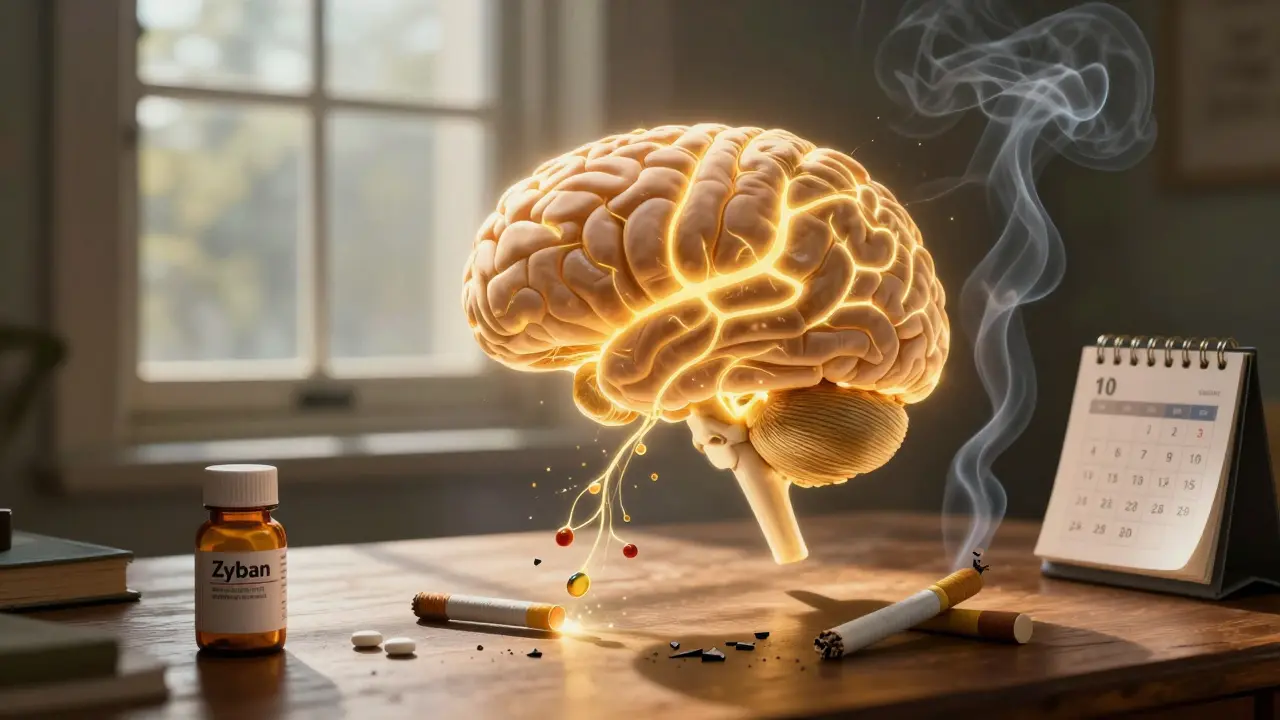
Quitting smoking isn’t just about willpower. For many people, it’s a battle against brain chemistry-and that’s where bupropion comes in. Marketed as Zyban for smoking cessation, this medication doesn’t replace nicotine like patches or gum. Instead, it rewires how your brain responds to cravings. But here’s the catch: bupropion doesn’t play well with everything. If you’re taking other meds, especially for depression, seizures, or heart conditions, you could be putting yourself at risk. Understanding these drug interactions isn’t optional-it’s essential.
How Bupropion Actually Works
Bupropion was originally designed as an antidepressant (Wellbutrin), but doctors noticed something strange: patients who took it for depression also tended to quit smoking. That led to its repurposing as a stop-smoking aid. Unlike nicotine replacement therapies (NRTs), which flood your system with low doses of nicotine, bupropion works from the inside out. It blocks the reuptake of dopamine and norepinephrine-two brain chemicals tied to reward and focus. This helps dull the pleasure you get from smoking and reduces withdrawal symptoms like irritability and brain fog.
It also directly interferes with nicotine receptors in the brain. Think of it like jamming a lock so nicotine can’t turn the key. This dual action-boosting mood chemicals while blocking nicotine’s effect-is why it works so well for people who’ve tried patches or lozenges and still relapsed.
Clinical trials show bupropion more than doubles your odds of quitting. At six months, about 19-23% of people using bupropion stay smoke-free, compared to just 7-10% on placebo. That’s not magic-it’s science. But the science only works if you use it right.
Dosing Protocol: Timing Matters
You can’t just pop a bupropion pill on the day you decide to quit. It takes time to build up in your system. The CDC recommends starting treatment 1-2 weeks before your quit date. Here’s the standard dosing schedule:
- Day 1-3: 150 mg once daily
- Day 4 onward: 150 mg twice daily, at least 8 hours apart
That second dose shouldn’t be taken after 5 p.m. Why? Because bupropion can cause insomnia in nearly a quarter of users. Taking it too late turns sleep into a battle. Most people report better results when they space doses evenly-say, 7 a.m. and 1 p.m.
Treatment usually lasts 7-9 weeks, but some doctors extend it to 12 weeks if cravings linger. The key is sticking with it even after you’ve stopped smoking. The medication doesn’t just help you quit-it helps you stay quit.
Biggest Drug Interactions to Avoid
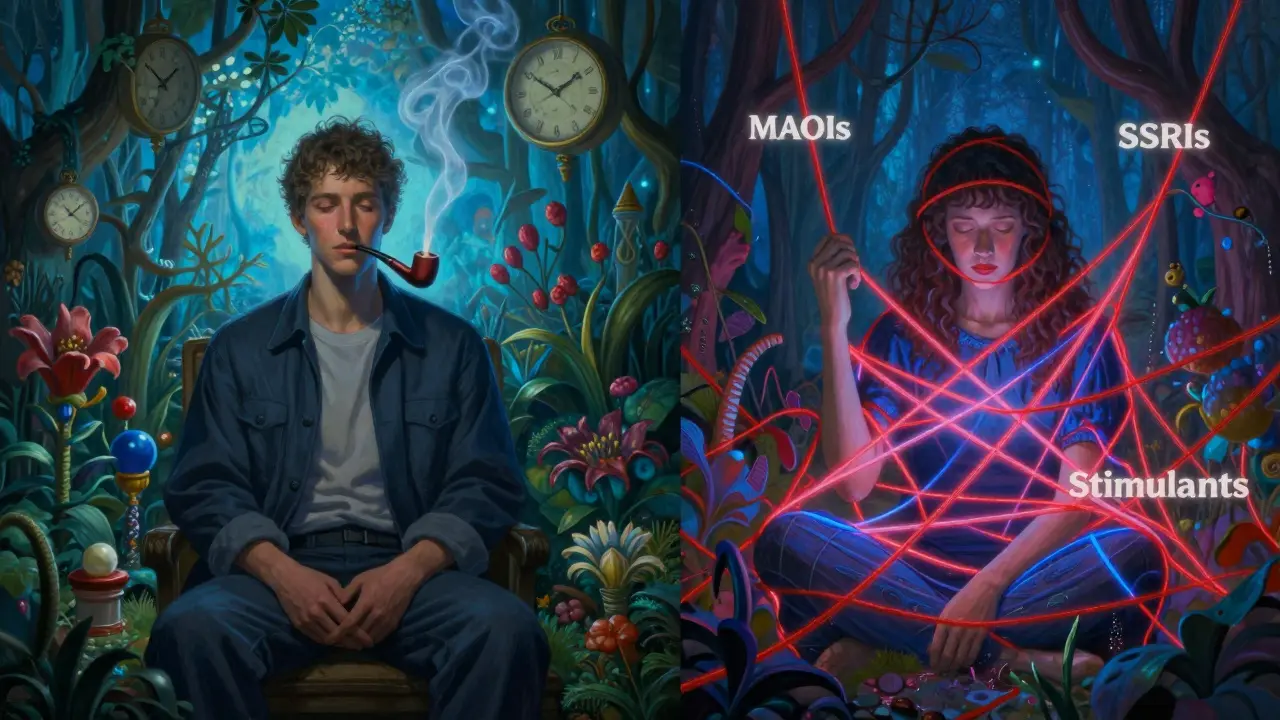
Bupropion’s biggest danger isn’t side effects-it’s what happens when it mixes with other drugs. Here are the top three interactions you must know about.
1. Monoamine Oxidase Inhibitors (MAOIs)
This is non-negotiable: never take bupropion with MAOIs. These include drugs like phenelzine (Nardil), tranylcypromine (Parnate), and selegiline (Emsam). MAOIs are used for depression and Parkinson’s, but when combined with bupropion, they can trigger a life-threatening surge in blood pressure and serotonin levels. The FDA requires a 14-day waiting period after stopping an MAOI before starting bupropion. If you’ve ever been on an MAOI, tell your doctor-even if it was years ago.
2. Varenicline (Chantix)
Some people think combining bupropion and varenicline will boost quit rates. It doesn’t. In fact, the FDA warns against this combo. While the 2016 EAGLES trial found similar safety profiles, newer data from 2023 suggests a higher risk of severe mood swings, agitation, and suicidal thoughts when both drugs are used together. Most clinics now avoid this combo unless under strict psychiatric supervision. If you’re considering varenicline, choose one or the other-not both.
3. Other Antidepressants and Stimulants
Bupropion can raise the risk of seizures when taken with other drugs that lower the seizure threshold. This includes:
- SSRIs like fluoxetine (Prozac) or sertraline (Zoloft)
- Stimulants like Adderall or methylphenidate (Ritalin)
- Antipsychotics like olanzapine (Zyprexa)
It’s not a blanket ban-some doctors carefully manage these combinations-but only if you have no history of seizures, eating disorders, or brain trauma. If you’re on any of these, ask your prescriber to check your seizure risk score before starting bupropion.
Who Shouldn’t Take Bupropion
It’s not just about drug interactions. Some people shouldn’t use bupropion at all. Absolute contraindications include:
- History of seizures or epilepsy
- Current or past diagnosis of anorexia or bulimia
- Allergy to bupropion or any of its ingredients
- Already taking another bupropion product (like Wellbutrin)
People with liver disease or uncontrolled high blood pressure should use caution. Bupropion is metabolized by the liver, so if your liver isn’t working well, the drug can build up to dangerous levels. A simple blood test can check your liver function before starting.
And don’t assume it’s safe just because it’s “just an antidepressant.” Bupropion’s seizure risk is real: about 1 in 1,000 people on therapeutic doses have a seizure. That number jumps to 1 in 100 if you have a history of head injury or alcohol withdrawal.
Side Effects You Can Manage
Most side effects are mild and fade within a few weeks. But some stick around-and knowing how to handle them makes a big difference.
- Insomnia: Take the second dose before 5 p.m. Avoid caffeine after noon.
- Dry mouth: Drink water, chew sugar-free gum, or use saliva substitutes.
- Headaches: Usually respond to acetaminophen (Tylenol). Avoid NSAIDs like ibuprofen if you’re at risk for seizures.
- Nausea: Take with food. Don’t take on an empty stomach.
One surprising benefit? Many users report less weight gain than with NRTs. In fact, a 2024 Drugs.com survey found that 43% of users felt bupropion helped them avoid the 15-20 pound weight gain they feared after quitting. That’s a major win for people who’ve tried quitting before and gained weight.
What Works Better: Bupropion Alone or With NRT?
For years, experts debated whether combining bupropion with nicotine patches or gum improved results. The answer? It depends.
A 2023 CDC analysis showed that bupropion alone gives you a 19% quit rate at 6 months. Add a nicotine patch, and that jumps to 25%. But here’s the twist: the combo doesn’t help everyone. People with anxiety or heart disease often do worse with NRTs because of the added nicotine. For them, bupropion alone is safer.
The new FDA-approved bupropion-nicotine patch combo (based on the 2022 COMMIT trial) shows even better results-31% abstinence at six months. But it’s not yet widely available. Most clinics still prescribe them separately.
Bottom line: If you’re okay with nicotine, combining bupropion with NRT gives you the best shot. If you want to avoid nicotine entirely, stick with bupropion alone.

Real People, Real Experiences
Reddit’s r/stopsmoking community has over 2 million members. Scrolling through their stories, two themes stand out.
Positive: “Zyban killed my cravings. After 10 days, I didn’t even think about smoking. I’ve been smoke-free for 18 months.” - u/SmokeFreeSince2022
Negative: “I couldn’t sleep. Every night, my heart was racing. I quit the pills after two weeks.” - u/ExSmoker2023
Drugs.com reviews show a 6.8/10 average rating. Half the users say it helped. The other half say it didn’t work-or made things worse. Why the split? Timing and expectations. People who started bupropion on the same day they quit almost always fail. Those who gave it 10-14 days to build up? Their success rate jumps by 40%.
And don’t underestimate adherence. A 2023 Truth Initiative survey found that 63% of people who finished the full 9-week course were still smoke-free at 3 months. Only 41% of those who quit early stayed quit. It’s not the drug that fails-it’s the commitment.
Cost and Accessibility
Bupropion is one of the cheapest smoking cessation drugs on the market. Generic bupropion SR (150 mg) costs about $35 for a 30-day supply. Compare that to varenicline (Chantix), which runs $550 for the same duration. Insurance often covers bupropion with a low copay. In the UK, it’s available on the NHS with a prescription.
Even better: bupropion is often prescribed off-label for depression, so if you’re already taking it for mood, your doctor might just extend the course for smoking cessation. No need to start over.
What’s Next for Bupropion?
Research is moving fast. In 2024, the National Institute on Drug Abuse announced phase 3 trials for a new bupropion prodrug designed to cut seizure risk by 60%. There’s also work on personalized dosing based on your CYP2B6 gene-about 25% of people metabolize bupropion slower than average, meaning they need lower doses to avoid side effects.
And while most studies focus on cigarette smokers, early data suggests bupropion works for vaping too. A 2023 pilot study found that 38% of vapers quit after 12 weeks on bupropion. That’s promising, since vaping cessation tools are still limited.
One thing won’t change: bupropion’s role as a first-line option. It’s not perfect, but for millions of people, it’s the best shot they’ve had.
Can I take bupropion if I’ve had a seizure before?
No. If you’ve ever had a seizure-even once-you should not take bupropion. The medication lowers your seizure threshold, and the risk increases dramatically if you’ve had a prior seizure, head injury, or alcohol withdrawal. This is a hard contraindication, not a caution.
How long does it take for bupropion to start working for smoking cessation?
It takes 7-10 days for bupropion to reach steady levels in your blood. That’s why you need to start it 1-2 weeks before your quit date. If you start on the same day you quit, you’ll likely struggle with cravings because the drug hasn’t kicked in yet. Patience here is critical.
Is bupropion safe if I have depression?
Yes-in fact, it’s often preferred. Bupropion is one of the few smoking cessation drugs that doesn’t worsen depression. In fact, it’s commonly used in people with both depression and nicotine dependence. Studies show it’s as effective as varenicline for this group, and with fewer side effects like nausea.
Can I drink alcohol while taking bupropion?
Moderate alcohol use is usually okay, but heavy drinking increases your seizure risk. If you’re used to having a few drinks daily, cutting back or stopping entirely is strongly advised. Bupropion lowers your alcohol tolerance, and mixing the two can trigger seizures even in people with no prior history.
What should I do if I miss a dose of bupropion?
If you miss a morning dose, take it as soon as you remember-but only if it’s before noon. If it’s after 2 p.m., skip it and wait until your next scheduled dose. Never double up. Missing a dose won’t ruin your progress, but taking two at once could trigger side effects like dizziness or seizures.
Haley DeWitt
February 17, 2026 AT 19:55Okay but like… I started bupropion two weeks before my quit date and honestly? It felt like my brain finally stopped screaming at me. 🙌 No more 3 a.m. cigarette cravings. I didn’t even miss it. Also-side note-dry mouth is REAL. I went through three liters of water and a whole bag of sugar-free gum. Worth it. 18 months smoke-free and counting. 🥹
Adam Short
February 19, 2026 AT 07:03This is why Britain’s NHS should stop pushing nicotine patches. Bupropion is the only thing that actually works. The Americans are finally catching up. I quit in 2018 with Zyban and haven’t looked back. Anyone who says it doesn’t work just didn’t give it time. Simple as that.
Linda Franchock
February 20, 2026 AT 21:20Let’s be real-half the people who say bupropion ‘didn’t work’ started it the same day they quit. 🤦♀️ Like, honey, you didn’t give it a chance. It’s not a magic bullet, it’s a slow-burner. I took it for 12 weeks, didn’t even think about smoking after week 4. And yeah, I had insomnia. So I moved my second dose to 11 a.m. Boom. Problem solved. Stop blaming the drug. Blame your impatience.
Kancharla Pavan
February 22, 2026 AT 17:25It is deeply concerning how casually people treat this medication as if it were a candy. Bupropion is not a toy. It is a neurochemical scalpel. When you combine it with SSRIs, stimulants, or worse-alcohol-you are not ‘experimenting,’ you are playing Russian roulette with your frontal lobe. I have seen patients with seizure histories on this drug. They did not survive. The data is not ambiguous. This is not a debate. This is a matter of life and death. Please, for the love of all that is rational, read the warnings before you self-prescribe.
PRITAM BIJAPUR
February 24, 2026 AT 01:22There’s something beautiful about how science quietly rewrites our understanding of addiction. Bupropion doesn’t ‘treat’ craving-it rewires the narrative. It doesn’t numb you. It doesn’t replace. It lets you see the smoke for what it is: a ghost. A chemical echo. And for the first time, you realize you’re not chasing pleasure-you’re chasing a memory. That’s why timing matters. You need the drug to settle into your synapses before the ghost returns. It’s not about willpower. It’s about patience. And maybe… just maybe… that’s the real cure.
Dennis Santarinala
February 24, 2026 AT 01:35I was skeptical too. Thought it was just another pill. But after 10 days, I realized I hadn’t even thought about smoking. Not once. Weird? Yeah. But also… kind of amazing. I still get the occasional urge, but it’s like a distant radio station-faint, static-y, easy to ignore. Also, no weight gain. Huge win. I lost 5 lbs. I didn’t even try. 🤯
guy greenfeld
February 24, 2026 AT 08:24Did you know the FDA knew bupropion caused seizures in clinical trials but pushed it anyway? Why? Because Big Pharma doesn’t care if you die. They care about profit. The 1 in 1000 seizure risk? That’s a marketing number. The real number is hidden in buried studies. And don’t get me started on the ‘combo’ with nicotine patches-designed to keep you hooked on BOTH. They’re not helping you quit. They’re keeping you in the system. Wake up.
Prateek Nalwaya
February 24, 2026 AT 18:03Here’s the thing nobody talks about: bupropion works best when you stop seeing quitting as a battle and start seeing it as a reset. It doesn’t make you stronger. It makes you clearer. The cravings don’t vanish-they just lose their power. Like a song you used to love but now sounds hollow. I took it for 9 weeks. Then I stopped. And I didn’t look back. No patches. No gum. Just me, my thoughts, and a whole lot of silence.
Agnes Miller
February 25, 2026 AT 17:47so i started bupropion and like… totally forgot to take the second dose for like 3 days? and i still quit? idk maybe i just got lucky? but i also had insomnia and drank like 1000 coffees and i think that made it worse?? anyway i’ve been smoke free for 6 months and i’m not even sure if the pill helped?? 🤷♀️
Geoff Forbes
February 26, 2026 AT 17:17Anyone who takes bupropion without a psychiatric evaluation is either brave or stupid. This isn’t a weight loss pill. You’re messing with dopamine pathways. If you’ve ever cried over a breakup, had a panic attack, or felt ‘off’ for more than two weeks-you’re not a candidate. You need a doctor who knows your history. Not a Reddit post. Not a 30-second ad. Real medicine. Real care. Or don’t bother.
Jonathan Ruth
February 28, 2026 AT 16:19Let me cut through the noise. Bupropion works because it’s not about nicotine. It’s about dopamine. And if you’re one of those people who think ‘I’ll just smoke one cigarette’ after quitting-you’re already wired wrong. The drug doesn’t care about your willpower. It reprograms your reward system. That’s why people who start it on quit day fail. They don’t understand timing. It’s not magic. It’s chemistry. And chemistry doesn’t negotiate.
John Haberstroh
March 2, 2026 AT 15:22I used to vape. Like, daily. Heavy. Then I tried bupropion. Didn’t expect much. But after two weeks? The vape pen sat in my drawer collecting dust. I didn’t even miss the flavor. The craving just… evaporated. I’m 8 months in. No side effects. No weight gain. Just peace. And honestly? I’m kinda mad I didn’t try it sooner.
Liam Earney
March 2, 2026 AT 15:58I wish I’d known all this before I lost my brother… He was on Wellbutrin for depression, started bupropion for smoking, and took an SSRI for anxiety-all at once. No one warned him. He had a seizure at 2 a.m. They couldn’t revive him. I’m not angry at the doctors. I’m angry at the system that lets this happen. Please. If you’re on anything else-anything-ask your pharmacist. Ask twice. Then ask again. This isn’t just advice. It’s a lifeline.