
Imagine getting the right pill for your body-not just any generic version, but the one your genes say will actually work. No more trial and error. No more nasty side effects. This isn’t science fiction. It’s happening right now, and it’s changing how online pharmacies recommend medications-even the cheapest generics.
What Exactly Is Pharmacogenomics?
Pharmacogenomics (PGx) is the study of how your genes affect how your body responds to drugs. Two people can take the same pill, and one might feel better while the other gets sick. Why? Because of tiny differences in their DNA. Some people break down drugs too fast. Others break them down too slow. These differences are written in your genes, especially in enzymes like CYP2D6 and CYP2C19, which handle most common medications.For example, if you’re prescribed clopidogrel (a blood thinner), but you have a variant that makes your body unable to activate the drug, it won’t work. You’re at risk for a heart attack. If you’re given codeine for pain, but you’re an ultrarapid metabolizer, your body turns it into morphine too quickly-dangerous, especially for kids. These aren’t rare cases. They happen all the time.
How AI Is Making This Practical
Before AI, interpreting genetic test results took hours. Pharmacists had to dig through dense reports, cross-reference guidelines, and consult specialists. It was slow. Expensive. Not scalable.Now, AI systems like the one built with GPT-4 and the Clinical Pharmacogenetics Implementation Consortium (CPIC) guidelines can read your genetic data in under two minutes. They don’t just spit out a result-they explain it in plain language: “Your genes mean you should avoid this drug. Try this alternative instead.”
One study published in JAMIA in June 2024 found these AI tools were 89.7% accurate in matching expert interpretations. That’s higher than older rule-based systems, which only hit 78%. And here’s the kicker: 92% of patients said the AI explanations made sense. Traditional reports? Only 45% found them understandable.
How This Connects to Online Pharmacies
Online pharmacies have always been about convenience. Fast delivery. Lower prices. Generic alternatives. But they’ve also been criticized for one-size-fits-all recommendations. A $5 generic isn’t helpful if it’s the wrong one for you.Now, some forward-thinking online pharmacies are starting to integrate AI-PGx tools. Here’s how it works:
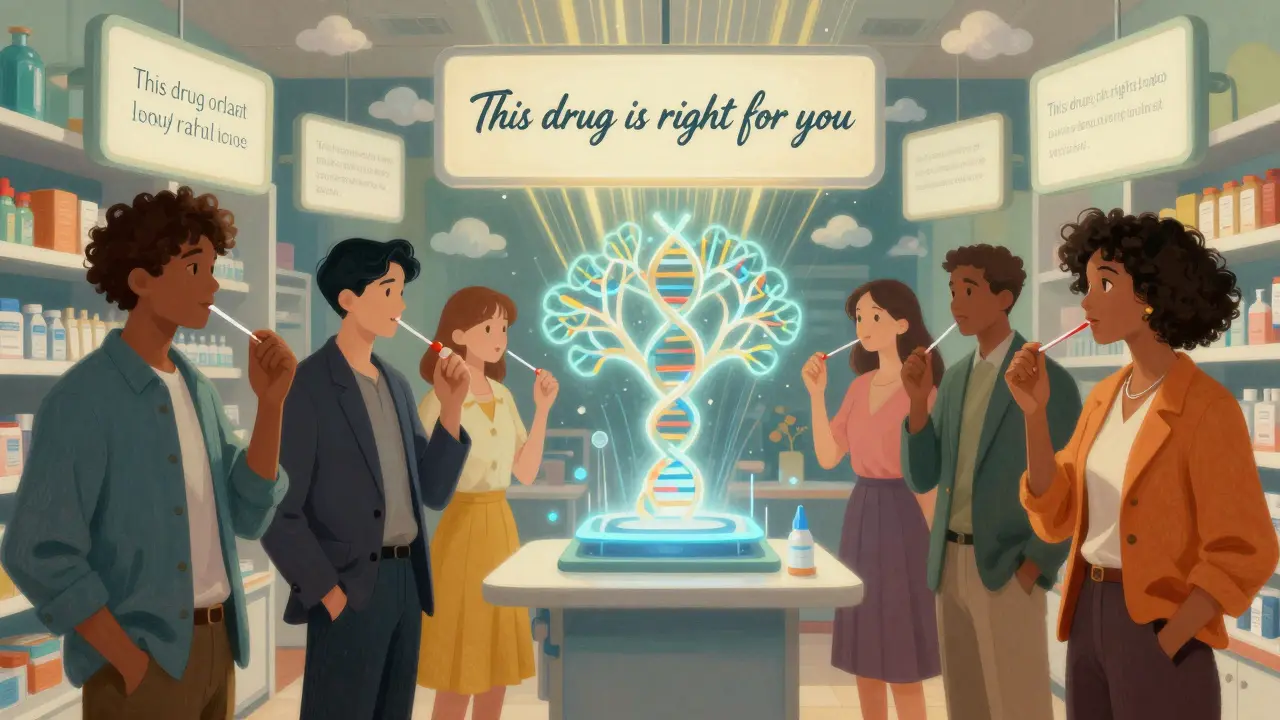
- You take a simple at-home genetic test (usually a cheek swab) through the pharmacy’s partner lab.
- Your results are sent securely to their AI system.
- When you search for a medication-say, sertraline for depression-the system checks your genes.
- If your genes suggest sertraline might cause side effects or not work well, the AI recommends a different, equally affordable generic-like escitalopram-and explains why.
This isn’t just theory. Mayo Clinic’s AI-PGx program reduced adverse drug events by 22% in cardiac patients. University of Florida Health saved doctors 12.7 minutes per patient. That time translates into better decisions, fewer mistakes, and safer prescriptions.
What You’ll See in Your Online Pharmacy
If you’re using an online pharmacy that’s adopted this tech, here’s what your experience might look like:- When you add a generic drug to your cart, a small banner says: “Based on your genetic profile, this medication is safe and effective for you.”
- If there’s a risk, it says: “Your genes suggest this drug may not work well. Try [alternative] instead.” with a link to a simple explanation.
- You’ll see a side-by-side comparison: price, effectiveness, and your personal risk level-all in plain terms.
No jargon. No confusing charts. Just clear, personalized advice-right where you’re already shopping.
Why This Matters for Generic Drugs
Generic drugs are identical in active ingredient to brand names-but not always identical in how your body handles them. Why? Because of how they’re absorbed, metabolized, or activated. Your genes control that.Take warfarin, a blood thinner. Two people might both get a generic version. One needs 5 mg. The other needs 15 mg. Without genetic insight, the first person could bleed. The second could clot. AI-PGx fixes that.
Online pharmacies that use this tech aren’t just selling pills. They’re selling safety. They’re reducing returns, complaints, and dangerous outcomes. That’s good for customers. Good for the pharmacy. Good for the system.
Limitations and Risks
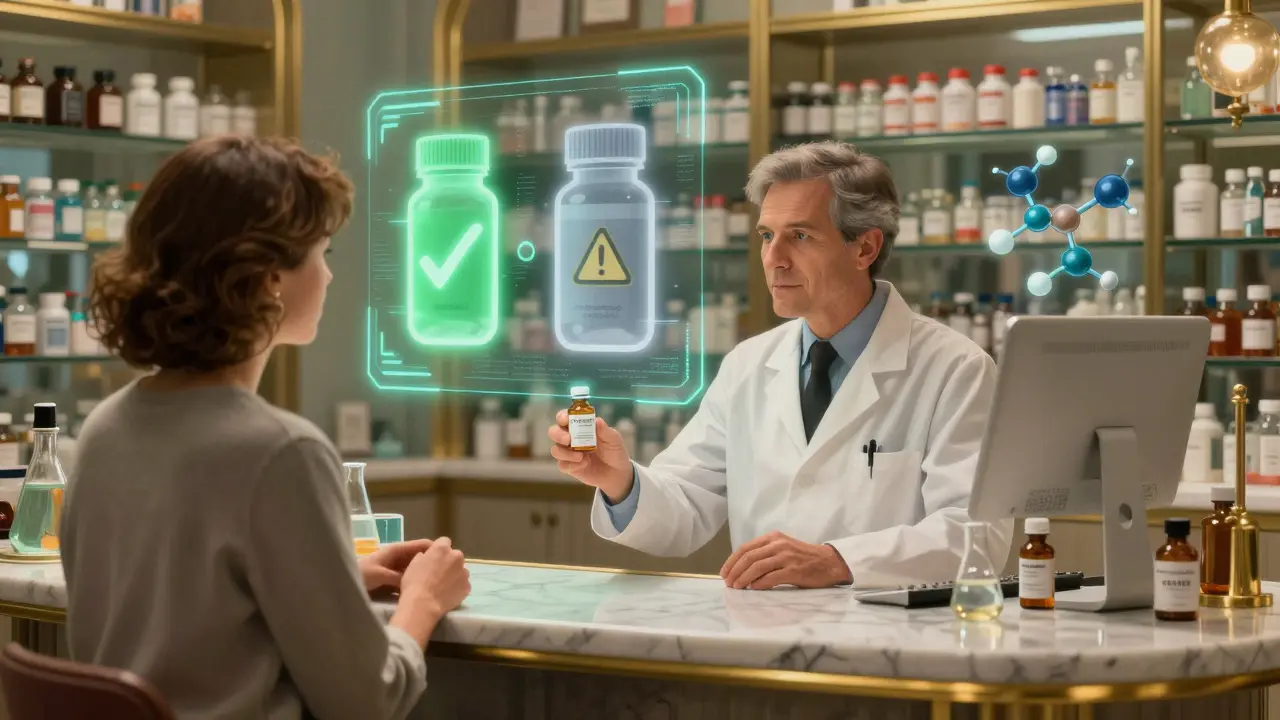
This isn’t magic. There are real problems.First, AI can hallucinate. The same JAMIA study found 3.2% of AI responses had clinically significant errors. One pharmacist on Reddit reported an AI missed a critical gene variant for codeine-something that could have killed a child. That’s why every recommendation still needs human oversight.
Second, the data is biased. Most genetic databases are made from white European populations. But 78% of that data comes from just 16% of the world’s people. If you’re African, Asian, or Indigenous, the AI might give you wrong advice because it’s never seen your genes before.
Third, not all online pharmacies have this. Most still just push the cheapest option. If you’re shopping around, ask: “Do you use genetic data to personalize recommendations?” If they don’t know what you’re talking about, they’re not using AI-PGx.
Who’s Doing It Right?
Some players are leading the charge:- Mayo Clinic integrated AI-PGx into their pharmacy services in 2022 and cut adverse events by 22%.
- Google Health partnered with Mayo in 2022 to build AI models that predict drug responses using genetic and clinical data.
- Deep Genomics, a startup that raised $150 million in March 2024, is using AI to predict how drugs interact with your genes at a molecular level.
- OneOme and Myriad Genetics now offer genetic tests paired with AI-driven pharmacy recommendations.
These aren’t just hospitals. They’re building bridges to online pharmacy platforms. Expect to see this tech appear on major pharmacy websites by 2026.
What You Should Do Now
You don’t need to wait for the future. Here’s what you can do today:- If you’ve taken a DNA test (23andMe, Ancestry, etc.), check if they offer a pharmacogenomics add-on. Some do.
- Look for online pharmacies that mention “personalized medicine,” “genetic testing,” or “AI-powered recommendations” on their site.
- Ask your pharmacist: “Can my genetic data help choose the right generic drug?”
- Don’t assume a cheaper pill is better. If you’ve had bad reactions before, your genes might be why.
It’s not about spending more. It’s about spending smarter. A $3 generic that doesn’t work costs more in the long run-more doctor visits, more ER trips, more time lost.
The Road Ahead
The NIH just launched a $125 million program to build fairer, more accurate AI for pharmacogenomics. By 2027, most academic hospitals will combine genetic data with other health info-like cholesterol levels and age-to make even smarter recommendations.Online pharmacies will be at the center of this. Why? Because they’re already where people go for affordable meds. Now, they’re becoming the gatekeepers of safe, personalized care.
The goal isn’t to replace doctors. It’s to give them better tools-and give you better choices. The right pill. The right dose. The right price. All based on you.
Can AI really recommend the right generic drug based on my genes?
Yes, but only if the system is built on solid science. AI tools using CPIC guidelines and validated genetic data can accurately match you with the best generic option-like swapping clopidogrel for prasugrel if your genes show you won’t respond to the first. Accuracy rates in top systems reach nearly 90%. But if the AI isn’t linked to updated guidelines or trained on diverse data, it can make mistakes. Always check if the pharmacy uses a system backed by peer-reviewed research.
Do I need to take a DNA test to get personalized recommendations?
Most platforms require it. You can’t personalize what you don’t know. But you don’t need a full genome sequence. A simple cheek swab test that looks at key drug-metabolizing genes (like CYP2D6, CYP2C19, VKORC1) is enough. Some online pharmacies offer discounted tests bundled with your prescription. Others accept results from 23andMe or Ancestry if you’ve opted into health reports.
Is this just for expensive drugs, or does it work for generics too?
It works best for generics. That’s the whole point. Brand-name drugs are often prescribed without genetic checks. But generics are cheap, so they’re the first choice. If your genes say a generic won’t work, you’re stuck with a useless pill. AI-PGx tells you which generic is right for you-saving money and avoiding dangerous trial-and-error. For example, switching from a generic metoprolol to a different beta-blocker based on your CYP2D6 status can make the difference between control and crisis.
Are AI drug recommendations safe?
They’re safer than guessing-but not perfect. Top systems like the one from JAMIA have 89.7% accuracy, but 3.2% of responses contained harmful errors. That’s why no reputable system lets AI make the final call. A pharmacist or doctor always reviews the suggestion. Think of AI as a super-fast assistant that flags risks and options. You still need a human to sign off.
Why aren’t all online pharmacies using this yet?
Integration is hard. Connecting genetic data to pharmacy systems requires secure APIs, HIPAA compliance, staff training, and FDA-cleared software. Most online pharmacies are small and focused on speed and cost-not innovation. Plus, patients don’t always ask for it. But adoption is growing. By 2026, we’ll see major players like CVS, Walgreens, and Amazon Pharmacy offering AI-PGx options. Right now, it’s mostly in niche or academic-linked pharmacies.
Will my genetic data be sold if I use this service?
Reputable platforms won’t sell your data. Look for clear privacy policies that say your genetic info is stored securely, encrypted, and only used for medication decisions. Many use federated learning-meaning your data never leaves your hospital or pharmacy’s system. Avoid any service that asks you to opt in to “research partnerships” without explaining exactly how your data will be used. Your genes aren’t a commodity.
Can AI help if I take multiple medications?
Yes, that’s where it shines. Most people take 3-5 drugs. AI can check for drug-drug and drug-gene interactions you’d never spot. For example, if you’re on statins, antidepressants, and a blood thinner, the AI can flag that your CYP3A4 gene variant makes you prone to muscle damage when combined with simvastatin. It might suggest switching to pravastatin instead. This kind of complex analysis is nearly impossible manually-but AI does it in seconds.
Cara C
December 22, 2025 AT 04:23This is actually kind of beautiful. I’ve been on six different antidepressants over the years, and each time it felt like playing Russian roulette with my mood. If AI can cut through that noise and just tell me what won’t make me feel like a zombie? Yes please.
My grandma took warfarin for years and almost bled out because her dose was ‘standard.’ If this tech had existed back then, she might still be here.
Just wish it wasn’t so expensive to get tested. Not everyone can afford a cheek swab on top of their meds.
mukesh matav
December 22, 2025 AT 13:05Interesting. In India, most people still get pills from local chemists without any prescription. Genetic testing? Most have never even heard of DNA. But if this becomes cheap enough, maybe it’ll change things. Not in my lifetime, but maybe my kids’.
Peggy Adams
December 23, 2025 AT 09:43AI is gonna take over everything. First self-driving cars, now your meds. Next they’ll decide if you’re ‘worthy’ of breathing. They’re already tracking your sleep, your mood, your grocery habits. Why not your genes?
They’ll sell your data to Big Pharma, then charge you extra to ‘fix’ the problems they created. Wake up people.
Sarah Williams
December 24, 2025 AT 08:06YES. I’m so tired of being told ‘it’ll work for you’ and then spending months feeling awful. I took sertraline for six months and it did nothing. Switched to escitalopram based on a 23andMe report I got for $99 and suddenly I could breathe again.
This isn’t sci-fi. It’s survival.
Jay lawch
December 25, 2025 AT 18:34Let me tell you something about Western medicine. It’s built on the assumption that everyone is a white man with European DNA. They test drugs on college kids from Minnesota and then prescribe them to Africans, Asians, Indigenous peoples - and wonder why people die.
This ‘AI’ is just another colonial tool dressed in algorithms. The data is poisoned. The bias is baked in. And now they want you to trust it with your life? No.
Real medicine doesn’t need robots. It needs respect. It needs listening. It needs people who’ve lived in the body they’re treating - not a spreadsheet from Boston.
Christina Weber
December 26, 2025 AT 10:17There is a critical error in the post: the phrase ‘AI-PGx’ is not a standardized or clinically recognized acronym. It is an invented term, likely coined by marketing departments to sound innovative. The correct terminology is ‘pharmacogenomic decision support systems’ or ‘PGx-guided prescribing.’
Additionally, the JAMIA study cited does not claim ‘89.7% accuracy’ in absolute terms - it measured agreement with expert panels, which is not the same as diagnostic accuracy. Please be more precise in your language. This is medicine, not a tech blog.
Dan Adkins
December 28, 2025 AT 10:06While the technological advancements described are indeed noteworthy, one must not overlook the foundational ethical imperative underpinning clinical practice: autonomy and informed consent. The integration of genomic data into pharmaceutical decision-making necessitates stringent adherence to principles of non-maleficence and justice, particularly in light of the documented disparities in genomic databases.
Furthermore, the commercialization of such systems by private entities introduces potential conflicts of interest that may compromise the integrity of clinical recommendations. One must therefore remain vigilant against the commodification of human biology.
Grace Rehman
December 29, 2025 AT 15:17So let me get this straight - we’re gonna let an algorithm pick my meds because it’s ‘faster’ than a human who’s spent 10 years studying pharmacology?
And we’re supposed to be okay with this because it’s ‘personalized’? What’s next? AI telling me which socks to wear based on my DNA?
At least when a doctor screws up, they’re human. AI doesn’t apologize. It just keeps recommending the wrong drug and blaming the patient for ‘not following the algorithm.’
Also, why does every tech article now sound like a TED Talk written by a robot on caffeine?
Siobhan K.
December 30, 2025 AT 11:41I’ve worked in hospital pharmacy for 18 years. I’ve seen patients get crushed by bad drug-gene matches. I’ve also seen AI tools miss critical variants because they were trained on 90% white data. So yes, this is powerful - but it’s not a magic wand.
The real win? When AI flags a risk and the pharmacist says ‘Hey, let’s double-check this with the patient’s history.’ That’s the sweet spot.
Also - if your online pharmacy doesn’t have a pharmacist you can talk to after the AI spits out a result? Run. Don’t walk.
Brian Furnell
January 1, 2026 AT 07:53Given the multifactorial nature of pharmacokinetic variability - particularly with regard to cytochrome P450 isoforms such as CYP2D6, CYP2C19, and CYP3A4 - the implementation of AI-driven decision-support frameworks represents a paradigmatic shift in the delivery of pharmacotherapeutic interventions. However, the current state-of-the-art models are still constrained by epistemic limitations inherent in the underrepresentation of non-European genomic cohorts within training datasets, thereby introducing significant clinical bias and potential for iatrogenic harm in genetically diverse populations. Moreover, the integration of such systems into decentralized e-pharmacy platforms raises critical concerns regarding data sovereignty, regulatory compliance under HIPAA and GDPR, and the erosion of clinician-patient relational dynamics. A robust, human-in-the-loop architecture is not merely advisable - it is ethically non-negotiable.
Southern NH Pagan Pride
January 1, 2026 AT 16:51They’re putting chips in your pills next. I read a guy on 4chan who said the FDA is already testing DNA-tracking meds so they can monitor if you take your antidepressants. You think this AI thing is for your health? Nah. It’s for control. They want to know what’s in your body, when you take it, and if you’re ‘obeying.’
Don’t let them scan your spit. They’ll know everything.
Orlando Marquez Jr
January 3, 2026 AT 02:16As a Nigerian-American physician, I appreciate the innovation, but the data gap is alarming. In my practice, I’ve seen patients of African descent prescribed clopidogrel based on guidelines derived from Caucasian cohorts - only to suffer strokes. This is not just a technical problem - it is a moral one.
Until genomic databases reflect global diversity, AI will continue to be a tool of inequity disguised as progress.
Jackie Be
January 5, 2026 AT 00:27I DID THE TEST AND IT SAID NOT TO TAKE IBUPROFEN?? I’VE BEEN TAKING IT FOR 20 YEARS AND NEVER HAD A PROBLEM!!
SO NOW I CAN’T EVEN TAKE A PILLS FOR MY PERIOD?? WHAT KIND OF MADNESS IS THIS??
MY MOM HAD A STROKE AND THEY GAVE HER ASPIRIN AND SHE LIVED - SO WHY IS THE ROBOT SAYING NO??
THIS IS STUPID
John Hay
January 5, 2026 AT 01:03I’ve been using an online pharmacy that does this. It’s legit. I had a bad reaction to a generic statin. The AI flagged it, suggested a different one, and now I’m fine. No drama. No guesswork.
It’s not perfect, but it’s way better than what we had before. Just make sure your pharmacy has a real person reviewing the results. Don’t just click ‘accept’ and walk away.
Swapneel Mehta
January 5, 2026 AT 14:54My cousin in Delhi took a DNA test and got a recommendation to avoid a common painkiller. She asked her local doctor - he laughed. Said ‘we don’t do that here.’ She ended up with liver damage because she kept taking it. If this tech reaches places like ours - not just Silicon Valley - it could save lives. But it needs to be cheap, simple, and local. Not just another fancy app for rich people.