
Traveling can be exciting, but motion sickness and jet lag can turn a dream trip into a nightmare. Millions of people deal with nausea, dizziness, or sleep disruption every year-not because they’re weak, but because their bodies haven’t caught up with the plane, boat, or car. The good news? Medications can help. The bad news? If you use them wrong, they can make things worse. You might end up groggy, confused, or even hospitalized. This isn’t about taking pills blindly. It’s about knowing which pill, when to take it, and what to avoid.
Understanding Motion Sickness and Why Medications Work
Motion sickness isn’t just ‘getting car sick.’ It’s your brain getting mixed signals. Your eyes see the inside of the car, your inner ear feels the motion, and your body feels still. That conflict triggers nausea, sweating, and vomiting. It’s not psychological-it’s biological. About 25-30% of adults get it, especially on boats, planes, or winding roads.
Medications for motion sickness work by blocking the signals that cause nausea. The most common types are antihistamines like dimenhydrinate (Dramamine) and meclizine (Bonine), anticholinergics like scopolamine (Transderm Scop), and stronger options like promethazine. Each has a different profile.
Dramamine (dimenhydrinate) kicks in fast-within 30 minutes-and works for about 4-6 hours. But it makes you sleepy. Up to 35% of users report drowsiness. Bonine (meclizine) is slower to start (about 40 minutes) but lasts longer-up to 24 hours-and causes drowsiness in only 18% of users. That’s why many travelers prefer it for long trips.
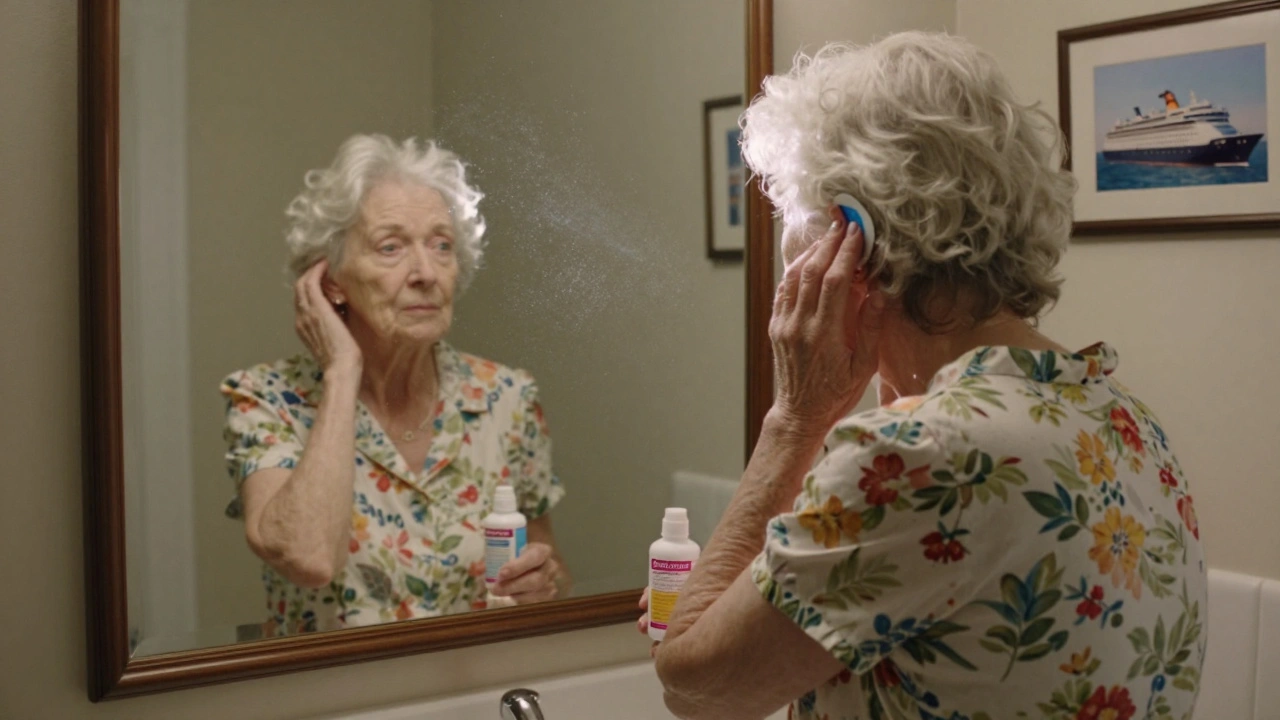
Scopolamine patches are the gold standard for extended travel. Applied behind the ear at least 4 hours before departure, they release medication slowly over 72 hours. They’re especially effective for cruises or road trips longer than 6 hours. But they’re not for everyone. Dry mouth? Common. Blurred vision? Happens. And if you’re over 65, you could get confused or disoriented. One in six elderly users report mental fogginess severe enough to need help.
Jet Lag: Resetting Your Internal Clock
Jet lag isn’t tiredness. It’s your body clock stuck in the wrong time zone. Crossing five or more time zones? Almost everyone feels it-sleepless nights, daytime fog, digestive issues. Medications don’t fix the time difference. They help you adapt faster.
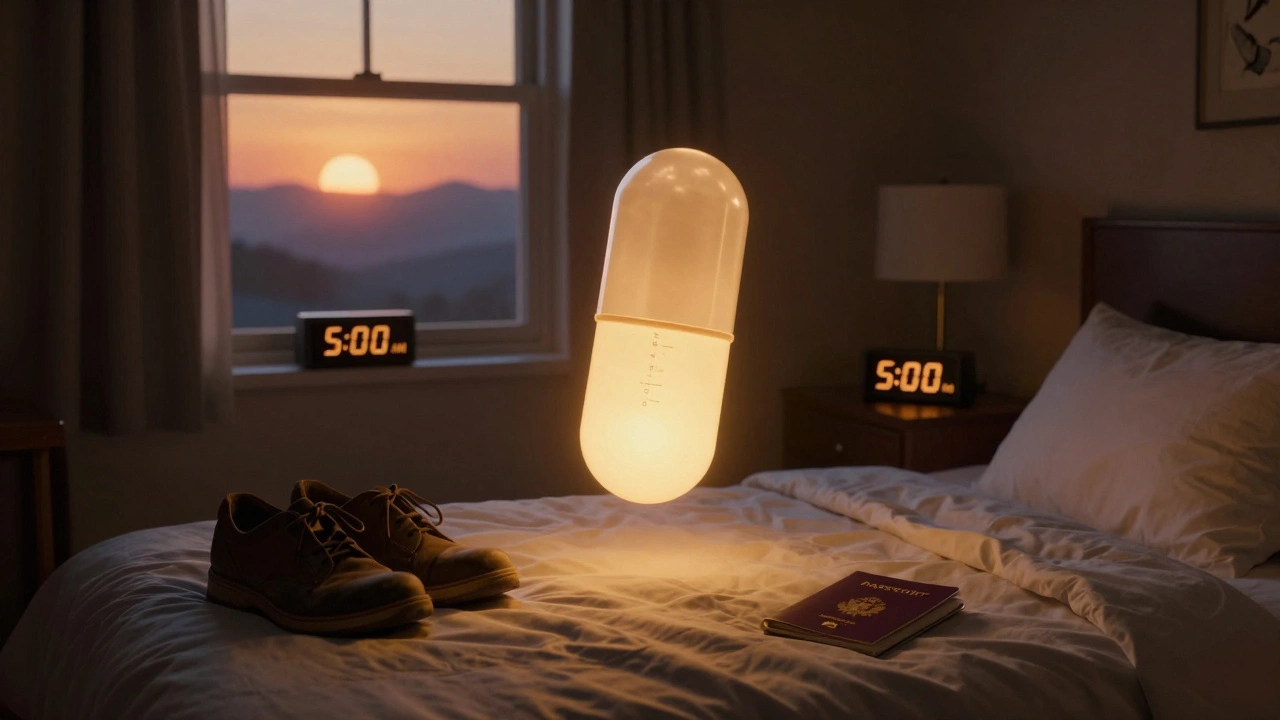
Melatonin is the first-line treatment. It’s not a sleeping pill-it’s a hormone your body naturally makes at night. Taking 0.5 to 5 mg 30 minutes before your target bedtime at your destination helps shift your rhythm. Surprisingly, 0.5 mg works just as well as 5 mg for most people. The trick? Timing. For eastward travel (like flying to Europe), take it in the evening. For westward travel (like flying to California), take it in the morning. Mess up the timing, and you’ll feel worse.
Nonbenzodiazepine sleep aids like zolpidem (Ambien) or eszopiclone (Lunesta) are stronger. They help you fall asleep fast, but they come with risks. About 1.8% of users report sleepwalking. 0.9% experience amnesia. And 4.3% feel groggy the next day. That’s dangerous if you’re driving, navigating an airport, or need to be alert for a meeting.
Stimulants like modafinil are sometimes used to stay awake during the day, but they’re not FDA-approved for jet lag. They last 12-15 hours. Take them after noon, and you’ll be wired at bedtime. Avoid them unless you’re under a doctor’s supervision.
What Not to Do: Common Mistakes and Dangers
People make the same mistakes over and over. Here’s what to avoid:
- Don’t mix alcohol with melatonin. It doubles the risk of confusion and dizziness. One in ten users report feeling ‘off’ or disoriented when they drink.
- Don’t use promethazine (Phenergan) for kids under 2. The FDA has a black box warning: it can cause fatal breathing problems.
- Don’t drive after taking dimenhydrinate or promethazine. Even if you feel fine, your reaction time is slowed. CDC recommends waiting at least 6 hours after dimenhydrinate and 15 hours after promethazine.
- Don’t apply a scopolamine patch and then go to a dark room. The patch can cause temporary blurred vision. Reading a book or staring at a phone? Bad idea. Bright light helps.
- Don’t assume all antihistamines work. Zyrtec, Claritin, and Allegra are great for allergies-but useless for motion sickness. They don’t cross the blood-brain barrier the same way.
Also, don’t rely on ‘natural’ remedies like ginger pills or wristbands alone if you’ve had severe motion sickness before. They help mildly, but they won’t stop vomiting on a rocking cruise ship.
Real User Experiences: What Works and What Doesn’t
People share their stories online, and the patterns are clear.
On Reddit, a user named u/TravelNurseAmy took a scopolamine patch for a 7-day Caribbean cruise. ‘It worked perfectly,’ she wrote. ‘But I needed Biotene every two hours because my mouth was bone dry.’ That’s the trade-off: effectiveness vs. discomfort.
Amazon reviews for Bonine show 4.1 out of 5 stars. Most praise the ‘less drowsy’ label. But nearly half say it takes too long to kick in. If you’re boarding a plane and feel queasy, Bonine might not help fast enough.
Jet lag meds on Drugs.com tell a similar story. Melatonin scored 7.2/10, but 29% said they had ‘weird dreams.’ Zolpidem scored 6.4/10. The biggest complaint? ‘Woke up feeling like a zombie.’
And for older travelers? CruiseCritic forums are full of warnings. About 12% of users over 65 reported confusion after using scopolamine patches-enough to need medical help. That’s not rare. It’s a real risk.
Timing Is Everything: When to Take What
Getting the timing right is the difference between feeling fine and feeling awful.
For motion sickness:
- Scopolamine patch: Apply 4+ hours before travel.
- Dimenhydrinate (Dramamine): Take 30-60 minutes before departure.
- Meclizine (Bonine): Take 1 hour before travel.
For jet lag:
- Melatonin: Take 30 minutes before target bedtime at your destination.
- Eastward travel (e.g., New York to London): Take melatonin at bedtime in the new time zone-this helps you fall asleep earlier.
- Westward travel (e.g., London to New York): Take melatonin in the morning at your destination-this delays your clock, helping you stay awake later.
- Zolpidem: Only take at night, and only if you can sleep for 7-8 hours. Never use on a plane.
- Caffeine: Stop after 2 p.m. Its half-life is 5 hours. A coffee at 3 p.m. can keep you awake at 10 p.m.
Don’t guess. Use the CDC’s Phase Response Curve chart (available in the 2024 Yellow Book) to map your travel direction and adjust your melatonin timing accordingly.
What’s New in 2025
Medications aren’t standing still. In May 2024, the FDA approved a new scopolamine buccal film that delivers the drug through the cheek instead of the skin. Early results show 30% less systemic absorption-meaning fewer side effects like dry mouth and blurred vision.
The CDC’s 2025 Yellow Book draft (released October 2024) now emphasizes personalized melatonin timing based on your body’s natural response curve. This isn’t one-size-fits-all anymore. Your sleep habits, age, and direction of travel all matter.
Future drugs are coming too. Phase III trials are underway for NK1 receptor antagonists-new medications that stop motion sickness without drowsiness. Early results show 78% effectiveness. If approved, they could replace Dramamine and Bonine by 2027.
When to Skip Medication Altogether
Not everyone needs pills. For mild motion sickness, try these first:
- Sit by the window on a plane or over the wing in a car.
- Look at the horizon-don’t read or stare at your phone.
- Get fresh air. Open a window or step outside between stops.
- Try ginger candy or peppermint tea. Not a cure, but they help some people.
For jet lag, light exposure is your best tool. Get sunlight in the morning if you’re traveling east. Get it in the evening if you’re traveling west. Avoid bright screens before bed. Your body responds to light more than any pill.
Dr. Emily Sena from the CDC says it best: ‘Medications should be a backup, not the first plan.’ If your symptoms are mild, try non-drug methods first. Save the pills for when you really need them.
Final Checklist Before You Travel
Before you pack your bags, run through this:
- Do you have a history of glaucoma? Then avoid scopolamine patches.
- Are you over 65? Talk to your doctor before using scopolamine or zolpidem.
- Are you flying with children under 2? Never use promethazine.
- Are you driving after taking medication? Wait at least 6 hours after Dramamine, 15 hours after promethazine, and 24 hours after a scopolamine patch.
- Are you taking melatonin? Don’t mix it with alcohol.
- Did you test your medication before? Take a trial dose at home 2-3 days before travel to see how you react.
Traveling should be about the destination-not the side effects. With the right info, you can manage motion sickness and jet lag safely, effectively, and without unnecessary risk.
Can I take motion sickness medicine and jet lag medicine together?
Yes, but only under careful planning. Don’t combine sedating meds like scopolamine and zolpidem-they’ll make you dangerously drowsy. If you need both, space them out: take scopolamine 4 hours before your flight, then melatonin only after you land and are ready for sleep. Avoid stimulants like modafinil if you’ve taken any sedative. Always check with a pharmacist or doctor if you’re unsure.
Is melatonin safe for long-term use during frequent travel?
Melatonin is generally safe for short-term use during travel. Most studies show no major risks with daily use for up to 3 months. But it’s not meant to be a permanent sleep aid. If you’re traveling every week, focus on light exposure and sleep hygiene instead. Long-term use can reduce your body’s natural melatonin production. Stick to 0.5 mg and avoid daily use unless advised by a doctor.
Why does scopolamine cause confusion in older adults?
Scopolamine blocks acetylcholine, a brain chemical involved in memory and attention. As people age, their brains become more sensitive to this effect. The result? Disorientation, hallucinations, or memory lapses. The FDA now requires scopolamine patches to carry a warning for elderly users. If you’re over 65 and considering the patch, talk to your doctor first. Non-sedating alternatives or light therapy may be safer.
Can I use Bonine instead of Dramamine if I’m worried about drowsiness?
Yes, Bonine (meclizine) is a better choice if you want to avoid drowsiness. It’s slightly less effective than Dramamine for severe motion sickness, but it causes drowsiness in less than 20% of users versus 35% with Dramamine. It also lasts longer-up to 24 hours-so you don’t need to re-dose. For most travelers, especially those driving or needing to stay alert, Bonine is the smarter pick.
What should I do if I forget to take my medication before traveling?
If you forget a scopolamine patch, it’s too late to apply it once you’re already sick-it needs time to absorb. For Dramamine or Bonine, take it as soon as you remember, even if you’re already feeling sick. It may still help reduce symptoms. For jet lag, if you miss melatonin, don’t take it later than 1 hour before your target bedtime. Taking it too late can shift your clock the wrong way. If you miss it entirely, rely on light exposure and hydration to help your body adjust.
Rashmin Patel
December 3, 2025 AT 07:52I’ve been using scopolamine patches for my Caribbean cruises for years 🌊 and honestly, it’s the only thing that keeps me from vomiting overboard. But yeah, dry mouth is REAL. I carry Biotene like it’s my job. Also, don’t even think about drinking alcohol with melatonin - I once did that and woke up thinking I was on a spaceship. Not fun. 🚀
sagar bhute
December 4, 2025 AT 17:10Everyone’s just blindly trusting these meds like they’re magic beans. Have you read the FDA warnings? Scopolamine can make elderly people hallucinate. Melatonin isn’t a vitamin - it’s a hormone. And you’re just popping pills like candy because some Reddit user said it worked? This is why people end up in ERs.
Cindy Lopez
December 5, 2025 AT 04:10There’s a misplaced comma in the section about zolpidem. Also, ‘bone dry’ is colloquial and unprofessional. And you say ‘CDC recommends’ but don’t cite the source. If you’re going to write something this authoritative, at least get the grammar right.
James Kerr
December 6, 2025 AT 03:43Big thanks for this breakdown! I used to take Dramamine on road trips and wake up feeling like a zombie 😴. Switched to Bonine last year and it’s been a game-changer. Also, the melatonin timing tip? Life saver. I fly to Japan every 6 weeks and now I’m actually sleeping instead of staring at the ceiling. 🙌
shalini vaishnav
December 6, 2025 AT 14:25Why are Americans so dependent on pills for everything? In India, we’ve used ginger, lemon, and deep breathing for centuries. You don’t need a patch or a prescription to handle motion sickness. This whole article feels like corporate pharmaceutical propaganda disguised as advice. Basic biology, not chemistry, is the answer.
vinoth kumar
December 7, 2025 AT 14:49Just wanted to add that if you’re on a long flight and forgot your melatonin, try using a blue light blocker app on your phone after sunset - it tricks your brain into thinking it’s nighttime. Also, hydration is huge. I used to think jet lag was just tiredness until I started drinking 3L of water on a 12-hour flight. Game changer.
bobby chandra
December 8, 2025 AT 14:41Let’s be real - the future is here. NK1 antagonists are going to blow scopolamine and Dramamine out of the water. No drowsiness? No dry mouth? 78% effectiveness? That’s not science fiction - it’s 2027’s new normal. Mark my words: by the time you read this, your pharmacist will be handing out these pills like gum. We’re entering the era of zero-sleepiness travel.
Archie singh
December 10, 2025 AT 14:39Why are you even recommending melatonin? It’s unregulated in the US. You have no idea what’s in those capsules. I tested three brands - one had zero melatonin. Another had 15mg when it said 5mg. This isn’t advice - it’s a lottery. And don’t get me started on the patch. That thing is a chemical trap.
Gene Linetsky
December 12, 2025 AT 05:57Ever wonder why the CDC changed the melatonin guidelines in 2025? It’s not about your sleep cycle - it’s about tracking your biometric data. They’re building a profile. Every time you take melatonin, they log your timezone, heart rate, sleep duration. Soon, your insurance will charge you extra if your ‘melatonin usage pattern’ doesn’t match their algorithm. Don’t be a lab rat.
Ignacio Pacheco
December 12, 2025 AT 08:17So if I take Bonine before the flight and melatonin after landing, am I just swapping one chemical dependency for another? Or am I just outsmarting my own biology? Either way, I’m still a human being trying to get from point A to point B without throwing up or crying in the airport. The real question is - why does modern travel require this much pharmacology just to function?
Jim Schultz
December 13, 2025 AT 15:25Wow. Just... wow. You actually included the 2025 CDC draft? That’s not public yet. Who gave you access? And why are you citing phase III trials for NK1 antagonists like they’re gospel? You sound like you work for the pharmaceutical lobby. This isn’t advice - it’s a marketing brochure with footnotes.