Medication Guide Distribution Calculator
Drug Distribution Requirements
Determine whether you need to distribute a Medication Guide based on FDA regulations and your specific distribution setting.
Distribution Recommendation
Common High-Risk Drugs Requiring Medication Guides
- Isotretinoin (Accutane)
- Clozapine (Clozaril)
- Estrogen pills
- Epoetin alfa
- Warfarin
- Amiodarone
- Stimulants (e.g., Adderall)
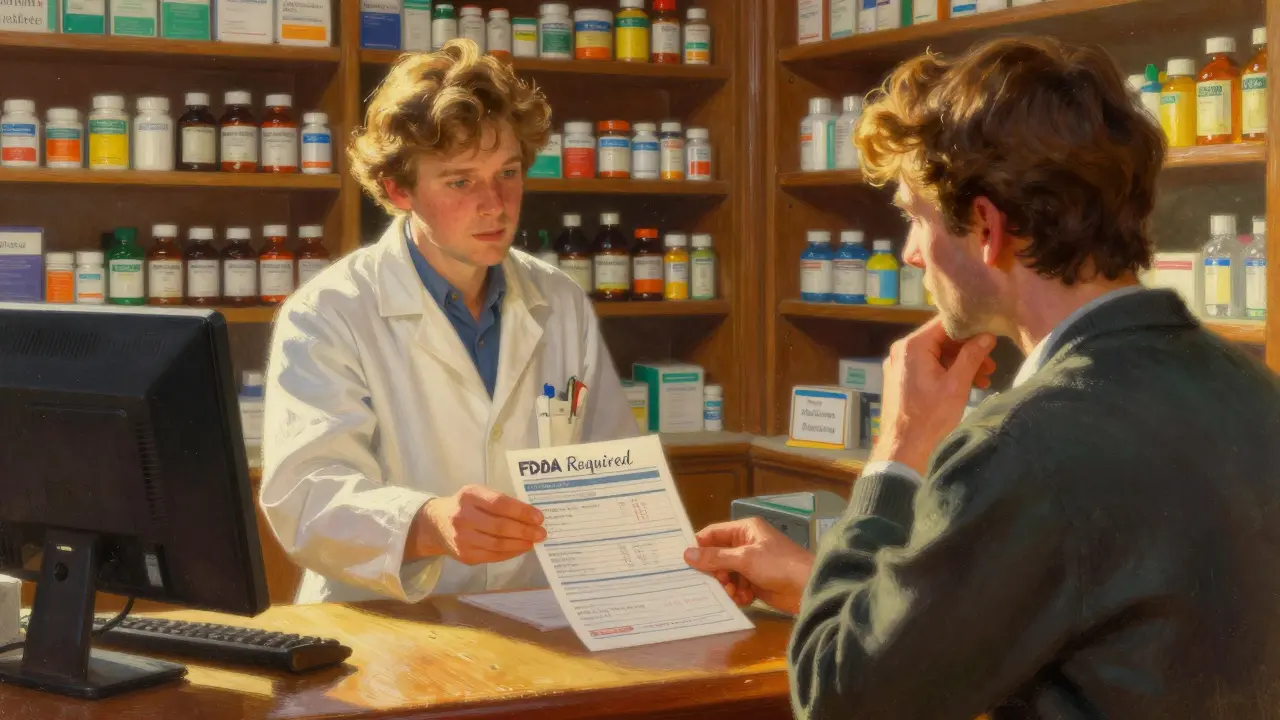
Every time a patient walks out with a prescription for a high-risk medication, there’s a legal document that should go with it - a Medication Guide. This isn’t just a handout. It’s a federally mandated safety tool designed to prevent serious harm. For pharmacists and providers, getting this right isn’t optional. It’s the law. And getting it wrong can mean legal trouble, patient harm, or both.
What Exactly Is a Medication Guide?
A Medication Guide (MG) is a printed, FDA-approved document that comes with certain prescription drugs. Unlike general patient info sheets you might find in a pharmacy waiting room, these are not optional. They’re required by federal regulation (21 CFR 208) for drugs that carry serious risks - things like life-threatening side effects, high potential for misuse, or situations where patients must follow instructions exactly to avoid danger.
The FDA only requires Medication Guides when three conditions are met: when patient understanding can prevent serious harm, when the risks clearly outweigh the benefits for some users, or when strict adherence to dosing is critical for the drug to work. Right now, over 200 drugs fall into this category. Think isotretinoin (Accutane) for acne - it can cause severe birth defects. Or clozapine (Clozaril) for schizophrenia - it can shut down your bone marrow. Or estrogen pills - they raise the risk of blood clots. These aren’t minor warnings. These are red flags.
When Do You Have to Hand Out a Medication Guide?
This is where things get messy. The rules change depending on where the drug is being given out. It’s not as simple as ‘give it every time.’
In a community pharmacy - the kind you walk into with a script in hand - you must hand the Medication Guide to the patient every single time the drug is dispensed, as long as it’s for self-administration. That means if someone fills their monthly prescription for clozapine, they get the guide each month. No exceptions.
But in an outpatient clinic, infusion center, or dialysis unit? It’s different. Here, you only need to give the guide the first time the patient receives the drug. After that, unless the guide itself has been updated by the FDA, you don’t need to hand it out again. So if a cancer patient gets epoetin alfa every week for six months, they only get the guide on day one. That’s a key distinction many providers miss.
There are five specific triggers under FDA guidance that require distribution:
- The patient or their agent asks for it.
- The drug is dispensed for self-administration in an outpatient setting.
- This is the first time the drug is given to a patient in a clinic or infusion center.
- The Medication Guide has been updated with new safety info.
- The drug is part of a REMS program (like iPLEDGE for isotretinoin) that specifically requires it.
And here’s a big one: no Medication Guides are required in hospitals or nursing homes. That doesn’t mean patients aren’t educated. Staff still need to talk through risks and instructions - but they don’t need to hand out the printed guide. The law doesn’t demand it in those settings.
Medication Guide vs. Other Patient Info - What’s the Difference?
Pharmacists often confuse Medication Guides with other types of patient handouts. Let’s clear that up.
Patient Medication Information (PMI) or Consumer Medication Information (CMI) - those are the one-page summaries you might get from a pharmacy. They’re helpful, sure. But they’re not FDA-approved. They’re created by pharmacies or vendors. No review. No oversight. Just general advice.
Medication Guides? They’re different. The FDA writes them. Reviews them. Approves every word. They’re drug-specific, legally binding, and written in plain language for patients - not doctors. They’re the only patient-facing documents that carry the full weight of federal regulation.
Some Medication Guides are also part of a REMS (Risk Evaluation and Mitigation Strategy). That’s a bigger safety program the FDA imposes on high-risk drugs. For example, with isotretinoin, the iPLEDGE program requires not just giving the guide - but also verifying the patient has read it, understands the risks, and has had a pregnancy test if applicable. In these cases, the Medication Guide isn’t just a handout - it’s a legal checkpoint.

What Happens When You Get It Wrong?
Most pharmacists aren’t trying to break the rules. They’re overwhelmed. A 2022 survey of over 1,200 hospital pharmacists found that 68% were confused about when to distribute guides in outpatient settings. Nearly half admitted they sometimes gave them out when they didn’t have to - just to be safe.
That’s a problem. Over-distribution creates clutter. Patients ignore the guides. And worse - if you don’t give one when you’re supposed to, you’re violating federal law. The FDA doesn’t typically fine pharmacies for minor slips. But if a patient has a bad reaction and it’s found you didn’t provide the guide - that’s a different story. Lawyers, regulators, and insurance companies start asking questions. Liability increases. Reputation takes a hit.
On the flip side, under-distribution is even riskier. A patient on clozapine who doesn’t know about the risk of agranulocytosis might not recognize early symptoms like fever or sore throat. They might wait too long to call their doctor. That’s preventable death.
How Are Pharmacies Handling This in Practice?
Leading institutions aren’t leaving this to memory or paper checklists. They’re building systems.
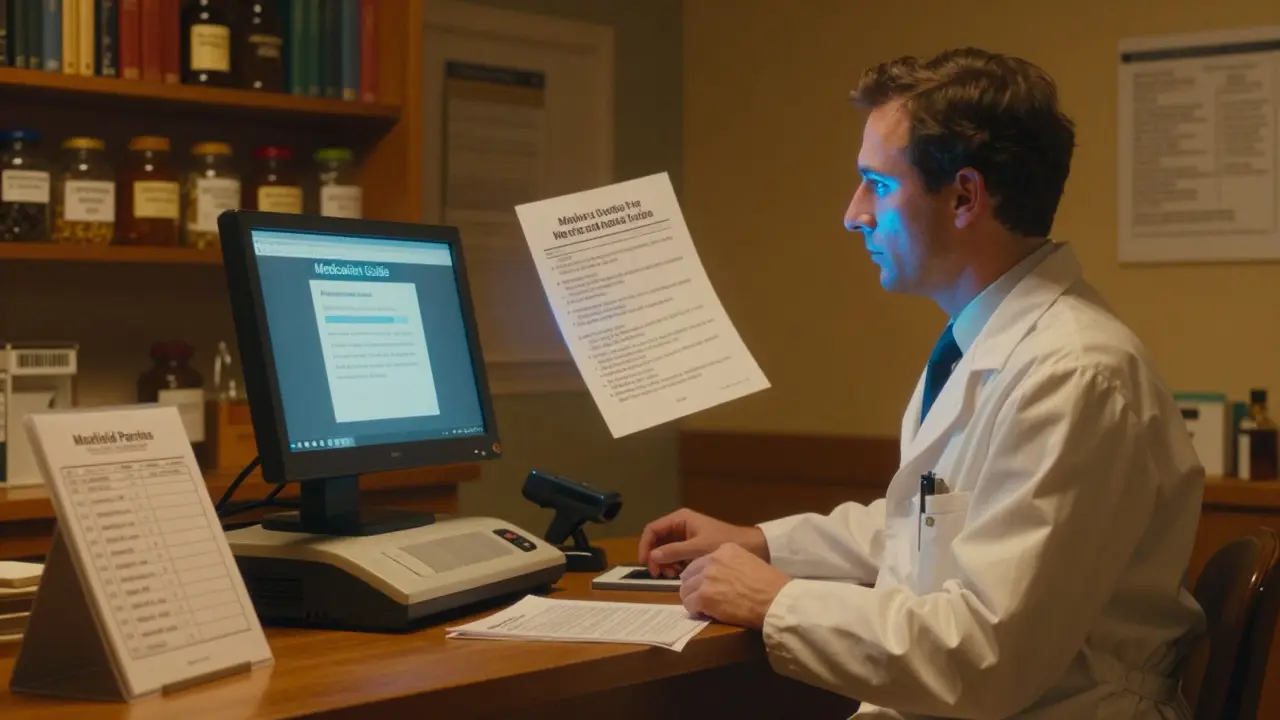
At the University of California San Francisco Medical Center, they integrated Medication Guide requirements into their pharmacy software. When a pharmacist scans a prescription for a drug that needs a guide, the system pops up a reminder. It tells them whether this is the first time the patient is receiving the drug, and whether the guide has been updated. They also added barcode scanning to confirm the guide was handed out. Result? A 73% drop in distribution errors.
Other hospitals created internal protocols. One clinic in Texas now has a laminated card for each drug that requires a guide. It lists: ‘First visit? Yes/No. Guide updated? Yes/No. REMS? Yes/No.’ Simple. Clear. No guesswork.
Even on Reddit, pharmacists are sharing real-world fixes. One user in an oncology unit said they started keeping a small logbook next to the infusion chairs. When a patient gets their first dose of a guided drug, they sign their name and date. No more arguments about whether it was given.
What’s Changing in the Future?
The FDA is pushing for more electronic options. In May 2023, they proposed allowing patients to receive Medication Guides via email or secure patient portals - as long as they can still get a paper copy if they want it. That’s a big shift. It could reduce printing costs and paper waste. But it also raises new questions: What if the patient doesn’t have email? What if they don’t check their portal? The FDA still requires paper to be available. So flexibility, not replacement, is the goal.
Industry experts predict the number of drugs requiring Medication Guides will grow by 22% over the next five years. More specialty drugs - especially in cancer, rare diseases, and complex mental health conditions - are entering the market. These drugs often come with complex safety profiles. The FDA is likely to expand the program.
But there’s a catch. A 2022 study found only 37% of patients could recall key safety points from a Medication Guide a week after receiving it. That’s not good enough. The FDA is now looking at redesigning them - simpler language, clearer visuals, maybe even video summaries. The goal? Not just to distribute the guide - but to make sure it’s understood.
What Should You Do Today?
If you’re a pharmacist or provider, here’s your action list:
- Know which drugs in your inventory require a Medication Guide. Make a list. Update it every quarter.
- Train your staff on the five distribution triggers. Don’t assume they know the difference between outpatient and inpatient rules.
- Use your pharmacy system to flag guide requirements. If you don’t have that tech, make a simple checklist.
- Don’t assume patients read it. Ask them: ‘What’s the biggest risk you need to watch for?’ If they can’t answer, go over it again.
- Keep a log of when you distribute guides in outpatient settings - especially for drugs given weekly or monthly.
Medication Guides aren’t about paperwork. They’re about preventing someone from ending up in the ER - or worse - because no one told them what to watch for. The law gives you the tool. It’s your job to make sure it’s used right.
Do I need to give a Medication Guide every time a patient refills a prescription?
Yes - in a community pharmacy, you must provide the Medication Guide each time the drug is dispensed for self-administration. This applies even if the patient has received it before. The only exception is if the guide has not changed and the patient is receiving the drug in an outpatient clinic setting, where distribution is only required the first time.
Are Medication Guides required in hospitals?
No. Medication Guides are not required for inpatient use in hospitals or nursing homes. However, healthcare staff must still provide verbal counseling on the drug’s risks, proper use, and warning signs. The FDA does not mandate the printed guide in these settings, but patient education remains a clinical responsibility.
Can patients request an electronic copy instead of paper?
Yes. Under FDA guidance from March 2020, patients may request an electronic version of the Medication Guide, such as via email or a secure patient portal. However, you must still offer a printed copy if the patient prefers it. Electronic delivery is an option, not a replacement.
What’s the difference between a Medication Guide and a package insert?
A Medication Guide is written in plain language for patients and approved by the FDA. A package insert is the detailed, technical document meant for healthcare professionals - full of medical jargon, dosing charts, and clinical trial data. They serve completely different audiences. You give the guide to the patient. You keep the insert in the pharmacy file.
What happens if the Medication Guide gets updated?
If the FDA approves changes to a Medication Guide - like new warnings or dosage instructions - you must distribute the updated version the first time the drug is dispensed after the change. This applies regardless of whether the patient has received the guide before. Always check the FDA’s website or your drug supplier for updates.
Why do some drugs have Medication Guides and others don’t?
The FDA only requires guides for drugs that meet three specific criteria: serious risks that patients need to understand, risks that outweigh benefits for some users, or where strict adherence is essential for safety or effectiveness. Only about 15% of prescription drugs in the U.S. currently require them - mostly high-risk medications in psychiatry, oncology, dermatology, and endocrinology.
Fabio Raphael
December 25, 2025 AT 07:19Really appreciate this breakdown. I’ve been in pharmacy for 12 years and still get tripped up on when the guide is required in outpatient clinics versus community settings. The five triggers are gold - printed and taped to my workstation now.
Peter sullen
December 25, 2025 AT 11:11It is imperative, nay, non-negotiable, that pharmacists adhere to the codified regulatory framework delineated under 21 CFR 208 - failure to do so constitutes a breach of the fiduciary duty owed to the patient population, and potentially exposes the institution to civil liability under federal tort statutes. The FDA’s mandate is not advisory; it is statutory.
Sophia Daniels
December 26, 2025 AT 04:39OMG YES. I work in oncology and we used to hand out guides like candy - then we realized half the patients were just tossing them. Now we have a 30-second script: ‘This isn’t fluff - this is your lifeline if your white blood cells crash. Read it or I’ll make you read it.’ Drama? Maybe. But our adverse event rate dropped 40%. 🙌
Becky Baker
December 28, 2025 AT 00:25Why do we even bother with paper? Everyone has a phone. If the FDA wants people to read it, make them download it. Stop wasting trees and printer ink. America doesn’t need more paper clutter.
Natasha Sandra
December 28, 2025 AT 17:49YESSSSS this is so true!! 😭 I had a patient cry last week because she didn’t know clozapine could kill her bone marrow. We gave her the guide but she didn’t read it. Now I make them say the risk out loud before they leave. 🙏
Brittany Fuhs
December 29, 2025 AT 03:07It’s pathetic how many providers treat this like a bureaucratic chore. The FDA doesn’t issue these guides because they’re bored - they issue them because people are dying. If you’re too lazy to hand out a sheet of paper, you shouldn’t be handling controlled substances. This isn’t a suggestion. It’s the law. And I’m tired of people pretending otherwise.
Sumler Luu
December 29, 2025 AT 19:10Just wanted to say - I’m a nurse in a long-term care facility. We don’t hand out the guides here, but we do daily verbal safety checks. I’ve seen patients forget their meds, miss symptoms, and end up in the ER. The guide is nice, but the conversation? That’s what saves lives.
Sandeep Jain
December 30, 2025 AT 02:43man i work in india and we dont even have this system properly. we give pamphlets but no one checks if its the right one. i wish we had the FDA rules here. maybe one day.
Steven Destiny
December 30, 2025 AT 07:40Stop overcomplicating this. If the drug has a guide, give it. Every time. No exceptions. If you’re worried about paper waste, use recycled stock. If you’re worried about patient confusion, train your staff. This isn’t rocket science - it’s basic patient safety. Do your job.
Rajni Jain
December 31, 2025 AT 07:22my cousin is on accutane and she said her pharmacy gave her the guide every time - but no one ever asked if she understood it. i told her to always say ‘what’s the one thing i need to watch for?’ - now she does. small thing, big difference 💛
Nikki Brown
January 1, 2026 AT 00:00Let’s be real - most patients don’t read these. The FDA should just require a 90-second video they have to watch before picking up the prescription. No more paper. No more excuses. If they don’t want to watch it, they don’t get the drug. Simple.
Erwin Asilom
January 2, 2026 AT 23:57Just a quick note: We started using a QR code on the guide that links to a 2-minute audio summary in 5 languages. Patients scan it while waiting. Feedback? ‘I actually listened this time.’ Small change. Huge impact.