
Imagine trying to hear your child whispering from across the room, but all you catch is silence. Or sitting in a quiet kitchen, listening to your partner talk - and realizing you can’t make out the low tones of their voice, even though they’re speaking clearly. This isn’t just aging. It’s otosclerosis - a hidden problem in the middle ear that slowly steals your ability to hear, especially the deeper sounds most people take for granted.
What Exactly Is Otosclerosis?
Otosclerosis is not a tumor. It’s not an infection. It’s a glitch in bone remodeling. Normally, the bones in your middle ear - the malleus, incus, and stapes - move freely to carry sound vibrations from your eardrum to the inner ear. The stapes, the smallest bone in your body at just 3.2mm long, is the one that gets stuck. In otosclerosis, abnormal bone starts growing around the stapes, fusing it to the oval window - the gateway to the inner ear. This stops it from vibrating. Sound can’t pass through. Your hearing gets muffled, especially in low frequencies. This isn’t rare. In the UK, about 1 in 200 adults has it. That’s over 300,000 people. It’s one of the top causes of hearing loss in adults under 50. Most cases show up between ages 30 and 50, and women are far more likely to be affected - about 70% of patients are female. If someone in your family has it, your risk jumps. Around 60% of people with otosclerosis have a relative with the same condition.How Does It Affect Your Hearing?
Unlike age-related hearing loss, which hits high pitches first - like birds chirping or children’s voices - otosclerosis targets the low end. You’ll struggle with deep voices, the hum of a refrigerator, or someone speaking softly. Whispered conversations become impossible. Phone calls are a nightmare. You might think people are mumbling, but it’s your ear that’s blocked. Audiograms show a clear pattern: an air-bone gap of 20-40 dB. That means sounds need to be much louder to reach your inner ear. Speech discrimination is usually still good - you can understand words if they’re loud enough. That’s a key difference from other conditions like Meniere’s disease, which causes spinning dizziness and fluctuating hearing, or noise-induced loss, which wipes out high frequencies first. In about 1 in 10 cases, the bone growth spreads into the cochlea. That’s when things get trickier. You start losing nerve-based hearing too - sensorineural loss. This is permanent. Once the inner ear is affected, hearing aids help less, and surgery won’t fix it. That’s why early diagnosis matters.Why Does It Happen?
No one knows exactly why otosclerosis starts. But we know a lot about what’s involved. Genetics play a huge role. Researchers have found 15 different gene spots linked to it, with the RELN gene on chromosome 7 being the strongest. If your mom or dad had it, you’re more likely to get it. But genes alone don’t explain everything. That’s why not everyone with the gene develops symptoms. Environmental triggers matter too. Measles virus has been tied to otosclerosis in studies. Hormones might play a part - symptoms often worsen during pregnancy, which is why women are more affected. Some research suggests fluoride might slow the bone growth, and that’s why sodium fluoride pills are being tested as a treatment. The bone itself changes. Instead of dense, strong bone, you get spongy, blood-rich tissue that slowly hardens. On a CT scan, this shows up as small, dark spots near the oval window - about 0.5 to 2mm wide. These are the early warning signs.How Is It Diagnosed?
Most people don’t realize they have otosclerosis until they’ve been struggling for months - or years. Many are misdiagnosed with Eustachian tube dysfunction, earwax buildup, or even stress. The average delay in diagnosis? About 18 months, according to Tampa General Hospital. The gold standard is a hearing test called pure-tone audiometry. If you have a conductive hearing loss with an air-bone gap of 15 dB or more, and your speech understanding is still above 70%, otosclerosis is likely. A tympanogram will show normal eardrum movement - which rules out fluid or pressure issues. If the audiogram is unclear, a high-resolution CT scan of the temporal bone can reveal the abnormal bone growth around the stapes. It’s not something your GP can diagnose. You need an ENT specialist - specifically an otologist who’s trained in ear surgery. That’s why so many people wait. Primary care doctors aren’t trained to spot subtle hearing patterns. If you’re under 50 and your hearing’s getting worse, especially with low-pitched sounds, ask for a referral.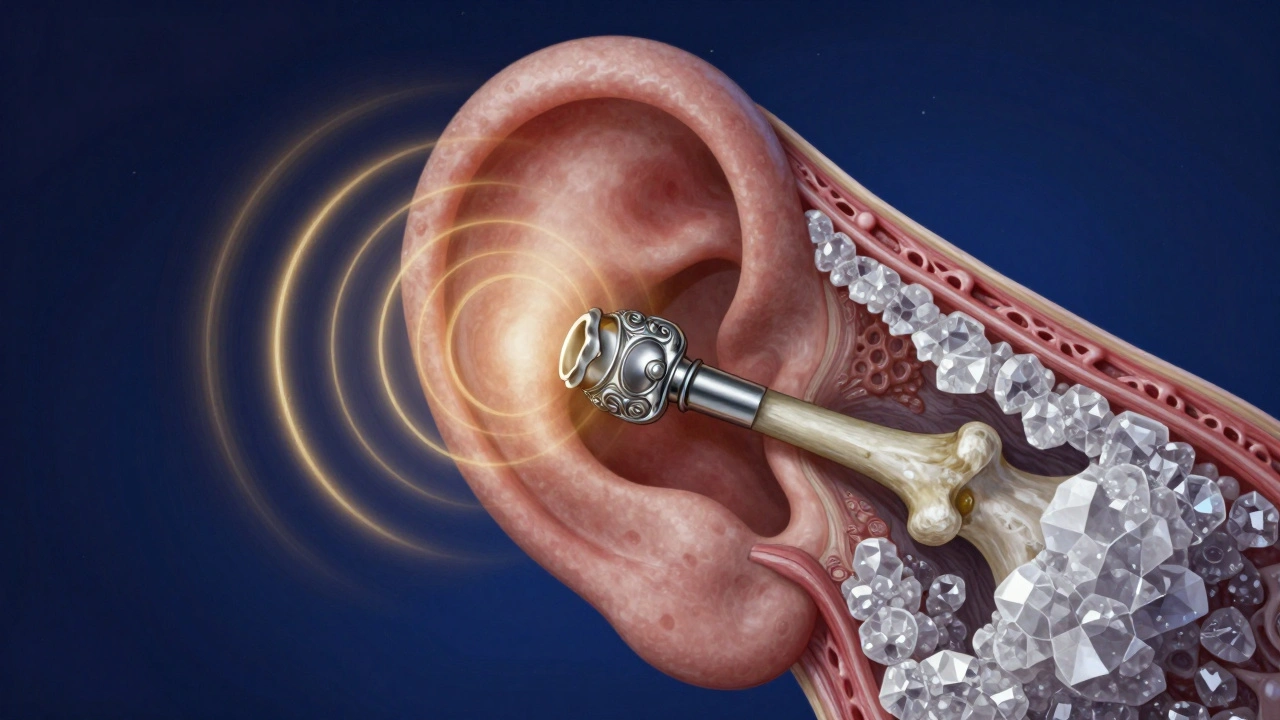
Treatment Options: Hearing Aids vs. Surgery
You have two real options: hearing aids or surgery. Neither cures the bone growth, but both restore hearing. Most people start with hearing aids. They’re non-invasive, reversible, and work well - especially for low-frequency loss. Modern digital aids can amplify the specific frequencies you’re missing, making voices clearer without cranking up background noise. About 65% of diagnosed patients choose this route first. But hearing aids don’t stop the disease. The bone keeps growing. Over five years, untreated otosclerosis can worsen hearing by 15-20 dB. That’s the difference between hearing a whisper and not hearing it at all. Surgery - stapedotomy - is the next step. It’s not risky, but it’s not simple. A surgeon uses a microscope to remove part of the stapes and replace it with a tiny titanium prosthesis. This lets sound vibrate again. Success rates? 90-95% of patients get their hearing back to near-normal levels. In 92% of cases, the air-bone gap closes to within 10 dB. That means you’re hearing like you did before the problem started. The new StapesSound™ prosthesis, approved by the FDA in March 2024, has a titanium-nitride coating that reduces scarring. Early results show 94% success at one year - better than older models. But surgery isn’t perfect. About 1% of patients end up with sudden, permanent sensorineural hearing loss - a devastating outcome. That’s why informed consent is critical. Your surgeon must explain this risk clearly. Also, if you’ve had a failed surgery before, revision rates drop to 75%. First-time surgery is your best shot.Who Should Consider Surgery?
You’re a good candidate if:- Your hearing loss is 30 dB or worse
- You’ve tried hearing aids and they’re not enough
- Your speech understanding is still strong
- You don’t have active inner ear involvement
- You’re in good overall health
What About Medications and Alternative Treatments?
There’s no pill that reverses otosclerosis. But sodium fluoride has shown promise in slowing it down. A 2024 study with 120 patients found fluoride reduced hearing loss progression by 37% over two years. It’s not a cure, but for people who aren’t ready for surgery - or who have early-stage disease - it’s a tool. It’s usually taken as a daily tablet, and side effects are mild: stomach upset, joint pain. Some people try supplements like magnesium or zinc. No solid evidence supports them. Acupuncture? No data. The only proven, science-backed options are hearing aids and surgery.
joanne humphreys
December 7, 2025 AT 07:10Otosclerosis is so under-discussed. I had no idea it targeted low frequencies first. I thought all hearing loss was just high-pitched stuff from listening to too much music. This explains why my mom kept asking me to repeat everything when my dad spoke - she wasn’t being rude, her ears were just failing on deeper tones. It’s heartbreaking when you realize it’s not them, it’s the bone.
olive ashley
December 8, 2025 AT 05:59Of course it’s worse in women. Probably because they’re more likely to be pregnant and their hormones are out of whack. Also, fluoride is a scam. The government put it in water to control the population. You think this is about hearing? It’s about mind control. The stapes gets stuck because they want you to stop listening to the truth.
Gwyneth Agnes
December 9, 2025 AT 22:29My uncle had this. Got the surgery. Now he can’t hear anything at all. Don’t trust doctors.
Max Manoles
December 10, 2025 AT 06:38Just read the part about the StapesSound™ prosthesis with titanium-nitride coating. That’s actually impressive. The 94% success rate at one year is statistically significant, and the reduction in fibrosis is a major clinical advancement. Most otologists still use the piston-type prosthesis from the 90s. This deserves more attention in surgical journals.
Katie O'Connell
December 11, 2025 AT 03:45One must wonder whether the proliferation of digital hearing aids has inadvertently discouraged surgical intervention. The commodification of auditory assistance, while well-intentioned, risks pathologizing a treatable ossicular pathology as an inevitable consequence of aging. A lamentable capitulation to convenience over cure.
Clare Fox
December 11, 2025 AT 14:34why do we even call it a ‘glitch’? like it’s a bug in some cosmic software. maybe it’s not a mistake. maybe it’s evolution trying to tell us something. we’re too loud, too fast, too distracted. our ears are shutting down the noise because our minds can’t handle silence anymore. i don’t know. just thinking.
Akash Takyar
December 12, 2025 AT 07:17Thank you for sharing this detailed and compassionate overview. Many in India suffer silently due to lack of awareness. I urge all readers to consult an ENT specialist if they notice difficulty hearing low voices - especially if there is a family history. Early detection saves not just hearing, but relationships.
Arjun Deva
December 14, 2025 AT 03:50So… measles causes this? And fluoride slows it down? And they’re trying to cure it with metal rods in your ear? That’s not science - that’s a cover-up. The pharmaceutical companies don’t want you to know that a simple vitamin D regimen can reverse it. They make billions selling hearing aids. And now they’re pushing this titanium thing? No way. This is all a scam. I’ve got my own research - I’ll post links later.
Inna Borovik
December 14, 2025 AT 04:14Let’s be real - if you’re under 50 and losing hearing, you’re probably just listening to too much bass. Or your phone’s volume is cranked up too high. This ‘otosclerosis’ nonsense is just a fancy term for lazy hearing habits. And don’t get me started on fluoride - it’s poison. People are getting surgery because they’re too lazy to turn down the music.
Rashmi Gupta
December 15, 2025 AT 13:05Everyone says surgery works - but what about the 1% who go completely deaf? That’s not a risk, that’s a gamble with your last sense. I’d rather live in silence than wake up one day and not even hear my own heartbeat. This whole thing feels like medical arrogance.
Andrew Frazier
December 16, 2025 AT 14:26So now we’re telling Americans they need to go get a metal rod shoved in their ear because of some ancient bone thing? Meanwhile, China’s got AI earbuds that translate speech in real time. We’re still stuck with 1980s tech because our doctors won’t adapt. This is why we’re falling behind.
Mayur Panchamia
December 17, 2025 AT 18:30Listen - I’ve seen this in my clinic. People come in saying, ‘I can’t hear my wife.’ Then I ask: ‘Did you ever consider she’s just being passive-aggressive?’ Half the time, the problem isn’t the stapes - it’s the relationship. The hearing loss? Just a convenient excuse to avoid conversation. Surgery won’t fix that.
Karen Mitchell
December 18, 2025 AT 00:57It’s appalling that sodium fluoride is even being considered as a treatment. Fluoride is a neurotoxin. It’s banned in seven countries. To suggest ingesting it for a non-life-threatening condition is not medical progress - it’s moral decay. Where are the ethics committees?
Priya Ranjan
December 18, 2025 AT 10:00You people are so naive. This isn’t about bone growth. It’s about EMF radiation from cell phones. The stapes is sensitive to frequencies. Your phone is slowly cooking your inner ear. No one talks about this because Big Tech owns the FDA. Try turning off Wi-Fi for a month. See if your hearing improves. I did. I’m living proof.