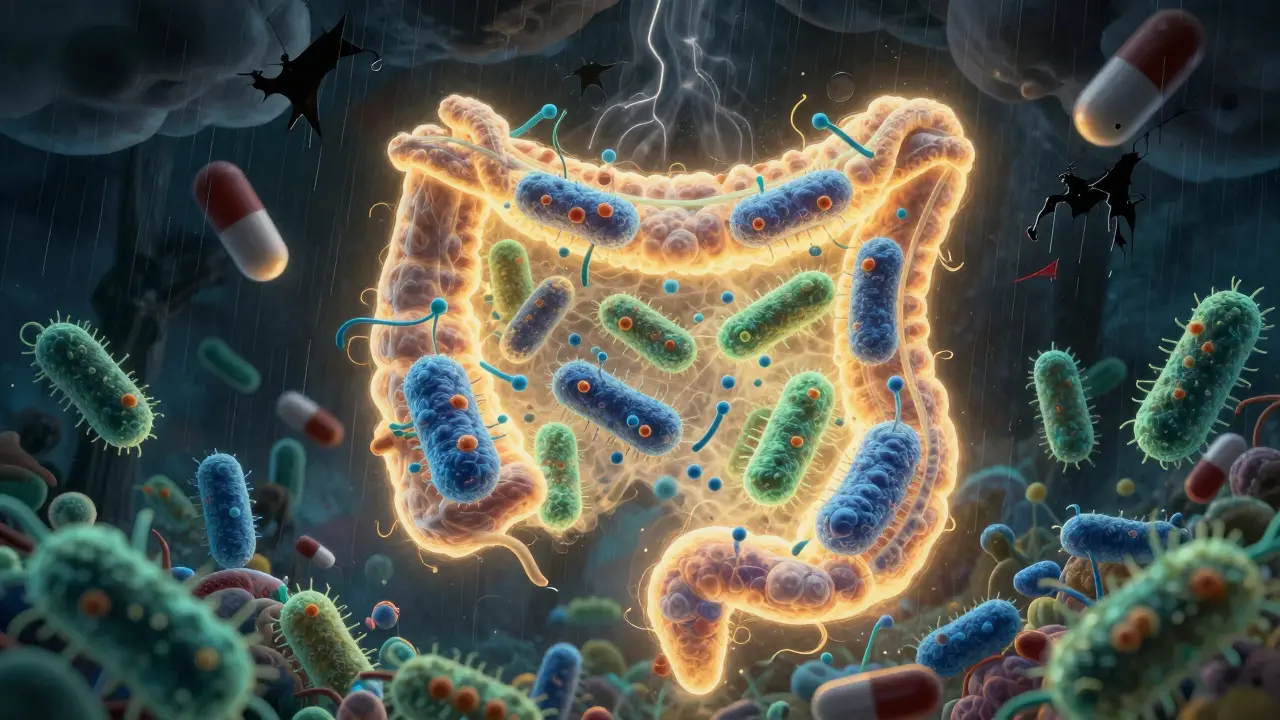
When antibiotics save your life, they can also break your gut. For many people, a simple course of pills for a sinus infection or pneumonia leads to something far worse: C. difficile colitis. It’s not just a bad stomach bug. It’s a dangerous infection that can turn deadly if left unchecked. And the worst part? It often comes back - again and again - no matter how many times you take more antibiotics.
Every year in the U.S., around half a million people get infected with Clostridioides difficile, or C. diff. About 29,000 of them die. In the UK, hospital cases have dropped since 2015 thanks to better hygiene and antibiotic control, but community cases are rising. You don’t have to be in a hospital to catch it. You can get it after taking antibiotics at your GP’s office, or even from someone who doesn’t know they’re carrying the bacteria.
Why Antibiotics Are the Main Culprit
Your gut is full of trillions of good bacteria. They help digest food, make vitamins, and keep harmful bugs in check. When you take antibiotics - especially broad-spectrum ones - you don’t just kill the bad bacteria. You wipe out the good ones too. That creates a vacuum. And C. diff doesn’t wait. It moves in fast.
Not all antibiotics are equally risky. Some are like sledgehammers to your gut microbiome. According to a major 2023 study analyzing over 33,000 hospital cases, piperacillin-tazobactam (a common IV antibiotic) carries the highest risk - more than double the chance of triggering C. diff compared to other drugs. Other high-risk offenders include clindamycin, later-generation cephalosporins like ceftriaxone, and fluoroquinolones like ciprofloxacin.
Even more telling? Each extra day you’re on antibiotics increases your risk by 8%. After 14 days, the danger spikes again. That’s why doctors are now told to review antibiotics within 48 to 72 hours. If you’re still on them after two weeks, ask: Is this still necessary?
On the flip side, tetracyclines - like doxycycline - show the lowest risk. That doesn’t mean they’re harmless, but they’re less likely to trigger C. diff. If you’re at high risk for gut infections - say, you’ve had C. diff before, or you’re over 65 - your doctor might choose a narrower-spectrum option.
The Cycle of Recurrence
Here’s where things get cruel. Even when you finish your antibiotics and feel better, C. diff doesn’t always disappear. Spores survive in your gut, lying dormant. When your microbiome hasn’t fully recovered - and it rarely does after broad-spectrum antibiotics - those spores wake up. And boom. You’re back to diarrhea, fever, and abdominal pain.
One in five people who get C. diff for the first time will have it come back. After two episodes, the chance jumps to 60%. After three? It’s over 80%. That’s not bad luck. It’s a broken system. Standard treatments - vancomycin or fidaxomicin - kill the active bacteria, but they don’t fix the damaged gut environment. So the infection returns.
Many patients describe the frustration: “I took the pills. I felt fine. Then, two weeks later, I was back in the bathroom all day.” One Reddit user wrote: “I had four relapses. Vancomycin worked each time - but only until I stopped. I was terrified to take another course.”
Fecal Transplant: The Game-Changer
Enter fecal microbiota transplantation - FMT. Sounds gross? Maybe. But it’s one of the most effective treatments in modern medicine for recurrent C. diff.
In a landmark 2013 study published in the New England Journal of Medicine, researchers compared FMT to standard antibiotic therapy. Of the patients who got FMT, 94% were cured after one or two treatments. Only 31% of those on antibiotics were. That’s not a slight edge - it’s a revolution.
FMT works by restoring the healthy gut bacteria that antibiotics destroyed. Donor stool - carefully screened for viruses, parasites, and drug-resistant bacteria - is delivered into the patient’s colon. It’s not about “poop in a pill.” It’s about rebuilding a broken ecosystem.
Today, FMT is recommended for anyone who’s had three or more C. diff infections. Success rates? Between 85% and 90%. That’s better than any drug. And it’s not just for hospitals anymore. In the U.S., 35% of hospitals now have formal FMT programs - up from just 5% in 2015.
Delivery methods vary. Colonoscopy is most common (about 65% of cases). Enemas are used in 20%. And now, oral capsules - frozen, processed, and odorless - make up 15%. These capsules are easier, cheaper, and less invasive. One patient told me: “I swallowed five pills. No prep. No scope. I went to work the next day.”
What About Probiotics?
You’ve probably heard that yogurt or probiotic supplements can prevent C. diff. The truth? It’s not that simple.
The American College of Gastroenterology and the Infectious Diseases Society of America both say there’s not enough evidence to recommend probiotics for preventing C. diff. Some studies show a tiny benefit. Others show no effect. Worse, in people with weak immune systems, probiotics have been linked to dangerous bloodstream infections.
One small study looked at kefir - a fermented milk drink - combined with a slow taper of antibiotics. It showed promising results, with cure rates close to FMT. But it was tiny. Not enough to change guidelines. Until larger, high-quality trials are done, don’t rely on probiotics alone.
What’s New in 2026?
FMT isn’t just a procedure anymore. It’s becoming a product.
In 2022, the FDA approved Rebyota, the first standardized, FDA-regulated FMT product. It’s a single-dose enema delivered in a clinic. In 2023, Vonjo followed as an oral capsule. These aren’t “donor poop.” They’re carefully processed, tested, and packaged microbiome therapies. Think of them like blood transfusions - but for your gut.
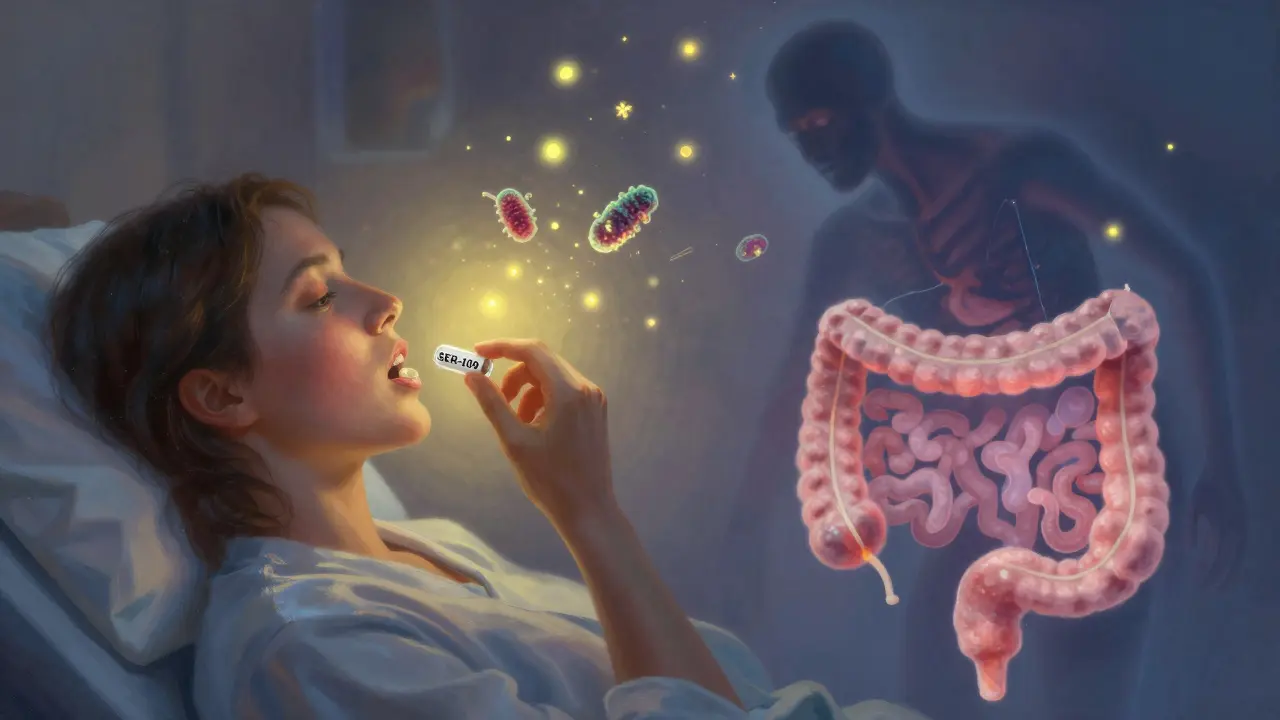
Even more exciting? Drugs like SER-109, an oral microbiome therapeutic made from purified bacterial spores, showed 88% effectiveness in phase 3 trials. It’s not FMT. It’s precision medicine for your gut. No donor needed. No stool involved. Just targeted bacteria designed to outcompete C. diff.
These new therapies are expensive - around $1,500 to $3,000 per dose - but they’re far cheaper than repeated hospital stays, which average $11,000 per episode. And they’re easier to scale. A hospital can stock 100 capsules. It can’t store 100 donor stool samples.

What You Can Do Right Now
If you’re prescribed antibiotics:
- Ask: “Is this absolutely necessary?” Many infections - like sinusitis or bronchitis - are viral and don’t need antibiotics at all.
- Ask: “What’s the shortest course possible?” Don’t take them longer than needed.
- Ask: “Is there a lower-risk option?” Tetracyclines or narrow-spectrum drugs might be safer if appropriate.
- If you’ve had C. diff before, tell your doctor. They may choose a different antibiotic or consider preventive measures like bezlotoxumab - a monoclonal antibody that blocks C. diff toxin.
If you’ve had recurrent C. diff:
- Don’t wait until the fifth relapse. Talk to a gastroenterologist about FMT or newer microbiome therapies.
- Don’t assume “it’ll go away on its own.” C. diff can lead to toxic megacolon, colon rupture, or sepsis.
- Ask about clinical trials. New treatments are being tested all the time.
It’s Not Just About Treatment - It’s About Prevention
The CDC calls C. diff an “urgent threat.” That’s not hype. It’s a warning. Antibiotic overuse is the engine driving this crisis. Every unnecessary antibiotic increases the risk - for you, your family, your community.
Doctors are learning. Hospitals are improving. But you have power too. Don’t pressure your doctor for antibiotics. Don’t take leftover pills. Don’t assume “it’s just a stomach bug.” If you’re sick and your doctor says “no antibiotics,” trust them. Your gut will thank you.
The future of C. diff treatment isn’t more drugs. It’s better microbes. And the best way to avoid it? Use antibiotics like a scalpel - not a sledgehammer.
Can you get C. diff without taking antibiotics?
Yes, but it’s rare. Most cases happen after antibiotic use. However, you can catch C. diff from contaminated surfaces, especially in hospitals or care homes. Asymptomatic carriers - people who have the bacteria but no symptoms - can spread it without knowing. Community cases are rising, partly because people are exposed outside hospitals. Good hand hygiene and cleaning surfaces help reduce risk.
Is fecal transplant safe?
When done properly, FMT is very safe. Donors are screened for over 30 infectious agents, including HIV, hepatitis, and drug-resistant bacteria. The FDA requires strict testing. Serious side effects are rare. The biggest risk is introducing unknown microbes that could affect long-term health - like triggering allergies or autoimmune conditions. But so far, no major long-term issues have been confirmed in thousands of cases. Newer products like Rebyota and Vonjo are even safer because they’re purified and standardized.
How long does it take to recover after a fecal transplant?
Most people feel better within 24 to 48 hours. Diarrhea stops, appetite returns, and energy improves. Full gut recovery takes longer - weeks to months - as the microbiome rebuilds. Some patients report bloating or mild cramping for a few days after the procedure. But the cure is usually permanent. Recurrence after successful FMT is less than 10%.
Can you do FMT at home?
No. FMT is not safe or legal to do at home. Donor stool must be rigorously tested for pathogens. Improperly screened material has caused life-threatening infections, including E. coli and drug-resistant bacteria. Even in hospitals, FMT is done under medical supervision. The FDA treats it as a biological product, not a home remedy. Don’t try DIY versions - they’re dangerous.
Are there alternatives to FMT for recurrent C. diff?
Yes. For first recurrence, fidaxomicin is preferred over vancomycin because it has a higher sustained cure rate. Bezlotoxumab, a monoclonal antibody given as a single IV infusion, reduces recurrence by about 10% when added to standard treatment. New oral microbiome therapies like SER-109 are now in late-stage trials and may become available soon. These are not “miracle cures,” but they’re better than repeating antibiotics.
If you’ve battled C. diff more than once, you know how exhausting it is. It’s not just physical - it’s emotional. You lose trust in your body. You fear every stomach ache. But you’re not alone. And there’s real hope now - not just in surviving it, but in finally beating it for good.
Jessie Ann Lambrecht
January 8, 2026 AT 03:17Just had my third C. diff relapse last month. Vancomycin worked each time, but I felt like my gut was never the same. When my GI doc suggested FMT, I cried. Not from fear-from relief. I swallowed the capsules, went to work the next day, and two weeks later? No diarrhea, no anxiety, no looking over my shoulder every time I eat salad. This isn’t magic. It’s medicine that finally understands the gut isn’t a sewer-it’s a garden.
Kyle King
January 8, 2026 AT 16:40They say FMT is safe but have you seen the donor screening forms? They’re asking about your sex life, your travel history, even your pet’s poop habits. Meanwhile Big Pharma is pushing these $3K capsules like they’re the cure-all. I’m not saying it’s fake, but why are we letting corporations patent poop? Next thing you know, they’ll charge you for breathing clean air.
Vince Nairn
January 10, 2026 AT 01:17Bro, I get the fear of corporate medicine but you’re ignoring the data. 94% cure rate? That’s not a coincidence. I had a cousin who was in and out of the hospital for two years. FMT was her last shot. Now she hikes, bakes bread, and doesn’t flinch at tacos. Sometimes the solution looks weird because science hasn’t caught up to how weird our bodies really are.
Rachel Steward
January 11, 2026 AT 01:47Let’s be real-this whole C. diff crisis is a manufactured panic. Antibiotics are vilified like they’re the devil, but the real problem is that modern medicine treats symptoms instead of root causes. You wipe out your microbiome, then you panic. You don’t fix the diet, the stress, the toxins, the glyphosate in your water. FMT is just a band-aid on a hemorrhage. And don’t get me started on how they sanitize donor stool-it’s all just a distraction from the real villain: industrial agriculture.
Mina Murray
January 11, 2026 AT 02:09Probiotics dont work? Says who? My yoga instructor took kefir daily after her antibiotics and never got C. diff. Meanwhile, your fancy capsules cost more than my rent. Who’s really profiting here? And why is the FDA letting them call this "therapy" when it’s just poop in a pill? They’re selling fear and then the cure. Classic.
Emma Addison Thomas
January 11, 2026 AT 05:49Interesting how the UK’s hospital rates dropped but community cases rose. It suggests the problem isn’t just in hospitals-it’s in how we’ve normalized antibiotics as a first resort. My grandmother never took them for a cold. She drank honey and ginger, rested, and trusted her body. We’ve outsourced immunity to pills. Now we’re paying the price.
Aparna karwande
January 12, 2026 AT 21:53India has been using fermented foods for gut health for centuries-curd, kanji, idli batter. We didn’t need FDA-approved poop capsules. We had grandmothers who knew what real microbiomes looked like. Now we’re importing American pharmaceuticals to fix problems our ancestors avoided by eating fermented rice and avoiding unnecessary antibiotics. This isn’t progress. It’s cultural surrender.
And don’t get me started on how Western medicine calls it "dysbiosis" like it’s a new discovery. We called it "gut imbalance" and fixed it with turmeric, asafoetida, and fasting. Why are we outsourcing our wisdom to a $3,000 pill?
It’s not just about C. diff. It’s about losing our ancestral knowledge to corporate science that profits from our ignorance.
LALITA KUDIYA
January 13, 2026 AT 16:34my aunt did FMT in hyderabad last year. no hospital. just a clinic. she said it felt like a warm hug inside. no drama. no pain. just peace. 🙏
Christine Joy Chicano
January 14, 2026 AT 00:49Correction: SER-109 isn’t just "in late-stage trials." It’s already FDA-approved as of Q1 2025. The article is outdated. Also, bezlotoxumab isn’t just "reduces recurrence by 10%"-it reduces it by 16.7% in patients over 65, per the 2024 JAMA meta-analysis. Don’t cite old data when newer, more precise numbers exist. Precision matters.
Jonathan Larson
January 15, 2026 AT 22:13The underlying philosophy here is not merely medical-it is ecological. The human body is not a machine to be repaired with isolated interventions, but a complex, symbiotic system that evolved over millennia. To treat C. diff with antibiotics is to wage war on an ecosystem we do not understand. To treat it with FMT or SER-109 is to restore balance-to act as stewards rather than conquerors. This is not just a treatment shift. It is a paradigm shift in how we conceive of health.
Katrina Morris
January 16, 2026 AT 12:32i never knew antibiotics could do this to you until i got sick after a tooth infection. now i dont even ask for them unless its pneumonia or something serious. and yes i eat yogurt. not because its proven but because it makes me feel better. and honestly? i trust my gut more than the internet.
Adam Gainski
January 17, 2026 AT 01:52For anyone considering FMT, talk to your GI doc about the new oral capsules. They’re way less intimidating than a colonoscopy. I was terrified until I realized I was swallowing something that literally saved my life. No one talks about the emotional toll of chronic C. diff-the isolation, the shame. FMT didn’t just fix my gut. It gave me back my life.