Kidney Risk Assessment Tool
Assess Your Kidney Risk
This tool helps you understand your personal risk of drug-induced kidney failure based on medications you take, health conditions, and lifestyle factors.
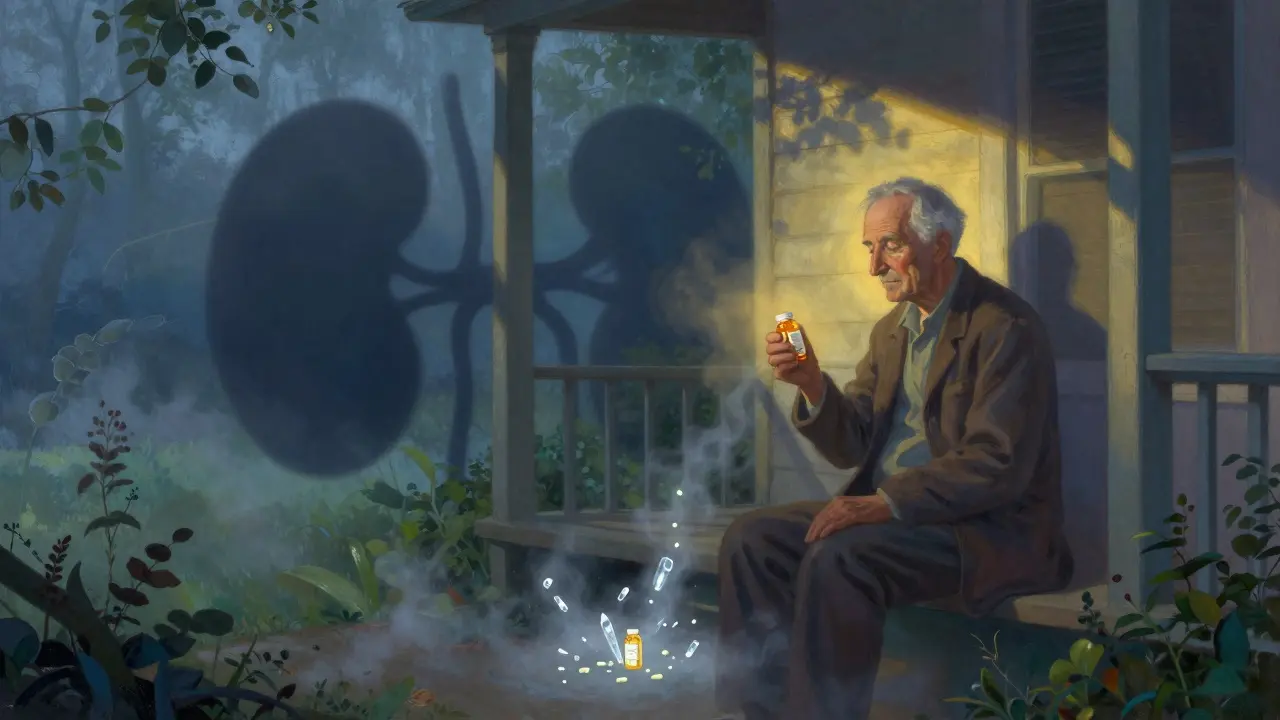
Every year, tens of thousands of people end up in the hospital with sudden kidney failure - not from an accident, not from diabetes, but from a pill they took for a headache, an infection, or joint pain. This isn’t rare. It’s drug-induced kidney failure, and it’s often avoidable. The truth? Your doctor might not even know you’re at risk. And if you’re over 60, have high blood pressure, or take more than five medications, you’re sitting on a ticking clock.
What Exactly Is Drug-Induced Kidney Failure?
It’s not one thing. It’s a group of reactions where common medicines damage your kidneys, sometimes within days. Doctors call it Drug-Induced Acute Kidney Injury (DI-AKI). It’s not slow, silent damage like diabetes. This is sudden. Your kidneys stop filtering waste. Fluid builds up. Toxins pile up. And if you don’t catch it fast, it can turn permanent.
The numbers don’t lie. About 1 in 5 hospital cases of sudden kidney failure are caused by drugs. In intensive care, that number jumps to 6 out of 10. And here’s the kicker - 60 to 70% of these cases could be prevented with simple steps. That’s not a guess. That’s from NHS England’s audit of over 12,000 patients.
Three main ways drugs hurt your kidneys:
- Acute interstitial nephritis - Your immune system attacks your kidney tissue after taking antibiotics, NSAIDs, or acid-reducing pills like omeprazole. It shows up with fever, rash, and swollen glands - often 1 to 2 weeks after starting the drug.
- Acute tubular necrosis - Toxic drugs like vancomycin, contrast dye, or aminoglycosides kill the tiny filtering tubes in your kidneys. This is common after surgeries or infections.
- Crystal-induced nephropathy - Some drugs form sharp crystals in your urine that clog your kidneys. Acyclovir, sulfamethoxazole, and protease inhibitors do this. It happens fast - sometimes within hours.
How Do You Know It’s Happening?
The scary part? You might feel fine. Kidneys don’t scream. They whisper. By the time you feel tired, puffy, or urinate less, it’s often too late.
Doctors use three clear signs to spot kidney injury:
- Your creatinine level rises by 0.3 mg/dL or more in 48 hours.
- Your creatinine jumps 50% or more from your normal baseline.
- You produce less than half a milliliter of urine per kilogram of body weight for 6 hours straight.
That’s it. No fancy scans needed. Just blood and urine tests you should already be getting if you’re on high-risk meds.
But here’s what patients report: 54% say their doctors missed the connection between their meds and their rising creatinine. One man took ibuprofen for 10 days after dental surgery. His creatinine jumped from 1.8 to 4.2 in three days. He didn’t get help for five days. He spent a week in the hospital.
On the flip side, a woman with early kidney disease switched from naproxen to acetaminophen after her doctor checked her eGFR. Her kidney function stabilized in two weeks. No hospital. No dialysis. Just a simple switch.
Which Drugs Are the Biggest Risks?
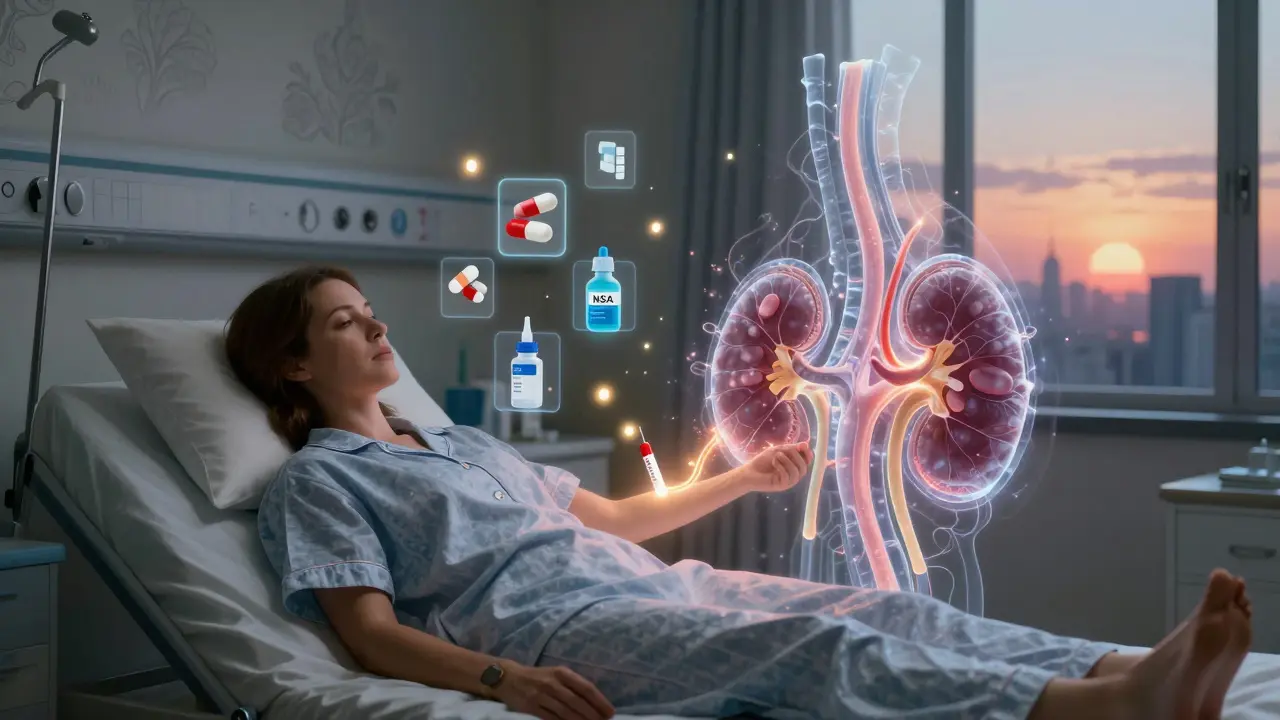
Not all meds are equal. Some are quiet killers. The top offenders:
- NSAIDs - Ibuprofen, naproxen, celecoxib. These are the #1 cause of drug-related kidney injury in older adults. One study found that in people with existing kidney issues, NSAIDs raise AKI risk by 15-20%. They’re sold over the counter, so people think they’re safe. They’re not.
- Antibiotics - Vancomycin and piperacillin-tazobactam top the list. The FDA’s adverse event database recorded over 12,800 reports of drug-induced kidney failure between 2020 and 2023. Vancomycin alone caused 2.7 cases per 1,000 patient-years.
- Proton pump inhibitors - Omeprazole, pantoprazole. These acid blockers are among the most prescribed drugs in the world. But they’re linked to interstitial nephritis. It’s rare, but when it happens, it’s serious.
- Contrast dye - Used in CT scans and angiograms. It’s not the scan that hurts you - it’s the dye. People with diabetes, heart disease, or existing kidney problems are at highest risk.
- Antivirals - Acyclovir and tenofovir can form crystals in your urine. Tenofovir has a black box warning from the FDA for kidney damage.
And don’t forget polypharmacy. Taking five or more medications at once triples your risk of kidney injury. It’s not the drug - it’s the combo. A blood pressure pill + NSAID + diuretic + statin + antibiotic? That’s a perfect storm.
How to Prevent It - The Real Strategies That Work
Prevention isn’t about avoiding all meds. It’s about smart choices. Here’s what actually works:
1. Know Your Baseline
Before you start any new drug - especially if you’re over 60 or have high blood pressure - ask for your eGFR. That’s your estimated glomerular filtration rate. It tells you how well your kidneys are working.
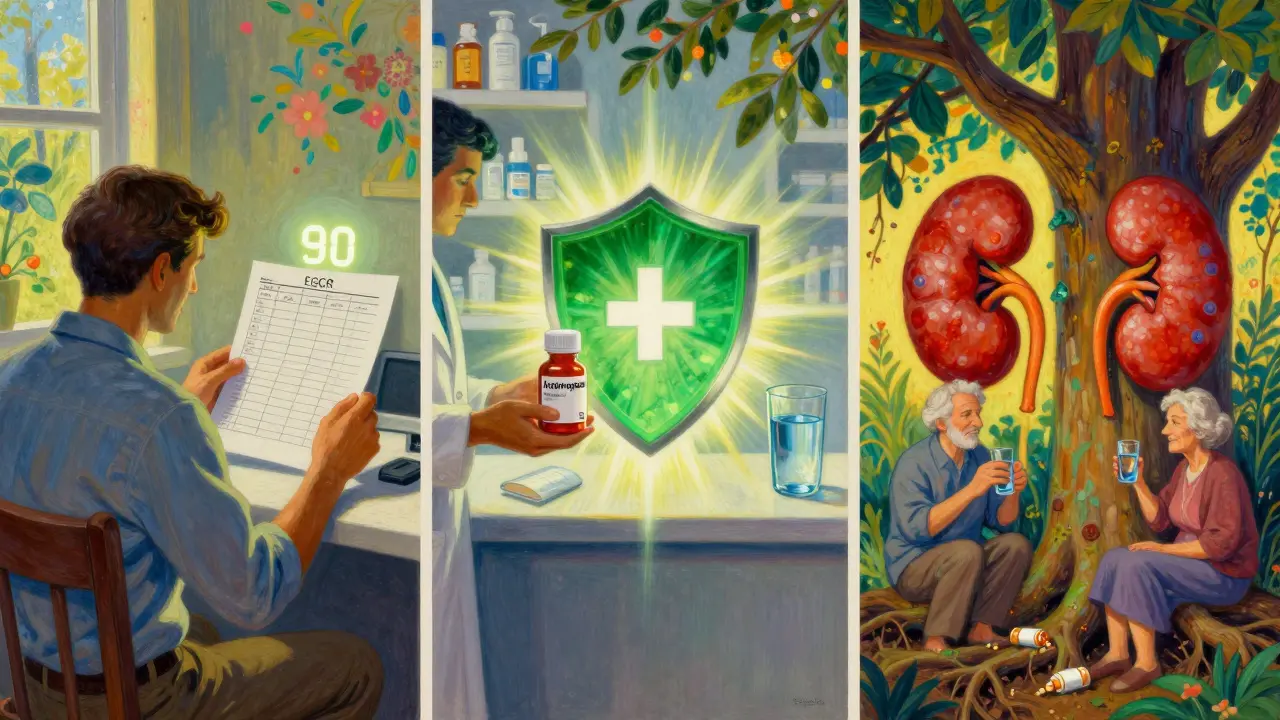
Normal is above 90. Below 60 means your kidneys are already impaired. Below 30? You’re in serious danger. If your eGFR is under 60, NSAIDs should be off the table. Period.
2. Swap the High-Risk Drugs
If you need pain relief and your kidneys are weak, swap NSAIDs for acetaminophen. It’s not perfect - too much can hurt your liver - but it’s safer for your kidneys. For inflammation, ask about non-drug options: physical therapy, ice packs, or topical creams.
3. Hydrate Before Contrast Scans
If you’re getting a CT scan with contrast, drink water. A lot. The American College of Radiology says high-risk patients should get 1 to 1.5 mL per kg of body weight per hour for 6 to 12 hours before and after the scan. Normal saline works. Baking soda? Doesn’t help. N-acetylcysteine? No proof it works. Just plain water or IV fluids.
4. Avoid Drug Clashes
Don’t take NSAIDs with diuretics or ACE inhibitors. That’s a triple whammy on your kidneys. If you’re on blood pressure meds and your doctor prescribes ibuprofen, say no. Ask for an alternative.
5. Use Tech to Your Advantage
Some hospitals now use AI systems that flag risky prescriptions before they’re filled. One system cut DI-AKI by 41% in a trial of over 15,000 patients. Ask your pharmacy or doctor if they use electronic alerts that warn when a drug dose is too high for your kidney function.
What Happens If You Ignore It?
Early? You stop the drug. Your kidneys bounce back. Simple.
Delayed? You risk permanent damage. One study showed that 15 to 20% of people with severe DI-AKI die in the hospital. Even if you survive, you might need dialysis. Or develop chronic kidney disease. That’s life-altering.
And it’s expensive. The average hospital stay for drug-induced kidney failure costs $18,450 in the U.S. - more than double a normal admission. In the UK, the NHS spends millions every year treating preventable cases.
The Bottom Line
Drug-induced kidney failure isn’t a mystery. It’s a failure of awareness. You don’t need to be a doctor to protect yourself. Just ask these three questions before you take any new medication:
- Is this drug known to hurt the kidneys?
- Do I already have kidney problems? What’s my eGFR?
- Is there a safer alternative?
If you’re on multiple meds, get your kidney function checked every 6 months. If you’re over 65, make it every 3 months. Don’t wait for symptoms. Don’t assume your doctor knows. Your kidneys don’t have a voice - you do.
The system isn’t perfect. But you can be smarter than the algorithm. Stop assuming pills are harmless. Start asking questions. Your kidneys will thank you.
Lance Nickie
January 13, 2026 AT 07:17NSAIDs are fine if you dont have kidney issues. Stop scaremongering. I take ibuprofen daily and my creatinine is 0.9. Chill out.
vishnu priyanka
January 14, 2026 AT 06:42Bro in India we call this 'dawa ka darr' - fear of medicine. But honestly? My uncle took 10 ibuprofen for a toothache and ended up in dialysis. Now he drinks coconut water like it’s holy water. Maybe we need more awareness, not more pills.
Angel Tiestos lopez
January 15, 2026 AT 01:00Our bodies are like ancient computers running 17 apps at once. NSAIDs? That’s like forcing a 2003 browser to run VR. 🤯 Your kidneys ain’t built for this. We got pills for everything now… but forgot to ask: ‘Do we really need this?’ 🤔
Pankaj Singh
January 16, 2026 AT 14:07This post is pure clickbait. 90% of people who read this are healthy as horses. Stop making normal people paranoid. NSAIDs kill 0.0001% of users. Meanwhile, obesity and sugar are killing millions. Fix the real problem, not the pill.
Scottie Baker
January 16, 2026 AT 22:05I had a friend who took 3 Advil a day for his back. Doctor never asked about it. Kidney failed in 14 days. Now he’s on dialysis 3x a week. And the doctor? Still prescribes it to others. This system is broken. Not the pills. The people giving them.
Anny Kaettano
January 18, 2026 AT 17:31As a nephrology nurse, I’ve seen this too many times. The real tragedy? Patients don’t know their eGFR. They think ‘normal blood work’ means ‘kidneys are fine.’ But if your baseline isn’t tracked, you’re flying blind. Advocate for yourself. Ask for the number. Write it down. Share it with every provider. You are your own best advocate.
Angel Molano
January 20, 2026 AT 04:43If you’re over 60 and still taking ibuprofen, you’re just asking for trouble. No excuses. You’re not special. Your pain isn’t more important than your kidneys. Stop being selfish.
Trevor Davis
January 20, 2026 AT 17:11I used to think meds were magic. Then my mom got hospitalized after a Z-pack and a naproxen combo. She didn’t even know they could interact. Now I keep a little notebook: drug, dose, date, kidney number. It’s not hard. It’s just… not taught. We need a culture shift. Not just warnings - a movement.
John Tran
January 22, 2026 AT 01:51Think about it: we live in a world where you can order a pizza in 12 seconds but can’t get a simple kidney test without jumping through 7 hoops. We’ve optimized convenience, not survival. The system doesn’t care if you live or die - it cares if you’re insured, if you clicked ‘accept terms,’ if you paid for the refill. Your kidneys? Just collateral damage in the great algorithm of capitalism. 🌍💔 We’re not just taking pills - we’re signing contracts with invisible forces. And guess who writes the fine print? The same people who profit when you need a transplant.
Milla Masliy
January 23, 2026 AT 03:37My grandma switched from naproxen to acetaminophen after her eGFR dropped to 52. She’s 81. Still walks 2 miles a day. No hospital. No drama. Just a conversation with her pharmacist. Sometimes the safest thing is asking, ‘Is there another way?’