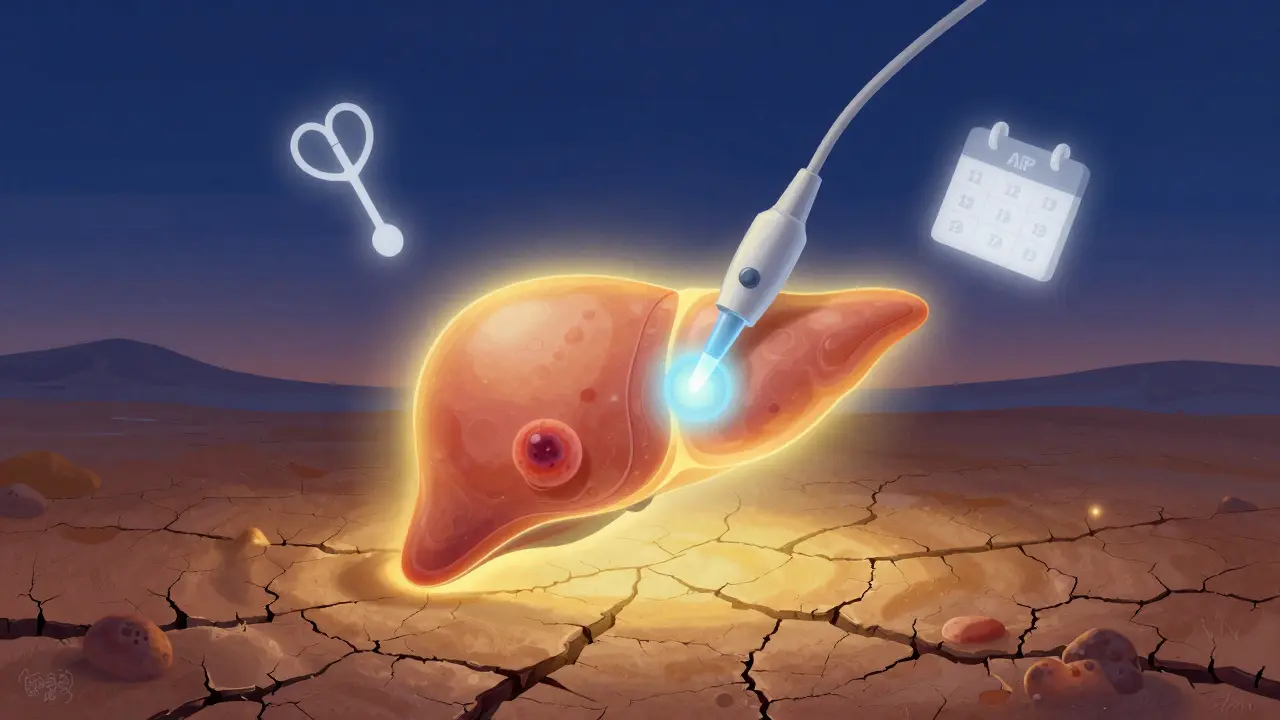
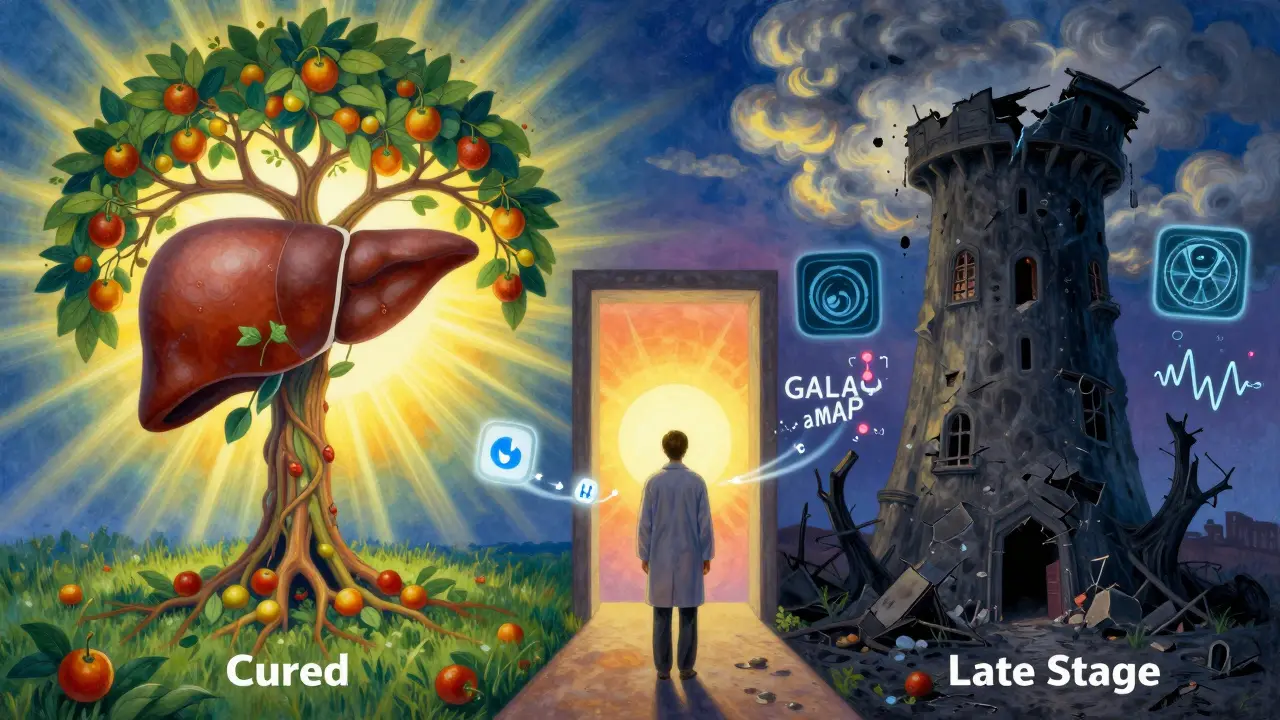
Most people with liver cancer don’t feel sick until it’s advanced. That’s why hepatocellular carcinoma (HCC) kills so many - it sneaks up. But here’s the good news: if you have cirrhosis, regular screening can catch it early enough to cure it. In fact, people who get screened regularly are more than three times as likely to survive five years compared to those who don’t. This isn’t theory. It’s what happens in real clinics when surveillance works.
Why Cirrhosis Is the Biggest Risk Factor
About 8 out of 10 cases of hepatocellular carcinoma happen in people who already have cirrhosis. That’s not a coincidence. Cirrhosis means your liver is scarred, damaged, and struggling to function. Over time, the constant repair process turns into chaos. Cells start growing abnormally. Some turn cancerous. The longer you have cirrhosis, the higher your risk. Whether it’s from hepatitis B, heavy drinking, or fatty liver disease, the damage adds up. If you’ve been told you have cirrhosis, you’re not just managing a chronic condition - you’re in a high-risk group for cancer. That’s why skipping checkups isn’t an option. Even if you feel fine. Even if your blood tests look okay. HCC doesn’t always show up in routine labs. It hides in plain sight.What Surveillance Actually Looks Like
The standard plan is simple: get an ultrasound of your liver every six months. No prep. No fasting. No needles. Just a quick scan that looks for tumors before they grow too big. This isn’t optional. It’s the single most effective thing you can do to stay alive. Major guidelines from the American Association for the Study of Liver Diseases (AASLD) and the European Association for the Study of the Liver (EASL) all agree on this. Ultrasound is the first line because it’s cheap, safe, and widely available. It can spot tumors as small as 1 centimeter - small enough that surgery or ablation can remove them completely. Some doctors also check a blood marker called alpha-fetoprotein (AFP). But it’s not reliable on its own. About 40% of early HCCs don’t raise AFP levels. That’s why guidelines only recommend it as a backup. If your AFP is above 20 ng/mL, it triggers a deeper look - but a normal AFP doesn’t mean you’re safe. Ultrasound is the real tool.Who Gets Screened - And Who Doesn’t
You might assume everyone with cirrhosis gets screened. But the truth is messy. In the U.S., only about 40% of eligible patients actually get the recommended scans. Why? Some doctors don’t know the guidelines. Others forget to schedule them. Some patients miss appointments because they don’t understand the risk. A study from the National Cancer Database found Black patients and those on Medicaid were far less likely to be screened than white patients with private insurance. That’s not just a gap in care - it’s a gap in survival. And then there’s the tricky part: not all cirrhosis is the same. Patients with Child-Turcotte-Pugh (CTP) Class C cirrhosis - meaning their liver is failing badly - often don’t live long enough for HCC to become the main threat. Their median survival is less than two years. So major guidelines say: don’t screen unless they’re on a transplant list. But in Asia, where hepatitis B is common and liver cancer hits younger, some doctors still screen even Class C patients if they’re otherwise stable. There’s no universal rule - just risk assessment.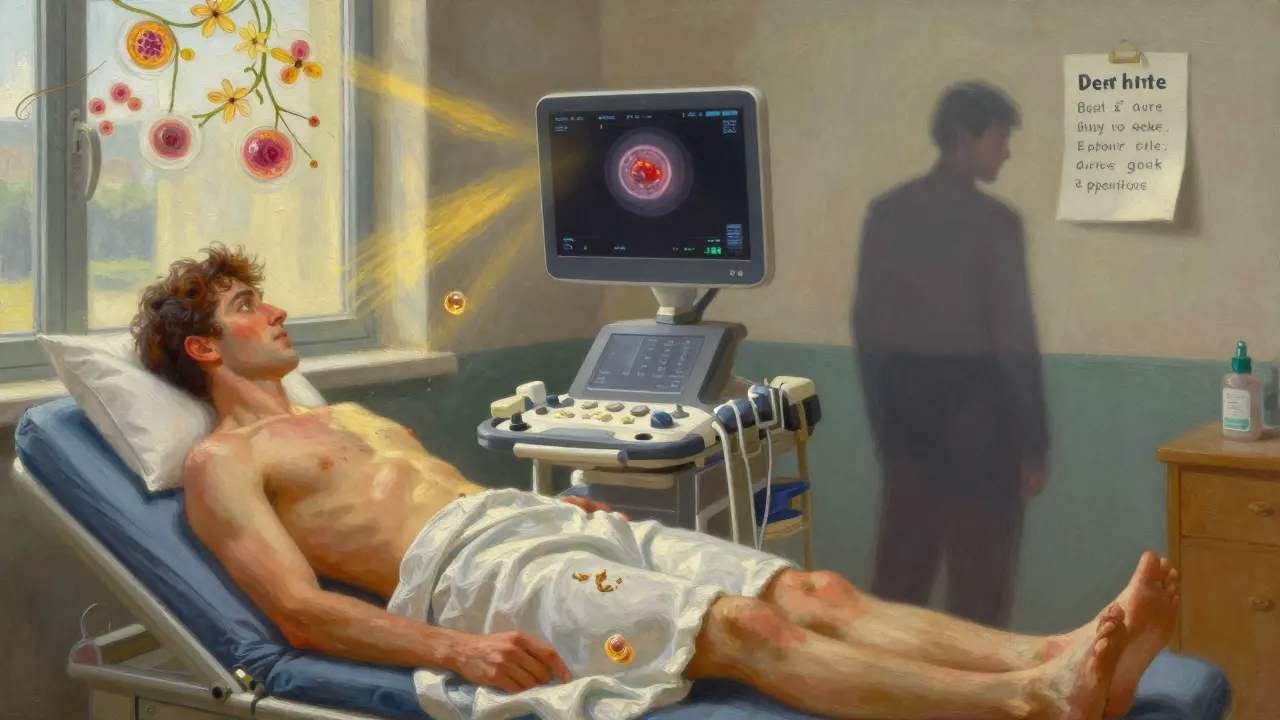
The New Shift: Risk-Based Screening
The old model treated all cirrhosis patients the same. But now, experts are moving toward something smarter: risk-based screening. The EASL 2023 Policy Statement introduced a three-tier system:- High risk (more than 2.5% chance of HCC per year): Ultrasound every 6 months - or even MRI if available.
- Medium risk (1.5-2.5% per year): Standard 6-month ultrasound.
- Low risk (under 1.5% per year): May not need routine screening.
What Happens If a Tumor Is Found
If your ultrasound shows a mass larger than 1 cm, the next step is fast. You’ll need a multiphase CT or MRI scan - not just any imaging, but a liver-specific one. Radiologists use a system called LI-RADS to classify what they see. It’s standardized. It reduces guesswork. If the scan confirms HCC, treatment depends on three things: how big the tumor is, how well your liver is working, and whether it’s spread.- Stage 0 or A (very early): Surgery to remove the tumor, or radiofrequency ablation (RFA) to burn it with heat. Cure rates here can be 70% or higher.
- Stage B (intermediate): If you have multiple small tumors but your liver still works, you might get transarterial chemoembolization (TACE) - a procedure that delivers chemo directly to the tumor and cuts off its blood supply.
- Stage C (advanced): If the cancer has spread to blood vessels or other organs, targeted drugs like sorafenib or lenvatinib are used. They won’t cure it, but they can extend life by months - sometimes years.
- Stage D (end-stage): If your liver is failing and the cancer is widespread, comfort care becomes the focus.
Barriers to Getting Screened - And How to Beat Them
You might want to get screened. But life gets in the way. Here’s what gets in the way - and how to fix it.- Doctors forget to order it. Ask for it at every visit. Say: “I have cirrhosis. Am I due for my HCC ultrasound?”
- You miss appointments. Set phone reminders. Ask a family member to drive you. Some clinics now use patient navigators - real people who call you before your appointment. They cut no-show rates by more than half.
- You don’t understand why it matters. This isn’t just a scan. It’s your best shot at living longer. One study showed surveillance added about three months to life expectancy - and for many, it meant the difference between being able to see a grandchild graduate and not.
- You can’t afford it. In the U.S., Medicare and most private plans cover HCC surveillance. If you’re denied, appeal. The cost of one missed scan can cost you your life - and the cost of late-stage treatment is 10 times higher.
What’s Coming Next
The future of HCC detection is faster, smarter, and more personal. By 2027, abbreviated MRI scans - taking just 5 to 7 minutes - may replace ultrasound for high-risk patients. They’re more sensitive. They catch tumors ultrasound misses. And prices are dropping. GE and Siemens are rolling out cheaper, faster protocols. AI tools are already helping. Medtronic’s LiverAssist, cleared by the FDA in 2022, boosts detection of small tumors by nearly 20%. It doesn’t replace the radiologist - it helps them see better. And by late 2024, the AASLD is expected to update its guidelines. The draft already leans heavily into risk-based screening and biomarker use. The era of “one-size-fits-all” surveillance is ending.What You Should Do Right Now
If you have cirrhosis:- Confirm you’re on a surveillance schedule - every 6 months.
- Ask your doctor: “What’s my HCC risk level?”
- Make sure your next ultrasound is scheduled before you leave the office.
- If you’ve missed one or more scans, call your hepatologist today.
- Don’t wait for symptoms. By the time you feel pain or jaundice, it’s often too late.
amanda s
December 17, 2025 AT 19:00This is why I tell everyone I know: if you got cirrhosis, you better be on top of this shit. I lost my uncle to this because he thought 'I feel fine' meant 'I'm fine.' Nope. It means you're a walking time bomb. Get scanned. Every six months. No excuses. I'm not being dramatic - I'm just telling the truth.
And don't even get me started on how the system screws over people on Medicaid. It's not healthcare - it's a lottery where you lose if you're poor.
Also, why is it that the people who need this the most are the ones who get ignored the most? Systemic racism in medicine? Yeah. It's real. And it's killing people.
Stop normalizing neglect. Your liver doesn't care how 'busy' you are.
Jigar shah
December 19, 2025 AT 05:02Interesting breakdown. The shift toward risk-based screening aligns with precision medicine principles, and the aMAP score seems promising, especially given its reliance on routinely available lab values. However, I wonder about its validation in non-Western populations, particularly in India, where HBV-driven HCC dominates and cirrhosis progression differs significantly from NAFLD or alcohol-related cases. The GALAD score’s 85% accuracy is compelling, but without local sensitivity data, its utility remains uncertain. Would be curious to see prospective studies from South Asia.
Jonathan Morris
December 20, 2025 AT 12:58Let me guess - this is all part of the Big Pharma playbook. Ultrasound? Too cheap. They want you on MRI. They want you on blood tests. They want you on expensive drugs. And don’t tell me it’s 'for your health.'
Why is it that every time someone gets diagnosed with liver cancer, the solution is always more testing, more scans, more $$$? Meanwhile, the real cause - glyphosate in our food, contaminated water, vaccines, whatever - is never discussed.
And don’t give me that 'evidence-based' crap. The same people who told us smoking was safe told us this was the answer too.
Wake up. They’re not saving lives. They’re selling you a subscription to fear.
Linda Caldwell
December 20, 2025 AT 16:33Just got my 6-month ultrasound yesterday and I’m still shaking. I had a 0.8cm nodule. They’re calling it 'likely benign' but I’m not taking chances. I’m not waiting for symptoms. I’m not waiting for 'maybe.'
If you have cirrhosis and you’re not getting screened - stop reading and call your doctor RIGHT NOW.
You got one liver. Don’t gamble with it.
Love you all. Stay alive.
❤️
CAROL MUTISO
December 21, 2025 AT 20:03It’s fascinating how we’ve turned survival into a checklist. Get the scan. Check. Ask about risk level. Check. Schedule the next one. Check.
But here’s the quiet truth no one says out loud: we’re not just screening for cancer. We’re screening for the right to keep living - and that’s a privilege, not a right, in this country.
The irony? The people who need this the most are the ones who can’t afford to be anxious about it. They’re working two jobs. They’re caring for kids. They’re scared of the bill. And yet, we act like the solution is just 'being more proactive.'
It’s not a behavioral problem. It’s a systemic one.
And the fact that we call this 'surveillance' instead of 'protection' says everything.
Virginia Seitz
December 22, 2025 AT 23:24My mom got diagnosed with HCC at 62. Screened. Caught early. Treated. Now she’s fine.
Don’t wait. ❤️
Brooks Beveridge
December 24, 2025 AT 16:14Hey - if you’re reading this and you’ve got cirrhosis, I see you. I know it’s overwhelming. You’re tired. You’re scared. You don’t know where to start.
Here’s your first step: write down your next ultrasound date. Put it on your phone. Set two alarms. Tell one person you trust.
You don’t have to do everything today. Just do this one thing.
And if you miss it? That’s okay. Call tomorrow. Don’t punish yourself. Just show up again.
You’re not failing. You’re fighting.
And that’s enough.
Evelyn Vélez Mejía
December 25, 2025 AT 02:09It is imperative to underscore that the adoption of risk-stratified surveillance protocols represents not merely a clinical evolution, but a moral imperative. The conflation of equitable access with procedural uniformity has historically resulted in the marginalization of vulnerable populations. The EASL 2023 framework, while statistically elegant, remains vulnerable to implementation bias unless accompanied by structural interventions - including subsidized imaging, culturally competent patient navigation, and mandatory provider education. Without these, we risk algorithmic inequity masquerading as innovation.
Moreover, the normalization of 'low-risk' categories may inadvertently foster complacency among patients who, despite statistically lower probability, remain biologically susceptible. Vigilance must be culturally embedded, not quantitatively delegated.
Victoria Rogers
December 26, 2025 AT 11:02lol so now we're supposed to believe ultrasounds are magic? my cousin got screened every 6 months for 3 years and still died. they missed everything. they're just making money off fear.
also why are they always talking about 'guidelines'? who even made these rules? some white doctors in a room? what about people who don't even have insurance? or who work 12 hour shifts?
and why do they always say 'if you feel fine you're fine'? that's literally the dumbest thing i've ever heard. you don't feel sick until it's too late. that's the whole point.
so... what's the real answer? i don't know. but i know this isn't it.
Nishant Desae
December 28, 2025 AT 10:38I'm from India, and I want to say - this article means a lot to me. Here, hepatitis B is everywhere. My uncle had it. My neighbor had it. We didn’t even know what cirrhosis meant until someone got sick.
Most people think if you don’t drink, you’re safe. But HBV doesn’t care. It just creeps in. And we don’t have access to regular scans. My sister’s doctor said, 'Come back if you feel pain.'
I’ve started telling everyone I know: get the ultrasound. Even if you think you’re fine. Even if it costs money. Even if you have to borrow. Because I’ve seen what happens when you wait.
And yes, I know the system is broken. But we can’t wait for it to fix itself. We have to fix it for each other.
Thank you for writing this. I’m sharing it with my village.
Meghan O'Shaughnessy
December 28, 2025 AT 17:04My dad had cirrhosis from hepatitis C. Got screened. Got a tumor. Got it removed. Now he’s 78 and still grilling burgers on the patio.
He says the ultrasound was the easiest thing he ever did.
Just do it.
And if you’re scared? Me too. But we do it anyway.