
Hyperkalemia Risk Calculator
Your Risk Assessment
Most people think of antibiotics as simple tools to kill infections. But trimethoprim, a key part of the widely used antibiotic combo Bactrim or Septra, carries a hidden danger many doctors still overlook: it can spike your potassium levels to dangerous heights - sometimes in just two or three days. This isn’t rare. It’s not theoretical. It’s happening in real patients, often with deadly results.
Trimethoprim isn’t just another antibiotic. It acts like a potassium-sparing diuretic, the kind you’d normally get for high blood pressure or heart failure. But unlike those drugs, which are prescribed with clear warnings, trimethoprim is often given out like a routine pill - for a urinary infection, a sinus infection, even as a preventive dose for people with weakened immune systems. And that’s where the trouble starts.
How Trimethoprim Raises Potassium Levels
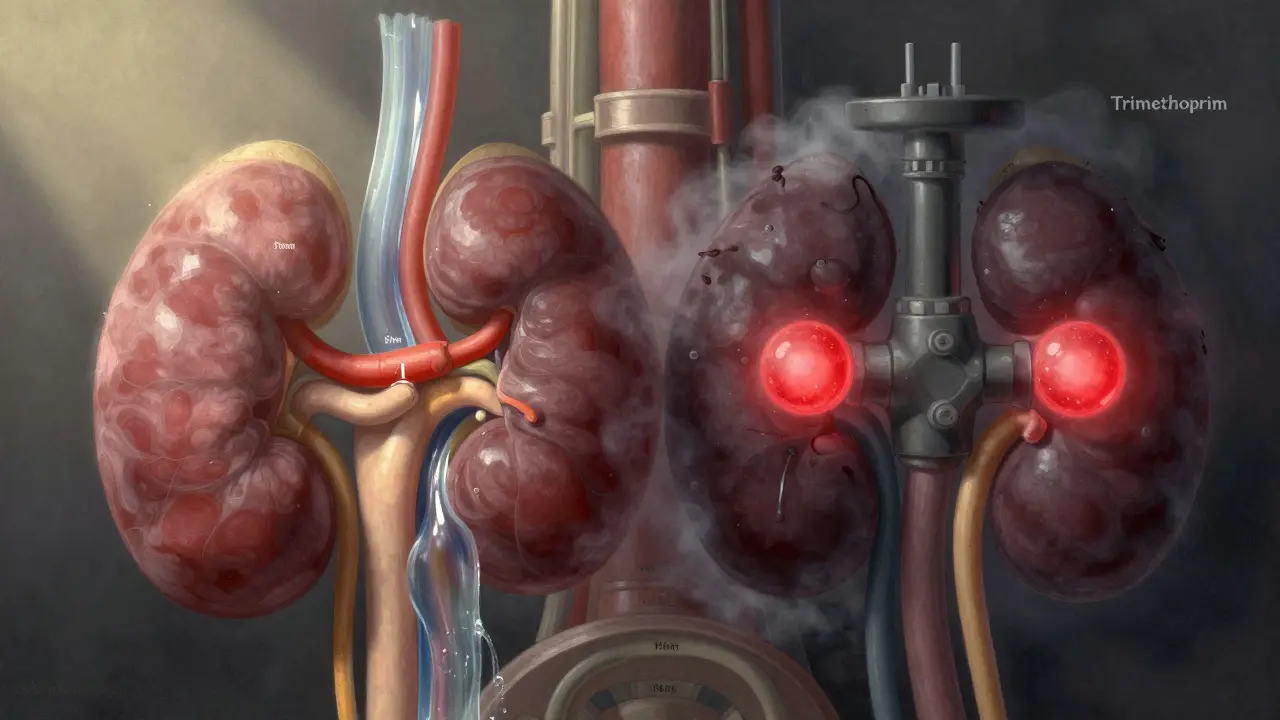
Your kidneys normally keep potassium in check by flushing out the extra through urine. Trimethoprim messes with that system. It blocks tiny channels in the kidney tubules called ENaC channels. These channels help move sodium into the bloodstream, and when sodium moves, it pulls potassium out with it. Block those channels, and potassium stays trapped in your blood.
It’s not complicated. Think of it like a clogged drain. Your kidneys are trying to flush potassium out, but trimethoprim shuts the valve. The result? Potassium builds up. Within 48 to 72 hours of starting the drug, levels can jump by 0.5 to 1.5 mmol/L. That might not sound like much - until you realize the normal range is 3.5 to 5.0 mmol/L. A level above 6.0 is a medical emergency. Above 7.0? That’s cardiac arrest territory.
What makes this even scarier is that trimethoprim concentrates in the kidneys 10 to 50 times higher than in your blood. So even a small dose can have a big effect where it matters most.
Who’s at Highest Risk?
This isn’t a risk for everyone. But if you fit into one of these groups, you’re playing with fire:
- Patients over 65
- Those with chronic kidney disease (eGFR under 60 mL/min)
- People taking ACE inhibitors (like lisinopril) or ARBs (like losartan)
- Anyone already on potassium-sparing diuretics (spironolactone, eplerenone)
- Diabetics with kidney damage
A 2014 study in JAMA Internal Medicine looked at over 4,000 hospital admissions for high potassium. They found that if you’re on an ACE inhibitor or ARB, taking trimethoprim raises your risk of hyperkalemia hospitalization by more than six times compared to amoxicillin. That’s not a small increase. That’s a red flag.
And it gets worse. A 2020 study found that in patients with diabetes, kidney disease, and an ACE inhibitor all at once, nearly one in three developed dangerous hyperkalemia after just a few days of trimethoprim. Meanwhile, the control group - same patients but on a different antibiotic - had only a 4% risk.
Real Cases, Real Consequences
In 2023, a case report described an 80-year-old woman in Japan. She had no kidney problems. Her creatinine was normal. She was on Bactrim for pneumonia prevention. Three days later, her potassium hit 7.8 mmol/L. She went into cardiac arrest. She survived - barely.
On Reddit, doctors share stories. One wrote: “72-year-old woman on lisinopril. Took Bactrim for UTI. Potassium 6.8. Needed emergency dialysis.” Another said: “I’ve reviewed 200 prescriptions. Only 15% had potassium over 5.5. But those 15%? All got better once we stopped the drug.”
The FDA’s own database recorded 1,247 cases of trimethoprim-related hyperkalemia between 2010 and 2020. Forty-three of them were fatal. Sixty-eight percent of those deaths were in people over 65.
These aren’t outliers. They’re predictable. And they’re preventable.
Why This Keeps Happening
Despite clear evidence since the 1980s, trimethoprim remains one of the top three most prescribed antibiotics in the U.S. - over 14 million prescriptions a year. Nearly 30% of those go to people over 65. That’s 4.2 million high-risk prescriptions annually.
Why? Because it works. It’s cheap. It’s familiar. And many doctors don’t realize how dangerous it can be.
A 2023 survey found that only 41.7% of primary care doctors check potassium before prescribing trimethoprim to patients on ACE inhibitors. Emergency medicine doctors? Only 32.4%. Nephrologists? Nearly 90%. That gap isn’t ignorance - it’s habit.
Even the FDA only added hyperkalemia to trimethoprim’s boxed warning in 2019 - and even then, it focused mostly on patients with kidney disease. It didn’t address the bigger problem: people with normal kidneys who are on blood pressure meds.

What Should You Do?
If you’re prescribed trimethoprim, here’s what you need to know:
- Ask if your potassium has been checked recently. If you’re on an ACE inhibitor or ARB, you need a blood test before the first dose.
- Get a repeat test in 48 to 72 hours. That’s when potassium peaks. Waiting a week is too late.
- If your potassium is over 5.0 mmol/L, don’t take it. The American Geriatrics Society says avoid trimethoprim entirely in people over 65 on these drugs.
- Ask for an alternative. Nitrofurantoin is just as effective for urinary infections and carries no hyperkalemia risk.
- Watch for symptoms. Muscle weakness, irregular heartbeat, fatigue, nausea. These can be subtle - but they’re your body screaming.
Electronic alerts in hospitals have cut hyperkalemia cases by over half. That’s proof that simple systems work. But outside hospitals? It’s still a gamble.
The Bottom Line
Trimethoprim isn’t evil. It saves lives - especially in people with weakened immune systems. But it’s not harmless. It’s a hidden potassium trap.
If you’re healthy, under 65, with normal kidneys and no blood pressure meds, the risk is low. But if you’re over 65, have kidney trouble, or take lisinopril, losartan, or similar drugs - this is a conversation you need to have with your doctor before you take the first pill.
Don’t assume it’s safe because it’s common. Don’t trust it because it’s cheap. Ask for the numbers. Demand the test. Push for an alternative. Your heart might depend on it.
Michelle Jackson
March 18, 2026 AT 15:56And don't get me started on how pharmacies still print Bactrim labels like it's harmless. No warning. No footnote. Just 'take twice daily.'
Suchi G.
March 18, 2026 AT 20:16becca roberts
March 19, 2026 AT 02:19Let me guess - next they'll tell us that aspirin secretly turns your spleen into a tiny drum set.
Just kidding. Sort of. This is terrifying. But also, why is this not on every prescription bottle? Like, a big red sticker: 'DO NOT TAKE IF YOU'RE ON BP MEDS OR OVER 65. ALSO, YOU'RE PROBABLY ALREADY DEAD.'
Andrew Muchmore
March 20, 2026 AT 06:55Stop pretending this is complicated. It's not. It's basic.
David Robinson
March 20, 2026 AT 15:12It's not ignorance. It's negligence dressed up as convenience.
Jeremy Van Veelen
March 21, 2026 AT 16:13Trimethoprim isn't just dangerous - it's a symbol of medical complacency. We treat antibiotics like candy, not pharmacological landmines. And the FDA? They added a warning in 2019. Like that fixes anything. It's like slapping a 'Wet Floor' sign on a tsunami.
jerome Reverdy
March 22, 2026 AT 13:38The problem isn't the drug. It's the culture. We're trained to treat symptoms, not systems. We don't ask about meds. We don't check labs. We just write scripts.
And then we wonder why people die.
Andrew Mamone
March 23, 2026 AT 16:58Imagine if every time someone got prescribed Bactrim, their phone popped up with a 10-second video: 'Your potassium could spike in 48 hours. Ask for a blood test.'
That’s not overkill. That’s basic care. We do this for opioids. We do this for blood thinners. Why not this?
It’s not hard. It’s just ignored.
Prathamesh Ghodke
March 23, 2026 AT 19:02One of my patients, 72, had a potassium spike after Bactrim. He was fine. But his wife? She stopped trusting doctors for a year. That's the real cost.
Stephen Habegger
March 24, 2026 AT 01:10Simple fix. Why isn’t everyone doing it?
Justin Archuletta
March 25, 2026 AT 11:33My potassium was 5.2. I didn't feel a thing.
So... what now?
Kendrick Heyward
March 26, 2026 AT 12:42It's not an accident. It's policy.
And you? You're just a number in their database.
lawanna major
March 27, 2026 AT 07:08We hand out prescriptions like coupons and expect patients to self-diagnose risk. We don’t educate. We don’t warn. We just prescribe.
And then we’re shocked when people suffer.
This isn’t about trimethoprim. It’s about how broken our relationship with medicine has become.
Kal Lambert
March 29, 2026 AT 05:38Trimethoprim isn’t the villain. The system is.
We need mandatory potassium checks before prescribing it to anyone on RAAS blockers. Period.
It’s not expensive. It’s not complicated. It’s just not mandatory.
And that’s the real tragedy.
Michelle Jackson
March 29, 2026 AT 12:20That’s not a side effect. That’s a massacre.