
When your kidneys aren’t working right, what you eat isn’t just about comfort or preference-it’s about survival. For people living with chronic kidney disease (CKD), protein intake isn’t a one-size-fits-all number. Too much can speed up kidney damage. Too little can leave you weak, hungry, and at risk for muscle loss. The truth? Protein targets for CKD stages aren’t just guidelines-they’re personal prescriptions, shaped by your stage of disease, age, weight, and even what kind of protein you’re eating.
What Protein Does (and Doesn’t Do) in Kidney Disease
Your kidneys filter waste from your blood. When you eat protein, your body breaks it down into urea and other nitrogen-based waste. Healthy kidneys handle this easily. But when kidney function drops, these wastes pile up. That’s why cutting protein has been a go-to strategy for decades. But it’s not as simple as eating less meat.
Research from the 1994 MDRD Study and updated in 2023 by the National Kidney Foundation shows that keeping protein intake in the right range can slow the decline of kidney function. It may delay the need for dialysis by up to a year. But here’s the catch: protein restriction only works if you’re still getting enough calories and nutrients. Otherwise, you risk protein-energy wasting-a dangerous condition that affects nearly half of people with stage 3b-5 CKD.
Protein Targets by CKD Stage
Not all CKD is the same. Your protein needs change as your kidneys decline. The Kidney Disease Outcomes Quality Initiative (KDOQI) and Kidney Health Initiative (KHI) set clear ranges based on your glomerular filtration rate (GFR):
- CKD Stage 1-2 (GFR ≥60): Aim for 0.8 grams per kilogram of ideal body weight. For a 150-pound person, that’s about 54 grams daily. This isn’t a strict limit-it’s a cap. If you’re healthy otherwise, you don’t need to cut below this. But going over 1.3 grams/kg/day may increase long-term risk.
- CKD Stage 3a-3b (GFR 30-59): Drop to 0.6-0.8 g/kg/day. This is where most people start seeing real benefits from careful protein control. A 150-pound person should aim for 40-54 grams daily.
- CKD Stage 4 (GFR 15-29): Stick to 0.55-0.60 g/kg/day. That’s roughly 35-45 grams for someone of average weight. At this stage, high-quality protein becomes critical-half your daily protein should come from sources like eggs, milk, chicken, fish, or soy.
- CKD Stage 5 (GFR <15): If you’re not on dialysis yet, stay at 0.6 g/kg/day. Once dialysis starts, protein needs jump back up to 1.0-1.2 g/kg/day because dialysis removes protein from your blood.
These numbers aren’t guesses. They’re backed by the 2022 Cochrane Review, which found that sticking to 0.6-0.8 g/kg/day cut the risk of reaching end-stage renal disease by 31% over two to four years. But adherence? Only 58% of patients stick to it long-term.
Animal vs. Plant Protein: The Real Difference
Not all protein is created equal-especially for your kidneys.
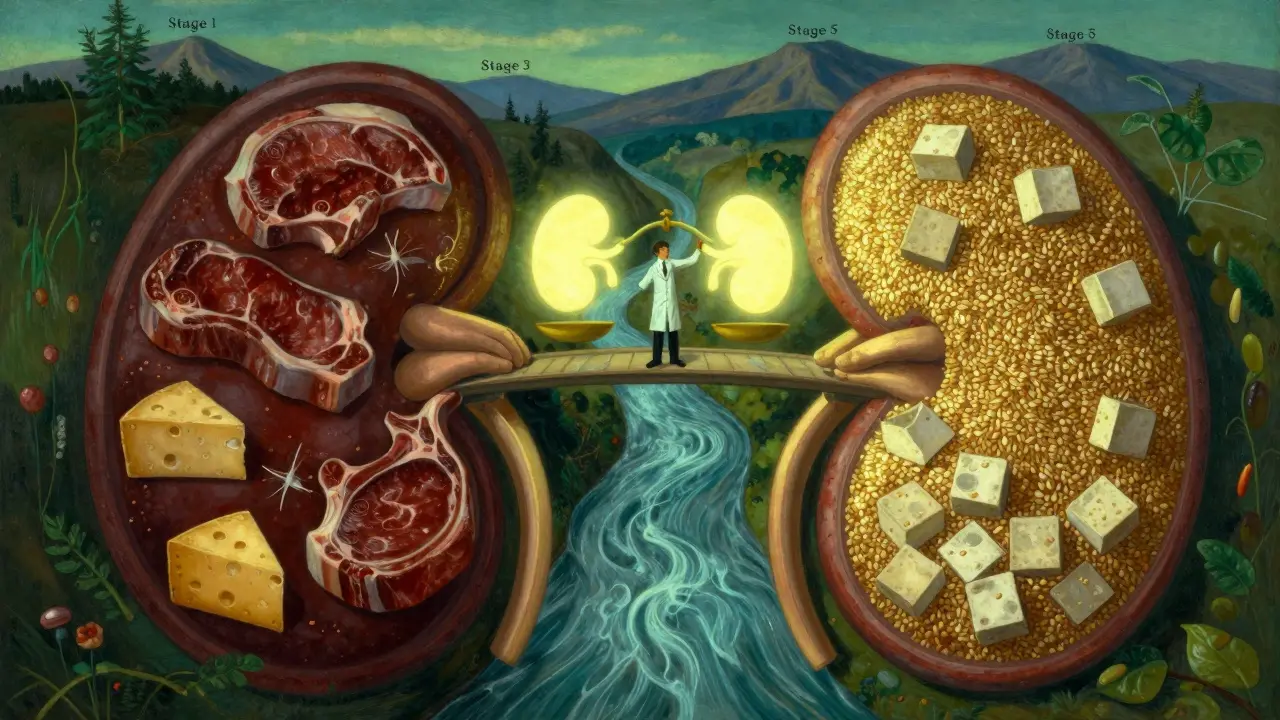
Animal proteins (meat, dairy, eggs) are complete-they contain all nine essential amino acids. But they also produce more urea and phosphate per gram. Red meat, in particular, generates up to 50% more advanced glycation end products (AGEs), which trigger inflammation and oxidative stress in already damaged kidneys.
Plant proteins (beans, lentils, tofu, nuts) are lower in these harmful byproducts. A 2021 meta-analysis in the Clinical Journal of the American Society of Nephrology found that swapping just 30% of animal protein for plant protein cut CKD progression risk by 14% and lowered death risk by 11%. That’s huge.
But here’s the trade-off: plant proteins are often low in lysine and methionine-the amino acids your body can’t make. If you go all-plant, you need to combine foods smartly. A bowl of rice and beans? Good. Just beans? Not enough.
And there’s another problem: potassium. Many plant proteins are high in potassium. For someone in stage 4 or 5 CKD, too much potassium can be dangerous. That’s why simply switching to vegan isn’t a fix-it’s a new challenge.

Special Cases: Diabetes, Older Adults, and Malnutrition
If you have both diabetes and CKD, your protein target isn’t the same as someone without diabetes. The American Diabetes Association recommends 0.8-0.9 g/kg/day to protect your kidneys without making blood sugar control harder.
For older adults (65+), the story gets even trickier. A 2024 JAMA Network Open study found that higher protein intake (up to 0.8 g/kg/day) was linked to lower death rates in this group. Why? Because many older CKD patients die from heart disease before their kidneys fail completely. Losing muscle mass from too-low protein can make falls, infections, and hospitalizations more likely.
And then there’s malnutrition. About 30-50% of people with stage 3-5 CKD develop protein-energy wasting. That means their body starts breaking down muscle for fuel. If you’re losing weight, feeling weak, or getting sick often, your protein target might need to go up-not down. This is why working with a renal dietitian isn’t optional-it’s essential.
How to Actually Do This: Real-World Tips
Knowing your target is one thing. Hitting it every day? That’s another.
Most people struggle with tracking protein in mixed dishes. One slice of pizza? Two eggs? A scoop of lentil soup? No one has a perfect mental database. That’s why apps like MyFitnessPal (with renal-specific food entries) or the National Kidney Foundation’s Protein Target Calculator app (downloaded over 47,800 times since 2023) are game-changers.
Meal prepping helps too. The Kidney Kitchen website-visited 1.2 million times a month-offers free, kidney-friendly recipes that balance protein, sodium, potassium, and phosphorus. Their meals are designed so you don’t have to guess.
Another tool gaining traction: keto acid analogues like Ketosteril. These are prescription supplements that let you reduce overall protein intake while still getting the amino acids your body needs. They’re prescribed to about 15% of stage 4-5 patients in Europe and are becoming more common in the U.S.
And if you’re feeling constantly hungry, weak, or isolated at meals-you’re not alone. A 2024 survey by the American Kidney Fund found that 74% of patients on low-protein diets felt hungry all the time. Sixty-two percent felt muscle weakness. Fifty-eight percent avoided social meals. But those working with a renal dietitian? 82% said their quality of life improved.
What’s Next: Personalized Protein
The future of renal nutrition isn’t about fixed numbers. It’s about personalization.
The American Society of Nephrology launched a machine learning algorithm in 2024 that predicts how your body responds to protein based on your genetics, urea levels, and eating habits. Meanwhile, the NIH-funded PRECISE-CKD trial is testing whether tailoring protein targets to your individual urea production rate works better than using your weight alone.
And researchers are developing new plant-based protein concentrates with potassium stripped out-so you get the benefits of plants without the potassium overload.
One thing’s clear: by 2030, kidney care won’t just ask, “How much protein?” It’ll ask, “What kind? For whom? And at what cost to your life?”
Final Takeaway: It’s Not About Deprivation
Renal nutrition isn’t about eating less. It’s about eating smarter.
For early-stage CKD, don’t panic. Stick close to 0.8 g/kg/day. Avoid processed meats and excessive dairy. Add more legumes, tofu, and whole grains-carefully.
For later stages, work with a dietitian. Use a protein tracker. Prioritize high-quality sources. Eat enough calories. If you’re losing weight, speak up-your protein target might need adjusting.
And if you feel like you’re missing out on meals with family? You’re not alone. But you don’t have to choose between your kidneys and your life. With the right plan, you can have both.
What happens if I eat too much protein with CKD?
Eating too much protein (over 1.3 g/kg/day) forces your kidneys to work harder to filter waste like urea and creatinine. This can speed up kidney damage over time. Studies show that consistently high protein intake in CKD stages 3-5 is linked to faster decline in glomerular filtration rate (GFR) and higher risk of reaching dialysis sooner. It also raises phosphate and acid levels in the blood, which can lead to bone loss and muscle wasting.
Can I follow a vegetarian or vegan diet with CKD?
Yes-but it requires careful planning. Plant proteins produce less waste and may slow kidney decline, but they’re often low in essential amino acids like lysine and methionine. You’ll need to combine sources (like rice + beans) and monitor potassium and phosphorus levels closely. Stage 4-5 patients on plant-based diets may need potassium binders or restricted portions of high-potassium foods like bananas, potatoes, and spinach. Always work with a renal dietitian to design a safe plan.
Why is protein target different for diabetics with CKD?
Diabetes and CKD together create a double burden. Too little protein can hurt blood sugar control by reducing muscle mass and insulin sensitivity. Too much can worsen kidney damage. The American Diabetes Association recommends 0.8-0.9 g/kg/day to balance both needs. This slight increase helps preserve muscle while still reducing kidney stress. It’s a tighter balance than in non-diabetic CKD, which is why personalized guidance is critical.
Do I need to take protein supplements?
Most people don’t. Whole foods are better. But if you’re struggling to meet your protein target without exceeding phosphorus or potassium limits, your doctor might prescribe keto acid analogues like Ketosteril. These supplements provide essential amino acids without the nitrogen waste. They’re not regular protein powders-they’re medical foods. Over-the-counter protein shakes often contain too much phosphorus and potassium and are unsafe for advanced CKD.
How often should I see a renal dietitian?
Start with a 60-90 minute initial consultation. Then, follow up every 4-6 weeks during early stages. If you’re in stage 4 or 5, or if your weight or lab values change, monthly visits are common. Medicare now covers 3 hours of initial counseling and 2 hours of follow-up each year for CKD patients, so cost shouldn’t be a barrier. Patients who see a renal dietitian regularly are 3.2 times more likely to stick to their plan and maintain better kidney function.
Is protein restriction right for everyone with CKD?
No. Protein restriction is most beneficial for people with moderate to advanced CKD (stages 3b-5) who aren’t on dialysis. But if you’re older, underweight, or losing muscle, higher protein may actually save your life. A 2024 JAMA study found that in adults over 65 with CKD, higher protein intake was linked to lower death rates. The goal isn’t a universal low number-it’s an individualized target based on your health, age, and goals.
Jeff Card
March 2, 2026 AT 14:45Also, plant proteins aren’t scary if you pair them right. Lentils + brown rice = complete. I do it every Sunday. Simple. No supplements. No stress.
Matt Alexander
March 4, 2026 AT 14:03marjorie arsenault
March 6, 2026 AT 12:06Deborah Dennis
March 6, 2026 AT 18:49Shivam Pawa
March 8, 2026 AT 00:32Diane Croft
March 8, 2026 AT 17:24tatiana verdesoto
March 9, 2026 AT 05:59Justin Rodriguez
March 9, 2026 AT 19:20