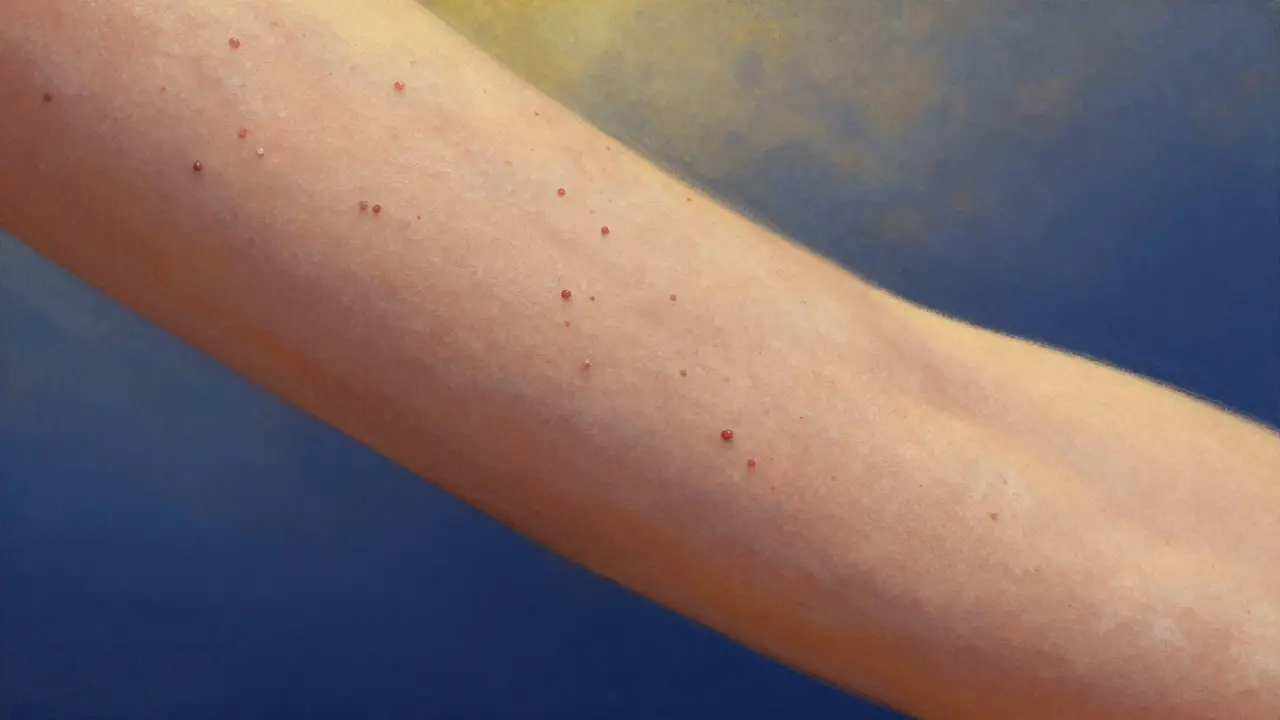
You know that feeling when you run your hand over your arm and it feels like sandpaper? Or maybe you've noticed tiny, stubborn red or brown bumps on your thighs that just won't go away no matter how much you scrub. If that sounds familiar, you're likely dealing with Keratosis Pilaris is a common, benign skin condition where keratin plugs block the hair follicles, creating rough, tiny bumps. Often called "chicken skin," it's not an infection or a disease, but it can definitely be a nuisance. The good news is that while there's no permanent cure, you can get your skin feeling significantly smoother with the right approach.
Quick Tips for Smoothing Your Skin
- Avoid harsh scrubs: Scrubbing doesn't clear the plugs; it just irritates the skin.
- Use chemical exfoliants: Look for ingredients like lactic acid or urea.
- Moisturize on damp skin: Apply lotion within three minutes of stepping out of the shower.
- Keep it cool: Use lukewarm water instead of steaming hot baths to prevent dryness.
- Humidify your home: Dry winter air makes bumps more prominent.
Why do these bumps happen?
To understand how to fix the bumps, we have to look at what's happening under the surface. Your skin produces a protein called keratin to protect itself. In people with Keratosis Pilaris, the body produces too much of it, or the skin doesn't shed it properly. Instead of sliding off, the keratin traps the hair follicle, creating a hard plug. This results in those 1-2 millimeter bumps that give your skin that rough texture.
For many of us, this is simply in the DNA. Research suggests a strong link to mutations in the filaggrin gene, which is responsible for maintaining the skin's barrier. If you have a family history of atopic eczema or ichthyosis, you're more likely to experience this. It's also incredibly common in teens and young adults, with some reports suggesting up to 70% of teenagers deal with it. For the lucky few, it often clears up on its own by age 30, but for others, it requires a bit more effort to manage.
The gold standard ingredients for smoothing
Since the problem is a "plug" of protein, the goal is to dissolve that plug without damaging the surrounding skin. You want ingredients that are both keratolytic (break down keratin) and humectant (pull moisture into the skin). Here are the heavy hitters:
| Ingredient | How it Works | Expected Result | Best For |
|---|---|---|---|
| Lactic Acid | Gently exfoliates and hydrates | 40-60% improvement in 4-6 weeks | General roughness and dry skin |
| Urea | Softens the keratin plug | 65% reduction in scaling in 8 weeks | Very thick, stubborn bumps |
| Glycolic Acid | Stronger chemical exfoliation | 30-50% smoothing in 12 weeks | Resistant cases (use with caution) |
| Tretinoin | Increases cell turnover | 70% improvement over 3-6 months | Prescription-level smoothing |
If you're just starting out, a 10-12% lactic acid lotion is usually the best bet. It's effective but generally gentler than glycolic acid. If your skin is exceptionally dry or the bumps feel "hard," a cream with 10-20% urea can help soften the skin so the exfoliants can actually penetrate the plug.
Building a daily routine that actually works
The biggest mistake people make is treating KP like a breakout. If you treat it like acne and use harsh scrubs or drying alcohols, you'll actually make the inflammation worse. Instead, think of it as a hydration and gentle peeling project. Here is the most effective way to structure your day:
- The Bath/Shower: Use lukewarm water. Hot water strips the natural oils from your skin, which triggers more keratin production and makes the bumps feel worse. Use a mild, fragrance-free cleanser.
- The Three-Minute Window: This is the secret. Your skin is 50% more permeable right after a shower. While your skin is still slightly damp, apply your active treatment (like a SA Lotion or lactic acid cream).
- The Seal: After your treatment has absorbed, follow up with a moisturizer containing ceramides. Ceramides act like the "glue" that holds your skin cells together, preventing moisture from escaping and keeping the skin barrier strong.
- Protection: If you're using retinoids or AHAs on your arms or face, you must use sunscreen. These ingredients make your skin more sensitive to the sun, and since KP often involves red bumps, UV exposure can make those red spots turn into permanent dark spots.

Managing the "Winter Flare" and other triggers
Have you noticed your skin gets way rougher in December than in July? You're not imagining it. Low humidity (typically below 40%) dries out the stratum corneum, making the keratin plugs more prominent. To fight this, try running a humidifier in your bedroom. Keeping the air moist can reduce winter flare-ups by as much as 60%.
Clothing choice also matters. Tight, synthetic fabrics like polyester can rub against the bumps, causing friction and inflammation. This can turn a few colorless bumps into an angry, red patch. Sticking to loose-fitting cotton clothing reduces this irritation significantly.
When to consider professional treatments
For some, over-the-counter lotions aren't enough. If you've tried the 12% lactic acid and urea creams for three months with no luck, it might be time to see a dermatologist. They can prescribe higher-strength retinoids, like 0.025% tretinoin, which force the skin to renew itself faster.
If the primary issue is the redness (erythema) rather than the texture, pulsed-dye laser therapy is an option. This targets the blood vessels in the skin to reduce the red color. While it can reduce redness by 50-75%, it's expensive and usually isn't covered by public health systems. It's a cosmetic choice, not a medical necessity.

Setting realistic expectations
Here is the truth that most skincare ads won't tell you: KP is a maintenance condition, not something you "cure." If you stop using your creams, the bumps will likely return within two to four weeks. This can be frustrating, but it's the nature of the condition. The goal isn't 100% porcelain skin-which is nearly impossible for most KP sufferers-but rather skin that feels smooth and looks blended.
Most people see a significant improvement in texture, even if a few bumps remain. Focus on consistency. Using a product once a week won't do anything; you need that daily application to keep the keratin from building back up.
Is keratosis pilaris contagious?
No, not at all. It is a genetic skin condition related to how your body produces keratin. You cannot catch it from someone else, and you cannot spread it to other people.
Can I scrub the bumps away with a loofah?
It's tempting, but don't do it. Aggressive physical exfoliation often causes inflammation and can lead to post-inflammatory hyperpigmentation (dark spots). Chemical exfoliants like lactic acid are much safer and more effective at dissolving the plug.
How long does it take to see results?
Patience is key. Lactic acid usually shows results in 4-6 weeks, while urea might take up to 8 weeks. Retinoids can take 3-6 months to show significant change. Stick with the routine for at least 12 weeks before deciding if a product works for you.
Does KP go away on its own?
For many people, yes. It often peaks during adolescence and naturally improves or disappears by the age of 30. However, for some adults, it persists and requires ongoing management.
Can diet affect these skin bumps?
There is no strong clinical evidence that diet causes or cures keratosis pilaris. Since it is primarily a genetic and structural issue with keratin, topical treatments are far more effective than dietary changes.
Next Steps for Your Skin Journey
If you're just starting, pick one active ingredient-like a lactic acid lotion-and commit to it for 8 weeks. If your skin feels too irritated, drop the frequency to every other day and increase your use of ceramide moisturizers. If you're dealing with extreme redness, consult a professional about laser options. Remember, the goal is comfortable, smoother skin, and consistency is your best tool for getting there.
Goodwin Colangelo
April 5, 2026 AT 04:40Lactic acid is definitely the way to go for most people starting out because it's way more forgiving than glycolic. I've seen a lot of people torch their skin barrier by jumping straight into high-strength acids without a slow ramp-up, so definitely stick to that three-minute window for moisturizing to keep things balanced.
Beth LeCours
April 5, 2026 AT 20:53Too much reading.
The Charlotte Moms Blog
April 6, 2026 AT 04:22This is completely reductive!!! Why isn't there a mention of organic alternatives??? Some of these chemicals are way too harsh for sensitive skin!!! Absolute failure in research!!!
Divine Manna
April 8, 2026 AT 03:48The failure of the modern individual is the desire for a quick fix over a systemic understanding of biological determinism. It is quite amusing that people believe a simple lotion can override a genetic mutation in the filaggrin gene, though the chemical approach is technically the only logical path for those lacking the discipline for holistic maintenance.
Lawrence Rimmer
April 8, 2026 AT 15:00Basically we're just paying companies to fight our own DNA forever. It's a racket. Why bother smoothing out bumps that don't even hurt? Existence is just a series of superficial fixes until the skin sags anyway.
angel sharma
April 10, 2026 AT 00:39You all need to realize that consistency is the absolute key to victory here because if you just put in the work every single day and stay disciplined with your routine you will see those results and feel amazing in your own skin and it is totally worth the effort to keep pushing forward until you hit that goal!
Rob Newton
April 11, 2026 AT 23:03Urea is overrated. Lactic is better.
simran kaur
April 13, 2026 AT 03:37It is so obvious they are pushing these specific acids because the pharmaceutical companies benefit from a maintenance condition that never actually goes away. They don't want you cured, they want you subscribing to a 12% lactic acid cream for the next forty years while they hide the actual natural remedies that would work in a week.
HARSH GUSANI
April 13, 2026 AT 09:11Indian oils work better than these western chemicals 🇮🇳🔥 Stop following these fake guides and use tradition! 🚩
Sakshi Mahant
April 15, 2026 AT 01:27Everyone has different skin types and cultural ways of handling this, so maybe we can just agree that both chemical and natural methods have their place depending on who is using them.
Dipankar Das
April 16, 2026 AT 14:17You must apply these treatments with absolute rigor and unwavering discipline or you are simply wasting your time and resources! Only those who are committed to a strict regimen will achieve the smoothness they desire!
Jenna Carpenter
April 17, 2026 AT 09:48Omg I tried the scrub thing and my arms look like a tomato now... pls tell me what to do for the rednes!!
Ace Kalagui
April 17, 2026 AT 21:18I've talked to so many people from different backgrounds who deal with this and the common thread is always just finding that one product that doesn't irritate your specific skin type, so just take your time and be gentle with yourself while you experiment with the options mentioned here because it really does get better for most of us if we just stay patient.
Hudson Nascimento Santos
April 18, 2026 AT 07:42There is a certain poetic irony in the fact that we spend our youth fighting the very textures that make us human, attempting to erase the biological markers of our lineage in pursuit of a sterilized ideal of beauty that doesn't actually exist in nature.