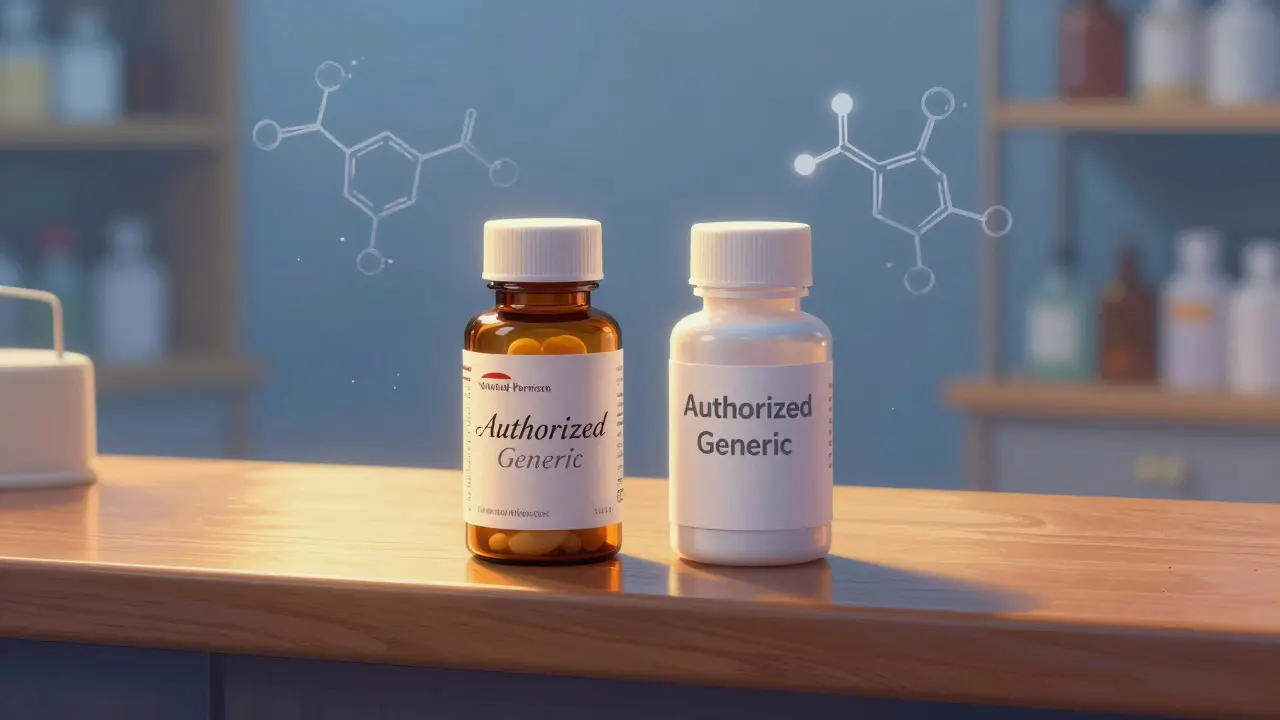
When you pick up a prescription, you might see two bottles on the counter: one with a familiar brand name, another with plain white labeling. The cheaper one says authorized generic on the box. You wonder: is this really the same drug? Or am I getting a cut-rate version that might not work as well?
The short answer? Yes, it’s the exact same drug. No tricks. No compromises. Authorized generics are brand-name medications sold without the brand name on the label. They come from the same factory, use the same ingredients, and follow the same manufacturing process. The only difference? The price.
What Exactly Is an Authorized Generic?
An authorized generic isn’t some knockoff made by a different company. It’s produced by the original brand manufacturer - the same company that makes the name-brand version. Think of it like a car maker selling the exact same model under a different badge. The engine, the seats, the suspension - all identical. You just don’t see the logo.
The U.S. Food and Drug Administration (FDA) defines it clearly: an authorized generic is an approved brand-name drug marketed without the brand name on its label. Everything else - active ingredients, inactive ingredients, strength, dosage form, and how it dissolves in your body - is identical. Even the manufacturing facility is the same. The FDA inspects these plants the same way they inspect brand-name production lines.
Unlike traditional generics, which must prove they’re bioequivalent through clinical studies, authorized generics skip that step entirely. Why? Because they’re not just similar - they’re the same product. They’re sold under the original brand’s New Drug Application (NDA), not the abbreviated application used by other generics. That’s why you won’t find them listed in the FDA’s Orange Book, which tracks traditional generics.
Why Do Authorized Generics Cost Less?
Price is the only real difference. Brand-name drugs often cost $100 or more for a 30-day supply. The authorized generic version? Often $10-$30 cheaper. That’s because the brand company is competing with itself. Once a patent expires, other companies can make traditional generics. To keep some market share, the original maker launches their own generic version - at a lower price.
It’s a smart business move. The brand company still profits, but now they’re undercutting the competition. That drives down prices across the board. Authorized generics usually cost 15-30% less than the brand name, but 10-20% more than traditional generics. Why the higher price? Because they’re still made by the original manufacturer, with the same overhead. But for patients, that’s still a big savings.
Are They Really as Safe and Effective?
Let’s cut through the noise. Yes, they’re just as safe. Just as effective.
A 2018 study tracked over 5,000 patients who switched from brand-name drugs to generics. Some switched to traditional generics. Others switched to authorized generics. The results? No meaningful difference in hospital visits, emergency room trips, or how often people stopped taking their meds. The only tiny bump? A slightly higher chance of ER visits for authorized generics - but researchers think that’s because of random noise in the data, not the drug itself.
Dr. Janet Woodcock, former head of the FDA’s drug division, put it plainly: “Authorized generics are the brand product without the brand name on the label - they are identical in every way.”
And it’s not just regulators saying this. The American College of Clinical Pharmacy confirms it. So do pharmacists. A 2022 survey found that 78% of independent pharmacists consider authorized generics interchangeable with brand-name drugs without needing a doctor’s approval. That’s because they are.

What About Side Effects or Tolerability?
This is where people get nervous. “I switched to a generic and felt weird.” That’s usually not the active ingredient. It’s the fillers - the inactive ingredients like dyes, binders, or coatings. Traditional generics can use different fillers than the brand name. For most people, that doesn’t matter. But for a small group - say, someone with a rare allergy or severe sensitivity - even a tiny change can cause issues.
Authorized generics don’t have that problem. They use the exact same inactive ingredients as the brand. If your body handled the brand name fine, you’ll handle the authorized generic the same way.
Real-world data backs this up. The Asthma and Allergy Foundation of America surveyed over 1,200 people who switched from Singulair (brand) to its authorized generic. 87% reported no change in effectiveness. Only 8% noticed minor differences - and those were tied to the pill’s shape or how the inhaler felt in their hand, not how the medicine worked.
GoodRx users gave authorized generics an average 4.6 out of 5 rating. 92% said they’d recommend them to a friend.
Why Do Pharmacists Sometimes Confuse Them?
Here’s the messy part: confusion at the pharmacy.
Many pharmacists aren’t trained to spot the difference between authorized generics and traditional generics. They see “generic” and assume it’s the same category. But an authorized generic isn’t just another generic - it’s the brand version in disguise.
On Reddit’s r/pharmacy, users reported cases where pharmacists told them, “This isn’t the same as your brand.” That’s wrong. It is the same. The pharmacist just didn’t know.
That’s why it’s smart to ask: “Is this an authorized generic?” If the answer is yes, you can be confident. If it’s not, and you’re sensitive to fillers, you might want to stick with the brand or ask for the authorized version.
How Common Are They?
They’re growing fast. In 2022, there were 387 authorized generic products on the U.S. market. That’s up from just a handful in the early 2000s. About 68% of top-selling brand-name drugs launch an authorized generic within six months of their patent expiring.
Why? Because it works. Brand companies use them to stay competitive. They keep patients loyal while undercutting cheaper generics. The U.S. market for authorized generics hit $18.7 billion in 2022 - and it’s growing at nearly 10% a year.
They’re especially common for high-cost drugs: cholesterol meds, asthma inhalers, diabetes pills, antidepressants. If you’re taking one of those, check your prescription. You might be paying more than you need to.
What About Insurance and Copays?
Most insurance plans treat authorized generics the same as traditional generics. That means lower copays - often $5-$15 instead of $40-$60 for the brand. Some plans even push them as preferred options.
A Kaiser Permanente study of over 8,000 patients found that people on authorized generics had slightly higher adherence rates than those on brand-name drugs. Why? Probably because they were cheaper. People stick with meds when they don’t have to choose between medicine and groceries.
Is There Any Risk?
Not in the drug itself. The FDA requires the same quality controls. The same batch tracking. The same safety monitoring. If there’s a problem with a brand-name drug, the authorized generic is pulled too - because it’s the same product.
The only real risk? Confusion. If you’re switched from brand to traditional generic without knowing, and you’re sensitive to fillers, you might feel off. But that’s not a flaw in authorized generics - it’s a flaw in how the system handles substitutions.
Bottom line: if you want the exact same drug as the brand, but at a lower price, authorized generics are your best bet. No guesswork. No compromise.
How to Spot an Authorized Generic
Look at the label. If it says “Manufactured for [Brand Name]” or “Distributed by [Brand Company]”, it’s likely an authorized generic. You can also ask your pharmacist: “Is this made by the same company as the brand?” If yes, you’ve got it.
Some apps like GoodRx or SingleCare show whether a generic is authorized. You can also check the FDA’s website - though it’s not always easy to navigate.
Don’t assume all generics are the same. Ask. It’s worth it.
Jennifer Taylor
December 15, 2025 AT 01:30Okay but what if the FDA is just lying to us? 😈 I read somewhere that the same factory that makes the brand also makes the generic for the government’s secret bio-weapons program. I mean, why else would they let the same plant do both? It’s too convenient. And don’t even get me started on the fillers-they’re probably laced with microchips to track our medication compliance. I switched to the generic and my cat started staring at me differently. Coincidence? I think not. 🧪👁️
Shelby Ume
December 15, 2025 AT 08:20It’s important to recognize that authorized generics are not just a cost-saving measure-they’re a public health win. The regulatory framework ensuring their equivalence is robust, and the data consistently supports their safety and efficacy. For patients navigating financial hardship, this option can mean the difference between adherence and abandonment of critical therapy. Let’s not let misinformation erode trust in a system that’s designed to protect us.
Jade Hovet
December 15, 2025 AT 13:41OMG I JUST SWITCHED TO AN AUTHORIZED GENERIC FOR MY ANTIDEPRESSANTS AND I FEEL SO MUCH BETTER?? 😭💖 Like, I didn’t even know this was a thing!! My pharmacist didn’t even tell me, but I checked the label and it said ‘Manufactured by Pfizer’-SAME AS THE BRAND!! I’m crying happy tears!! 💕💊 If you’re on meds and not asking about this, you’re leaving money on the table AND your mental health might be suffering!! GO CHECK YOUR PRESCRIPTION RIGHT NOW!! 🚨✨
nithin Kuntumadugu
December 16, 2025 AT 18:52lol u think this is about health? nah. this is corporate manipulation 101. brand companies create 'authorized generics' to trick you into thinking you're saving money while they still control the market. they're not cheaper because they're better-they're cheaper because they're the ONLY option left after they bought out all the real competitors. and the FDA? totally in the pocket. they don't even list these in the orange book because they don't want you to know they're just rebranding the same pill. 🤡💸
John Fred
December 17, 2025 AT 03:20Big win for patient access here. Authorized generics = identical pharmacokinetics + lower copay = higher adherence. We’re talking about chronic meds-diabetes, hypertension, asthma-where consistency matters more than branding. The bioequivalence isn’t even the question; it’s the *identical* formulation. No need for AB ratings when it’s literally the same molecule, same excipients, same batch line. If your pharmacist says it’s ‘just another generic,’ educate them. Or better yet, ask for the NDA product by name. 📊💊
Harriet Wollaston
December 17, 2025 AT 22:29I used to be super skeptical too-until my mom’s blood pressure med switched and her numbers stabilized and she didn’t have to skip doses to afford groceries. I think we forget how much stress cost adds. This isn’t just about chemistry-it’s about dignity. Being able to take your medicine without choosing between it and your kid’s school lunch? That’s the real win. 💛
Lauren Scrima
December 18, 2025 AT 11:32So… you’re telling me the $50 bottle and the $15 bottle are the same? 🤔 Wow. And I thought my pharmacist was just bad at math. Guess I’ve been overpaying for branding my whole life. Thanks, capitalism. 😏
Tyrone Marshall
December 19, 2025 AT 02:45There’s a deeper truth here: we’ve been trained to equate price with value, and brand with quality. But medicine isn’t fashion. The pill doesn’t care if it has a logo on it. The body responds to chemistry, not marketing. Maybe the real question isn’t whether authorized generics work-but why we ever believed the brand name was anything more than a label. We’ve outsourced trust to corporations and then wonder why we feel betrayed when the system fails us. The authorized generic is a quiet rebellion against that. It says: you don’t need the story. Just the science.
Emily Haworth
December 20, 2025 AT 19:30Wait wait wait-so if they’re the SAME, why does my insurance ONLY cover the $15 one? 😳 And why did my doctor never tell me? I think they’re hiding this from us on purpose. I’m gonna start a petition. This is a conspiracy. Someone’s making money off our ignorance. I found a Reddit thread where someone said the FDA gets kickbacks from big pharma. I’m not saying it’s true… but I’m not saying it’s NOT true. 🤫👁️