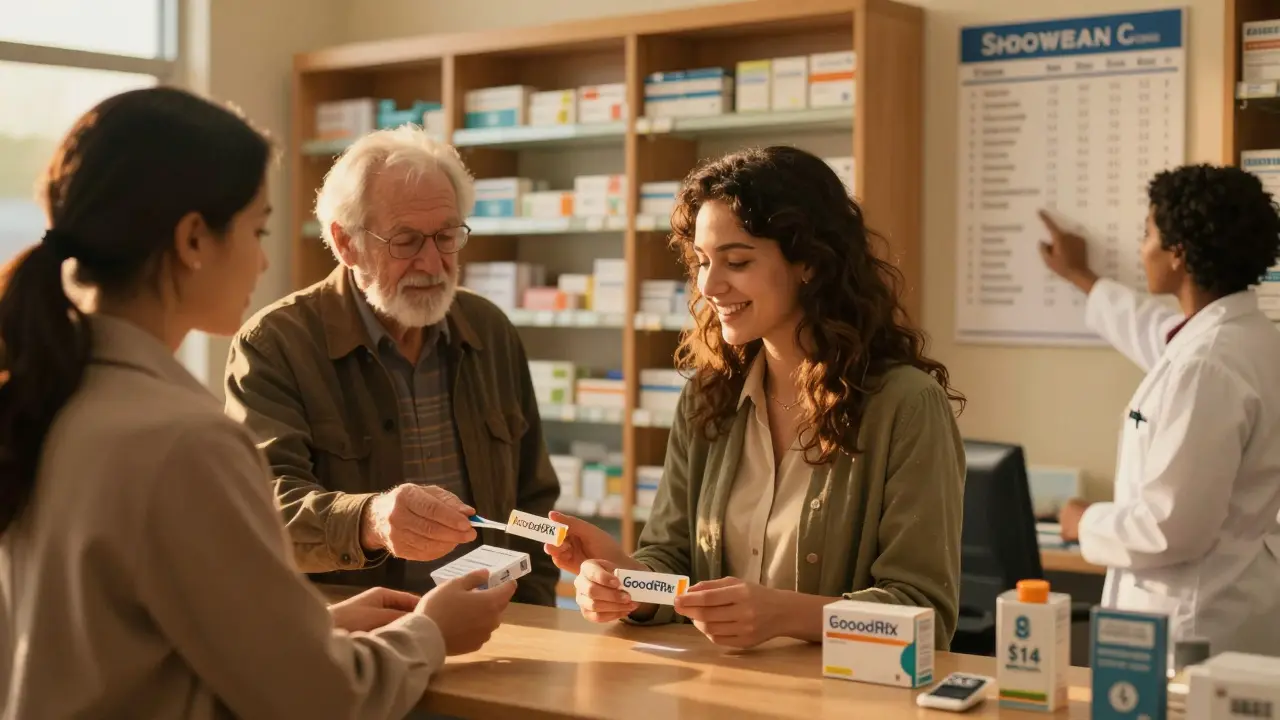
When you pick up your prescription and the pharmacist says, "That’ll be $185," you might feel like you’re being asked to pay for a small car. But then they hand you a coupon or a discount card and say, "Try this instead." Suddenly, the price drops to $45. It feels like magic. But is it real? Do prescription discount programs and coupons actually work - or are they just a clever trick that shifts the cost elsewhere?
How These Programs Really Work
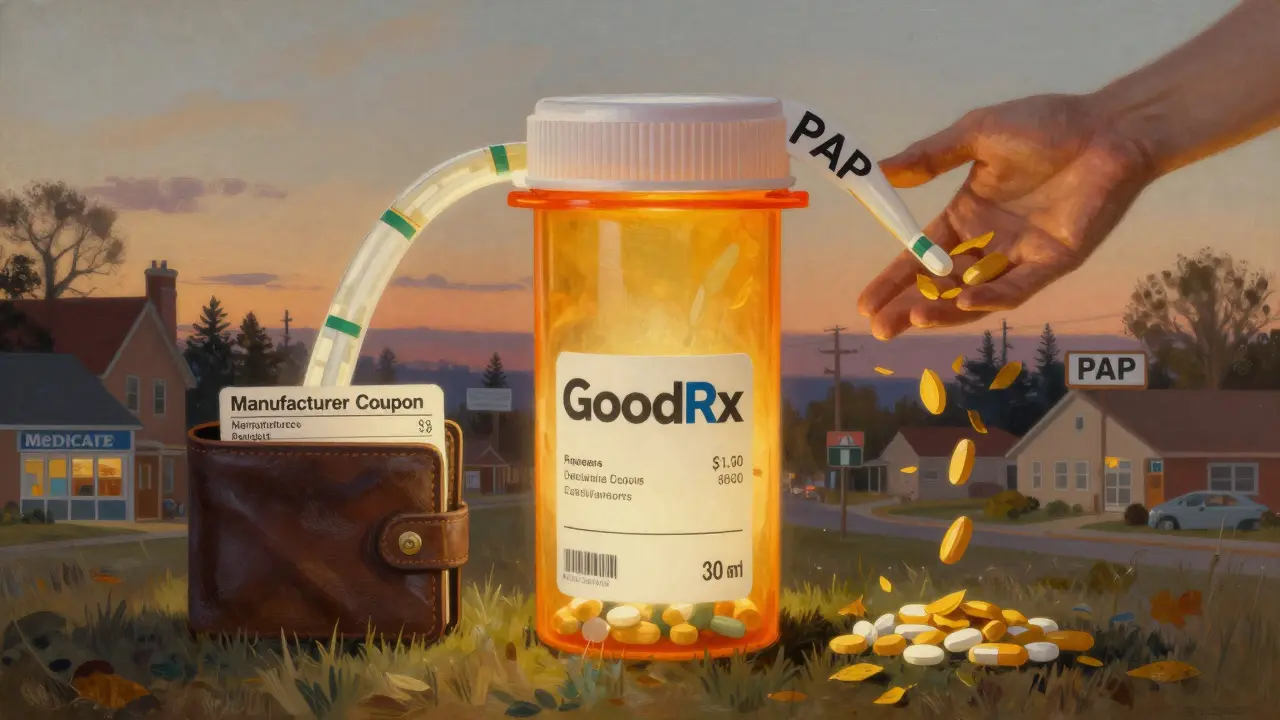
There are three main types of prescription savings tools you’ll run into: manufacturer coupons, third-party discount cards like GoodRx, and prescription assistance programs (PAPs). Each works differently, and none of them are the same as insurance.Manufacturer coupons come from drug companies. They’re meant to lower your out-of-pocket cost at the pharmacy - but they don’t lower the actual price of the drug. Instead, the company pays the pharmacy back after you buy it. This keeps the list price high, which can inflate costs for everyone else on insurance. These coupons are usually only available for brand-name drugs, and they often require you to sign up on the manufacturer’s website, print or download a code, and present it at the pharmacy.
Third-party discount cards - like GoodRx, Blink Health, and SingleCare - are different. These companies negotiate prices directly with pharmacies. They don’t deal with insurance. Instead, they offer cash prices that are often lower than what insurance pays. For generics, these discounts can be huge. One 2022 study found that a 90-day supply of a common heart medication dropped from $52.80 to just $18.60 using a discount card. But for brand-name drugs? The savings shrink. In the same study, a four-drug heart failure regimen went from $1,300.50 to $1,212.46 - barely a $90 cut.
PAPs are the quiet heroes. Run by clinics, nonprofits, or drug manufacturers, they give free medications to people who qualify based on income. A Tennessee free clinic found that over 13 months, they saved patients an average of $3,649 each on 23 different medications. No coupon needed. No insurance. Just direct help.
Who Saves the Most?
The truth? Not everyone saves the same. Your savings depend on three things: the type of drug, your insurance, and which program you use.If you’re taking a generic drug - like metformin for diabetes or lisinopril for blood pressure - a discount card can cut your cost by 60% or more. One Reddit user, u/MedSaver2023, saved $47.83 on a 90-day supply of metformin using GoodRx, even though their insurance copay was higher.
But if you’re on a brand-name drug - like Lyrica for nerve pain - the savings are often tiny. Another Reddit user, u/ChronicPainPatient, used a coupon and saved just $1.20. That’s because manufacturers rarely offer deep discounts on their own drugs. Why? Because they don’t need to. They’re the only ones making it.
Insurance matters too. If you’re on Medicare Part D, you can’t use manufacturer coupons unless your plan allows it. In fact, the rules say these coupons don’t count toward your deductible or out-of-pocket maximum. That means you might use a coupon and still be stuck paying more later. A 2024 JAMA study found that nearly half of seniors saved more than $5 per prescription using discount cards - but only if they were using generics.
Uninsured patients benefit the most from PAPs. But applying takes time. You need paperwork, proof of income, and sometimes a doctor’s signature. It’s not quick. But if you qualify, it’s free medicine.
The Hidden Costs
Here’s where things get messy. Discount programs don’t just save you money - they change how the whole system works.Manufacturer coupons encourage people to stick with expensive brand-name drugs instead of switching to cheaper generics. A 2024 study showed coupon use increased brand-name drug demand by 60% or more. That means fewer people use generics - and the overall cost of healthcare goes up. The Congressional Budget Office estimates these coupons could add $2.7 billion to Medicare spending each year.
Pharmacists get confused too. One in four users reported pharmacists didn’t know how to process their discount card. Some pharmacies refuse to accept certain coupons. Others charge extra fees. One user on Consumer Affairs said they had to visit three pharmacies before finding one that honored the card.
And then there’s the insurance loophole. If your plan has a high deductible, using a coupon might mean you’re not making progress toward your out-of-pocket maximum. That could leave you paying more later in the year. A Blue Cross Blue Shield analysis found that 54% of people who abandoned prescriptions due to cost later used discount cards - but only after realizing their insurance wasn’t helping.
Real Savings in Real Life
Let’s look at what actually happened to people who tried these programs.GoodRx has a 4.3/5 rating on Trustpilot. People love the app. Easy to use. Shows prices at nearby pharmacies. But 37% of negative reviews say the prices change between the time they check online and when they get to the pharmacy. One user said they saved $22 on a prescription one day - and the next day, the same drug at the same pharmacy cost $38.
At the same time, a 2024 study found that patients who got financial help - whether through coupons or PAPs - improved their medication adherence from 48.5% to 72.7%. That’s not just money saved. That’s fewer hospital visits. Fewer ER trips. Fewer complications.
One man in Ohio, on a fixed income, was skipping his blood pressure pills because they cost $110 per month. He found a PAP. Now he gets them free. His BP is stable. His doctor says he’s lucky.
Another woman in Alabama used GoodRx to cut her statin cost from $67 to $14. She told her sister. Her sister did the same. Now they both take their meds. They didn’t need insurance. Just a phone.
What Should You Do?
Here’s how to make these programs work for you:- Check your insurance first. Call your pharmacy and ask: "What’s my copay for this drug?" Then, check GoodRx or another discount card. If the card price is lower, use it.
- For generics, always compare. A 2022 study showed 65% average savings on generics. That’s not small change. That’s groceries.
- For brand-name drugs, ask about PAPs. Go to NeedyMeds.org or the drug manufacturer’s website. Fill out the application. It takes 15 minutes. You might get free medicine.
- Don’t assume coupons are always better. If you’re on Medicare, some coupons don’t count toward your out-of-pocket limit. Ask your pharmacist.
- Use the app. GoodRx, SingleCare, and Blink Health all have apps. Set up alerts. Compare prices before you leave home.
And if you’re still confused? Talk to your pharmacist. They’re not salespeople. They’re the ones who know the prices, the rules, and the loopholes.
What’s Changing in 2026?
The Inflation Reduction Act is starting to change the game. Starting in 2025, Medicare Part D will cap out-of-pocket drug costs at $2,000 a year. That means fewer seniors will need coupons. But for the 30 million Americans without insurance? They’re still on their own.Meanwhile, the FTC is investigating whether manufacturer coupons are anti-competitive. If they’re found to inflate prices, the rules could change. Some states are already setting up prescription affordability boards to force drugmakers to lower prices.
The future? Programs that work with insurance - not against it. AI tools that compare your insurance plan with discount cards in real time. Telehealth apps that offer coupons right after your virtual visit. But for now? You’ve got to be the one to do the math.
Do prescription discount cards work better than insurance?
Sometimes. For generic drugs, discount cards like GoodRx often offer lower prices than insurance copays - especially if you’re on a high-deductible plan. But for brand-name drugs or if you’ve already met your deductible, insurance may be cheaper. Always compare the cash price from a discount card with your insurance copay before paying.
Can I use a manufacturer coupon with Medicare?
Generally, no. Medicare Part D rules prevent you from using manufacturer coupons to reduce your out-of-pocket costs. Even if the pharmacy accepts the coupon, it won’t count toward your deductible or catastrophic coverage. Some plans allow it with prior authorization, but it’s rare. Check with your plan first.
Why do prices change between pharmacies for the same discount card?
Because pharmacies negotiate different cash prices with discount card companies. A drug might cost $15 at CVS, $12 at Walgreens, and $22 at a small independent pharmacy. The discount card shows you the lowest price - but it doesn’t guarantee it’ll be available when you arrive. Always call ahead.
Are prescription discount programs legal?
Yes. All major programs like GoodRx, Blink Health, and PAPs are legal. However, manufacturer coupons are under scrutiny by the FTC and Congress because they may encourage higher drug spending. As long as you’re not falsifying documents or using someone else’s card, using these programs is perfectly allowed.
Can I use a discount card if I have Medicaid?
Usually not. Medicaid already negotiates very low prices with pharmacies. In most cases, using a discount card will cost more than your Medicaid copay. Some states allow it if the card price is lower - but it’s rare. Always check with your Medicaid office or pharmacist before using one.
Pat Fur
March 22, 2026 AT 23:37Just used GoodRx for my metformin-$12 instead of $48 with insurance. Wild how a phone app can outsmart a whole system.
Now I tell everyone I know. No magic, just math.
Anil Arekar
March 23, 2026 AT 08:08It is with profound respect for the complexity of pharmaceutical economics that I observe the utility of discount programs, particularly for those without access to comprehensive health coverage.
While the system remains imperfect, the agency afforded to individuals through these tools is both commendable and necessary.
Elaine Parra
March 24, 2026 AT 14:07Stop pretending these coupons are ‘helping.’ They’re a corporate smokescreen. Drug companies set prices sky-high on purpose, then offer ‘discounts’ to keep you hooked.
It’s not saving you money-it’s making you pay more later. Medicare’s getting robbed, and you’re the patsy.
And don’t even get me started on GoodRx-pharmacies hate them because they’re forced to sell at a loss. Who pays? You do, in higher premiums.
Natasha Rodríguez Lara
March 25, 2026 AT 00:57I’ve been using PAPs for my insulin since 2020. It changed my life.
Applying was a nightmare-two weeks of paperwork, calls to my doctor, waiting for faxed forms.
But now? Free. Every month.
And I’ve started helping others fill out the forms. It’s not glamorous, but it works.
Someone should make a simple app for this. Seriously.
Why does it still take 17 steps to get life-saving medicine?
Also-have you tried NeedyMeds? It’s clunky but goldmine.
Caroline Bonner
March 26, 2026 AT 02:28Oh my goodness, I just had to comment because this is so important, and I feel like nobody is talking about how these programs are actually helping people who are just trying to survive, you know? Like, I’m a single mom, and my statin was $72, and I found it for $11 on GoodRx, and I cried, honestly, I cried, because I was going to skip doses, and now I’m not, and my cholesterol is down, and I feel like I’m doing something right for my kids, and I just want to say thank you to whoever wrote this because it’s not just about money, it’s about dignity, and I think we forget that, and also, I told my sister, and she did the same thing, and now we both take our meds, and we’re talking about it at family dinner, and it’s like, wow, this is what community looks like, right? And I think we need more of this, not less, and I hope more people know about this, because honestly, if you’re not using these tools, you’re leaving money on the table, and your health, and your peace of mind, and I just… I’m so glad this exists.
peter vencken
March 27, 2026 AT 23:32goodrx saved me on my zoloft-$13 vs $85 with insurance. crazy right?
pharmacist was like ‘uhhh we dont usually take this’ but then did it anyway.
also, if you got medicaid, dont bother. they already got the lowest price.
ps: i spelled ‘pharmacist’ wrong on purpose. lol
Chris Crosson
March 28, 2026 AT 11:33People act like discount cards are some kind of hack, but really, they’re just exposing how broken the system is.
Why should a diabetic have to Google coupons just to afford insulin?
That’s not innovation-that’s failure.
And if you’re using a coupon because your insurance copay is higher? That’s not your fault. It’s the system’s.
Stop praising these programs as ‘solutions.’ They’re bandaids on a hemorrhage.
Linda Foster
March 29, 2026 AT 21:06Thank you for this comprehensive and well-researched analysis. The distinction between manufacturer coupons and third-party discount programs is critical to understanding their respective impacts on healthcare economics.
I would respectfully suggest that further examination of state-level regulatory frameworks may yield additional insights into the disparities in pharmacy acceptance rates.
Rama Rish
March 31, 2026 AT 10:09used goodrx for my bp med-$15 instead of $60
my mom in india says same thing here
no insurance? no problem
just check app
Kevin Siewe
April 2, 2026 AT 03:26If you’re on a high-deductible plan and haven’t met your deductible yet, always compare the cash price with your insurance copay.
It’s not about being smart-it’s about being informed.
Most people don’t even know they can do this.
I’ve helped three friends do it this year.
One saved $200 on a single script.
It’s easy.
You just need to ask.
Chris Farley
April 2, 2026 AT 06:10Let me guess-you’re one of those people who thinks GoodRx is ‘saving people.’
Newsflash: it’s not saving you. It’s keeping you dependent on overpriced brand-name drugs.
Generic metformin costs $4. You’re using a coupon for Lyrica? That’s not empowerment. That’s corporate brainwashing.
And don’t get me started on ‘PAPs.’ You think free medicine is a gift? It’s a band-aid on a system that’s been rigged since 2003.
Stop celebrating the cracks. Fix the wall.
Darlene Gomez
April 4, 2026 AT 02:06I used to think coupons were just for rich people who could afford to ‘choose’ brands.
Then I met a woman at the clinic who was skipping her heart meds because she couldn’t afford them.
I helped her apply for a PAP.
She got them free.
Two months later, she showed up with a cake.
She said, ‘I didn’t know I could ask.’
That’s the real story here.
Not the math.
Not the savings.
But the fact that so many people don’t know they’re allowed to ask.
We need to make asking the default.
Not the exception.
Katie Putbrese
April 5, 2026 AT 22:57So let me get this straight-you’re encouraging people to use discount cards instead of insurance?
That’s not helping. That’s undermining the entire system.
Insurance exists for a reason.
It’s not perfect, but it’s structured.
These apps? They’re just profit-driven middlemen.
And now you’re telling people to ditch their coverage?
That’s irresponsible.
What happens when you need a $50,000 drug next year?
GoodRx won’t help then.
Insurance will.
Stop romanticizing shortcuts.