Ever walked into a pharmacy to buy cold medicine, only to be asked for your ID, told you can only get two boxes, and then had to wait while the pharmacist logged your purchase? That’s not a glitch in the system-it’s the behind-the-counter (BTC) model in action. These aren’t regular over-the-counter (OTC) drugs you can grab off a shelf. They’re not prescriptions either. They sit in a gray zone: accessible without a doctor’s note, but only after a pharmacist checks your ID, logs your purchase, and sometimes even asks you a few questions. If you’ve ever been confused by why some meds are harder to buy than others, this is why.
What Exactly Are Behind-the-Counter Medications?
BTC medications are a third category of drugs, sitting between prescription-only and regular OTC. Think of them as "pharmacist-approved OTC." You don’t need a doctor to prescribe them, but you can’t just pick them up like aspirin or antacids. They’re stored behind the counter, and you must interact with a pharmacist to get them. This system started in the U.S. in 2006 after Congress passed the Combat Methamphetamine Epidemic Act. The goal? Stop people from buying huge amounts of pseudoephedrine-used in cold meds-to make illegal meth. So instead of letting it sit on shelves, they moved it behind the counter, where pharmacists could monitor sales.
Today, about 15 to 20 common medications fall under this category. Some you might recognize: Sudafed, Claritin-D, Allegra-D. Others, like Plan B One-Step and ReliOn insulin, might surprise you. These aren’t rare or experimental-they’re everyday drugs that millions use. The key difference? You can’t just walk in, grab it, and go. You have to talk to someone first.
How BTC Differs from Regular OTC and Prescription Drugs
Let’s break it down simply:
- General Sales List (GSL) OTC: These are the meds you find in supermarkets, gas stations, or convenience stores. Think ibuprofen, antihistamines, or cough syrup. No ID, no questions, no limit.
- Behind-the-Counter (BTC): These are kept behind the counter. You need to ask for them. You must show ID. Your purchase is logged. There are legal limits on how much you can buy in a day or month.
- Prescription Only (POM): These require a doctor’s signature. No exceptions. You can’t buy them at all without one.
The big advantage of BTC? It gives you access to stronger, more effective meds without the hassle of a doctor’s visit. For example, pseudoephedrine (in Sudafed) is far more effective at clearing nasal congestion than phenylephrine (the OTC alternative). Studies show pseudoephedrine works for 72% of users, while phenylephrine only works for 38%. But because pseudoephedrine can be misused, it’s kept behind the counter-so you still get the better medicine, just with oversight.
Top Behind-the-Counter Medications You Should Know
Here are the most common BTC medications you’ll encounter:
- Pseudoephedrine products (Sudafed, Claritin-D): These are the most regulated. Federal law limits you to 3.6 grams per day and 9 grams per 30 days. That’s about 15 tablets of 24mg Sudafed. You need a photo ID, and your purchase is tracked through the National Precursor Log Exchange (NPLEx) in 45 states. Some states, like Oregon, have even stricter monthly limits.
- Emergency contraceptives (Plan B One-Step, Next Choice): Since 2013, anyone 17 or older can buy these without a prescription. You still need to ask for them, show ID, and the pharmacist must confirm your age. They’re 89% effective if taken within 72 hours of unprotected sex. Between 2007 and 2017, teen pregnancy rates dropped 46% in part because of easier access.
- Insulin (Humulin R, Novolin N via Walmart’s ReliOn): You can buy these without a prescription at Walmart, CVS, and other chains for $25-$40 per vial. This is huge for people without insurance. But not all insulins are available this way-only older, generic types. Newer analogs like NovoLog still require a prescription.
- Codeine cough syrups (in some states): A few states still allow low-dose codeine (up to 12.8mg per dose) behind the counter. Most states now require prescriptions for any codeine, but rules vary.
These aren’t just random drugs. Each one has a history of misuse, abuse, or serious side effects that make regulators nervous. The BTC model tries to keep them accessible while reducing harm.
What Happens When You Buy a BTC Medication?
Here’s what you can expect:
- You walk up to the pharmacy counter and ask for the medication.
- The pharmacist asks for a government-issued photo ID (driver’s license, passport, military ID).
- You’re asked how much you need and why. This isn’t a personal interrogation-it’s a safety check.
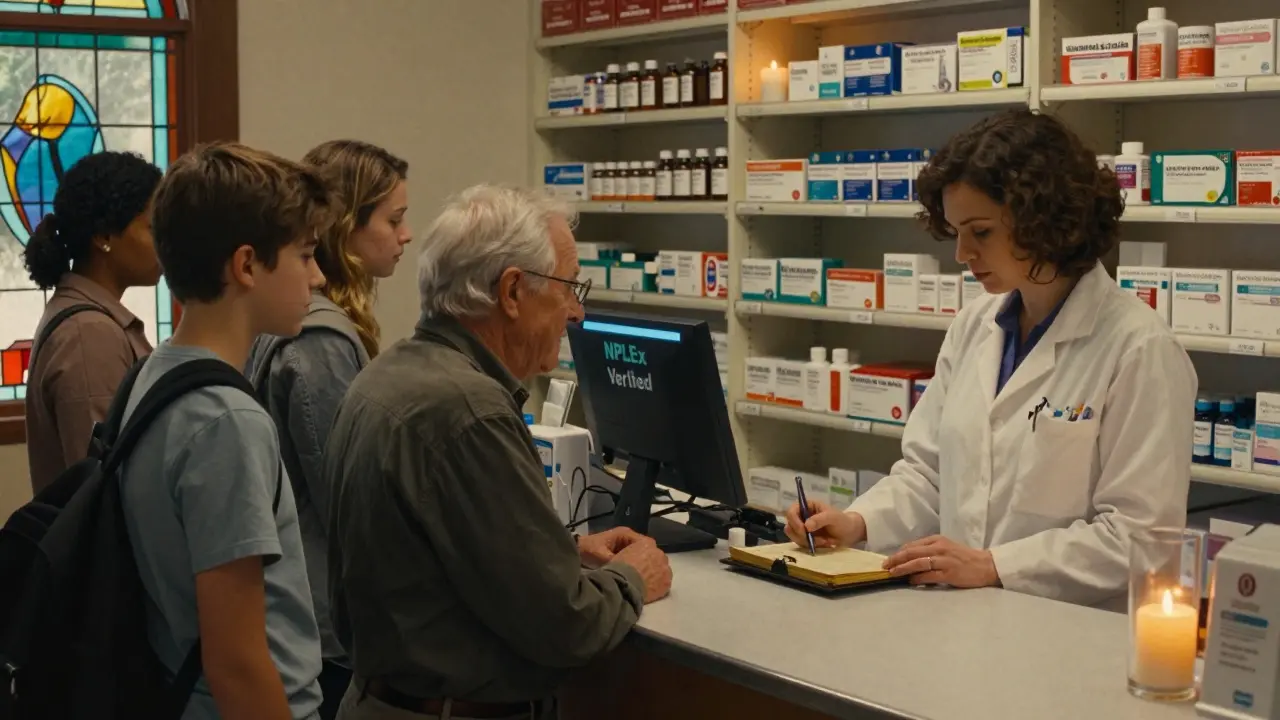
- The pharmacist enters your purchase into a national tracking system (NPLEx). This logs your name, ID number, product, and quantity.
- You’re given the medication, along with printed instructions or a quick verbal rundown on usage.
Some pharmacies use tablets or touchscreens to speed this up. Others still write it down on paper. Either way, it takes time. First-time buyers often spend 5 to 7 minutes going through the process. That’s longer than buying gum, but it’s meant to protect you.
One surprising thing? Pharmacists are trained to spot red flags. If someone comes in every few days buying the maximum amount of pseudoephedrine, the pharmacist may refuse the sale or report it. This isn’t about being suspicious-it’s about preventing drug manufacturing.
Problems with the System
It’s not perfect. There are big flaws.
1. Inconsistent rules across states. One state might let you buy 9 grams of pseudoephedrine in 30 days. Another limits you to 7.5 grams. If you travel, you could be blocked from buying what you need. A 2023 report found 28 different state-level BTC rules in place. That’s chaos for anyone who moves or travels.
2. Pharmacist refusal. A 2022 study in the American Journal of Public Health found that 18% of people trying to buy Plan B were refused, delayed, or given incorrect info-even though it’s legal. Some pharmacists object on moral grounds. Others are just overworked and skip steps.
3. Racial bias. A 2021 University of Michigan study found Black customers were 3.2 times more likely to be questioned or denied pseudoephedrine than white customers, even when their purchase patterns were identical. This isn’t about policy-it’s about bias in practice.
4. Rural access. About 60 million Americans live more than 10 miles from a pharmacy. If you’re in a small town, and the pharmacy is closed, you can’t just order pseudoephedrine online. You’re stuck.
And let’s not forget: the system doesn’t even stop meth production anymore. Most illicit labs now use different chemicals. The BTC rules for pseudoephedrine have mostly inconvenienced people with colds, not criminals.
Who Benefits From BTC Medications?
Despite the flaws, the system helps a lot of people.
People with no insurance get insulin for $25. Teen girls can get Plan B at 2 a.m. without waiting for a clinic to open. Diabetics, asthma sufferers, and allergy sufferers get better relief than they would with weaker OTC options.
A Pharmacy Times survey of 1,200 people found 76% felt more confident about using their medication after a pharmacist’s guidance. That’s huge. Pharmacists aren’t just cashiers-they’re trained health advisors. A quick chat can prevent dangerous interactions. For example, someone with high blood pressure might not realize pseudoephedrine can spike their pressure. A pharmacist catches that.
And for some drugs, BTC is the only path to access. Before Plan B became BTC, teens had to sneak into clinics or beg doctors for emergency contraception. Now, they can get it themselves. That’s progress.
What’s Next for Behind-the-Counter Medications?
The future of BTC is expanding. In May 2023, the FDA approved LoRez (low-dose naltrexone) as the first BTC opioid treatment medication for alcohol use disorder. That’s a big deal-it means addiction treatments could become more accessible without full prescriptions.
Experts predict 5 to 7 more prescription drugs will move to BTC status by 2027. Candidates include low-dose atorvastatin (for cholesterol) and mifepristone (for certain gynecological conditions). The market for BTC drugs is growing at 4.7% a year-faster than the overall OTC market.
But without federal standardization, the system could fall apart. Right now, every state runs its own rules. A pharmacist in Texas has to learn 28 different sets of guidelines. That’s unsustainable. The FDA and Congress are under pressure to create one national standard. Until then, you’ll keep running into confusion.
What You Can Do
If you need a BTC medication:
- Always carry a government-issued photo ID.
- Know your state’s purchase limits-search for "BTC limits [your state]" online.
- If you’re refused, ask for the pharmacy manager. Pharmacists can’t legally deny you if you meet the requirements.
- Ask questions. Pharmacists are there to help, not to judge.
- If you’re in a rural area and can’t get to a pharmacy, talk to your doctor about alternatives. Some OTC options exist, even if they’re less effective.
And if you’re frustrated? You’re not alone. Thousands of people post about BTC struggles on Reddit and forums. Change is slow, but awareness grows. The system isn’t broken-it’s just outdated. And that’s something we can fix.
Can I buy pseudoephedrine without an ID?
No. Federal law requires a government-issued photo ID for every pseudoephedrine purchase. Pharmacies that skip this risk fines and losing their license. Even if the pharmacist seems lenient, they’re still required by law to check your ID.
Why can’t I buy Plan B on the shelf like aspirin?
Plan B was originally prescription-only. In 2013, the FDA moved it to behind-the-counter status for people 17 and older to balance access with oversight. While it’s now available without age restrictions (for all ages), it’s still kept behind the counter because regulators want pharmacists to confirm the buyer’s age and provide basic instructions. This reduces misuse and ensures people understand how and when to use it.
Is ReliOn insulin really available without a prescription?
Yes. Walmart’s ReliOn brand offers Humulin R (regular insulin) and Novolin N (NPH insulin) without a prescription at $25-$40 per vial. This is legal under FDA guidelines for certain generic insulins. However, newer insulins like Humalog or NovoLog still require a prescription. Always check the label-it’s only the older, generic types that are available this way.
Do all pharmacies have the same BTC rules?
No. While federal limits apply nationwide (like the 3.6g daily pseudoephedrine cap), states add their own rules. For example, Oregon limits monthly purchases to 7.5g, while Texas allows 9g. Some states require extra training for pharmacists. Others don’t track purchases at all. Always check your state’s pharmacy board website for local rules.
Can a pharmacist refuse to sell me Plan B if I’m under 17?
No. Since 2021, the FDA removed the age restriction entirely. Plan B is now available to anyone, regardless of age, without a prescription. Pharmacists cannot legally refuse to sell it based on age. If you’re denied, ask for the manager or report the pharmacy to the FDA’s OTC Drug Hotline.
Gloria Ricky
February 11, 2026 AT 05:46I used to hate the BTC system until my mom got diagnosed with diabetes and couldn't afford insulin. Then I found out ReliOn was $25 at Walmart. No prescription. Just walk in, show ID, get the vial. It saved her. Pharmacists aren't just gatekeepers-they're lifelines.
Stacie Willhite
February 11, 2026 AT 20:21This post made me cry. I’m a nurse, and I’ve seen people turned away from pharmacies because they didn’t have ID or looked "suspicious." The system’s meant to protect, but too often it punishes the vulnerable. We need better training-and less bias.
Alyssa Williams
February 12, 2026 AT 13:07Just bought Plan B last week and the pharmacist asked if I was okay. I said yes. She handed it over. No drama. No judgment. Just human. That’s what this system should be.
Annie Joyce
February 12, 2026 AT 21:09Let’s be real-pseudoephedrine behind the counter is less about stopping meth and more about making cold sufferers feel like criminals. I had a sinus infection last winter and spent 12 minutes being interrogated like I was smuggling cocaine. Meanwhile, the guy buying 30 boxes of NyQuil? No questions. Double standard much?
Rob Turner
February 14, 2026 AT 07:11Interesting how the UK handles this differently. We’ve got P medicines-available behind the counter but without ID checks or logs. Just ask the pharmacist. They’re trained to assess need, not track you. Maybe we’re over-engineering the solution here. Simpler systems often work better.
Jack Havard
February 15, 2026 AT 03:23Here’s the truth no one says: the BTC system doesn’t stop meth. It just inconveniences people with allergies. The real meth labs use phenyl-2-propanone now. The whole thing’s theater. Congress passed this law because it looked like they were doing something. They weren’t solving a problem-they were performing a solution.
Jason Pascoe
February 15, 2026 AT 10:43As someone who’s lived in three countries, I’ve seen how this plays out differently. In Australia, we don’t log purchases, but pharmacists have to complete a short training module before selling pseudoephedrine. They’re empowered to say no if something feels off-but they’re also trusted to use judgment. Maybe that’s the middle ground?
Neha Motiwala
February 16, 2026 AT 11:39Do you realize the government is tracking your every cold medicine purchase? They’re building a database on you. They don’t care if you have a sinus infection. They care if you’re a potential meth cook. This isn’t healthcare-it’s surveillance. And soon, they’ll be logging your aspirin too. Mark my words.
christian jon
February 16, 2026 AT 17:53Oh, so now we’re supposed to trust pharmacists? The same ones who refuse to sell Plan B because of their "personal beliefs"? The same ones who stare at you like you’re stealing jewelry when you ask for Sudafed? No. This system is broken. It’s not about safety-it’s about control. And if you’re okay with being treated like a criminal just because you have a runny nose, then you’re part of the problem.
athmaja biju
February 17, 2026 AT 04:34As an Indian citizen who traveled to the U.S., I was shocked at how much bureaucracy exists over a simple cold medicine. In India, you buy pseudoephedrine over the counter like candy. But here? ID, log, wait, question, track. It’s absurd. And yet, Americans praise this as "responsible." Maybe we’re not the ones who need reform.